Director – Yael Melamede – 2024 – US – Cert. 12a – 81m
***1/2
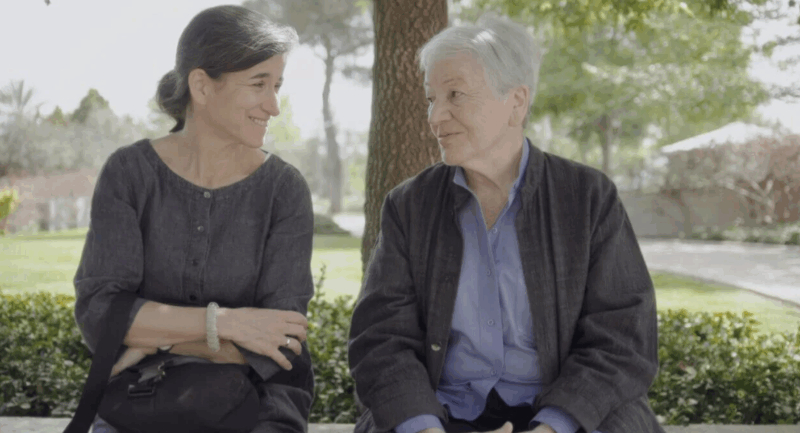
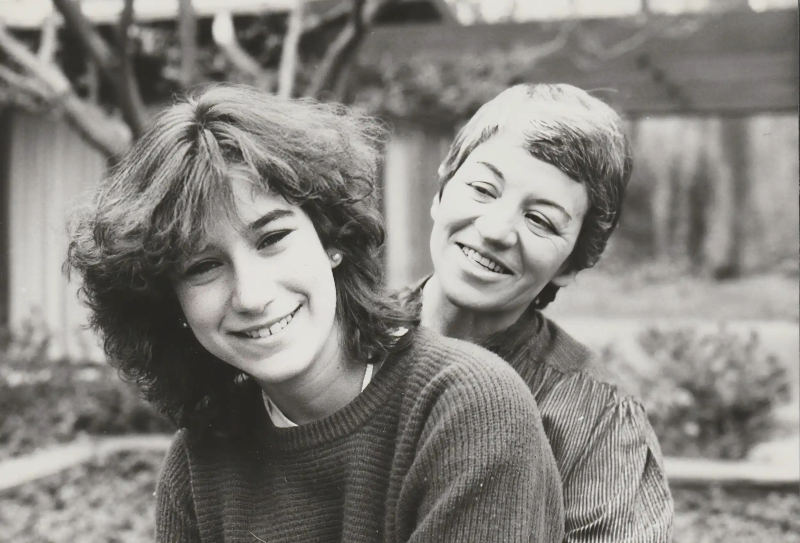
A portrait by her New York-based daughter of top Israeli architect Ada Karmi Melamede – out in UK cinemas on Friday, May 1st
This opens with the filmmaker daughter asking her architect mother if she wants to speak English or Hebrew. The mother is happy to speak both. For the titles, we watch her hands drawing / designing buildings on white paper as we hear various one-liners about her qualities as an architect.
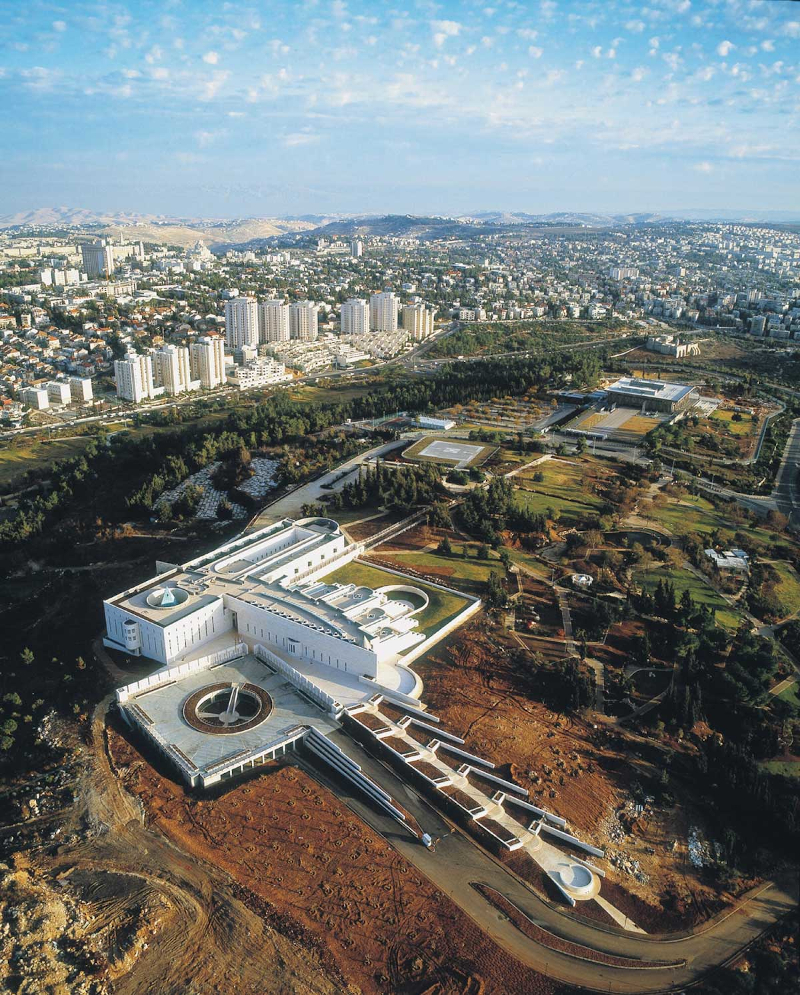
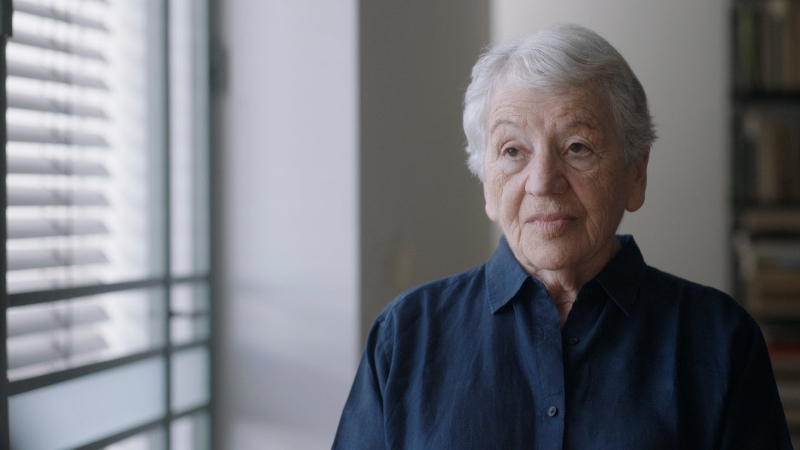
Daughter Yael lists “ a few things you should know about my mother.” Ada Karmi Melamede is eighty and goes to the office every day. She is one of a family of architects who built Israel from the ground up. She left Israel twice, once to study in London and once to spend time in New York, where Yael and her family grew up. She returned to Tel Aviv in 1983 and her career took off: she has been working ever since. The Israel Supreme Court. Airports. Universities.
Architecture seems to be her model for discussing the world. She talks about the importance of roots in buildings, decrying glass towers that have no roots, of which she clearly thinks there are too many. The technological envelope of glass and transparency has taken over these buildings, For her, they lack the architecture of the sky or the land, or of the in-between.
Her earliest memory is of Jerusalem in the snow and her father taking her through that to kindergarten. She grew up in “a country being formed” where idealism was de rigeur. She talks about the word ‘legashim’ , meaning “to fulfil” as in, “to fulfil the ideology that you were brought up with.”
Everywhere she went, she ran into buildings by her father – apartment blocks. She remembers working with him as he moved a window around an elevation until he found its correct position. She walks her daughter to the outside of one of these buildings, constructed before the advent of air conditioning – AC units added in the interim make the structures look ugly.
Although she lived abroad, her roots were in Israel. Asked in Hebrew about when she spoke Hebrew and when English, she talks about the Hebrew language itself having roots. She contrasts this with life in 1960s New York City, a city that was constantly changing. She taught architecture at NYU Columbia.
Former student Doug Suisman, now an architect, goes through his course notes picking out such succinct statements of hers as: “Chaos at the bottom necessitates clarity of structure at the top.” She never promoted her own buildings, he recalls, she was always pulling ideas from other people’s work, trying to extract guiding principles. Word mattered to her; she chose them carefully. “I taught with my pencil, the words were secondary,” she recalls. Columbia’s Kenneth Frampton extols her sensitivity. Noted architect Frank Gehry recalls her in terms of “a well-founded credibility”.
Hurt by not being given tenure, for reasons that Frampton finds himself unable to fathom, she started taking time off from the university to go back to Israel.
Having talks about roots, the film now talks about routes. Ada thinks you should know where you go in to a building and where you end up. Routes through buildings build memory, something she feels doesn’t happen in the open plan interiors of today, shared memory evolving from things fixed not things that change. Change erases memory.
Mother takes daughter around the Neot Hovav Museum and City Council while it’s under construction. She prefers building this way, before all the plastering and little details are added, comparing the place to 8 ½ (Frederico Fellini, 1963) in terms of, the space that waits for the theatre that doesn’t come. She indicates two different curved lines, helpfully picked out on the image by two animated graphic lines. She also shows all the mistakes made by the construction crews (“nothing went right here”) including doors where the door handle is fitted too close to the door frame and another problem she dismisses as “the big fuck”.
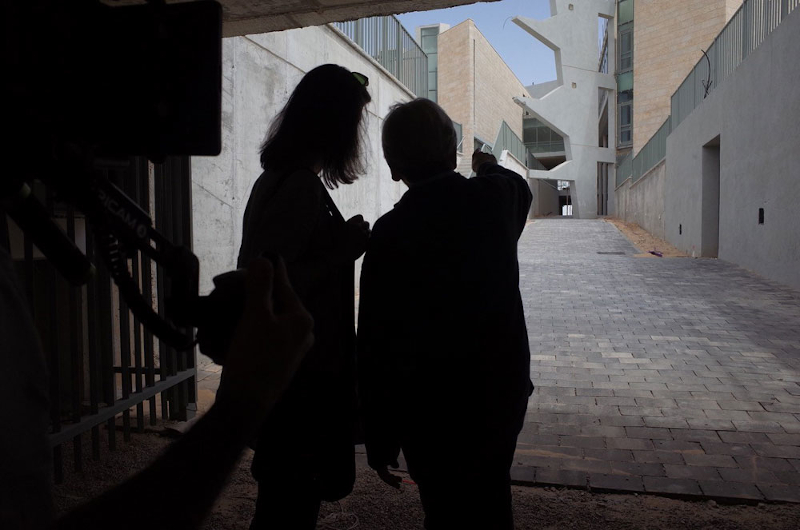
A jump cut, and they’re walking through the still unfinished building two years later, with mother still talking about the route as more significant than whatever you find once you reach the route’s end. There’s an efficient, functional short route and a longer one which she thinks has more possibilities, equating the latter with “life”. She returns to paper and pencil to explain what she means in both words and drawings, using phrases with obvious visual equivalents like “forward and backward, “echo”, and “heartbeat.” Yael gets a bit fed up with her mother going on, and gets her to draw a cat.
Yaeli now begins talking about “something you should know about me.” She too was an architect, but it never quite clicked, so she switched to filmmaking. Ada was always intrigued by her older brother Rami, who became an architect. It seemed back then to be a profession for men.
Up to the end of the 19th Century, all buildings had a centre, according to Ada. Without common ground, we have no life, she adds. No heart.
She and Rami together entered a competition to design the Supreme Court Building, with at least three famous architects in the running. Winning changed her life. She felt that somehow a building should embrace the past while being open to the possibilities of the future. The two siblings designed it together, arguing with each other behind closed doors. The process took six years, after which she felt the need to leave and set up her own office.
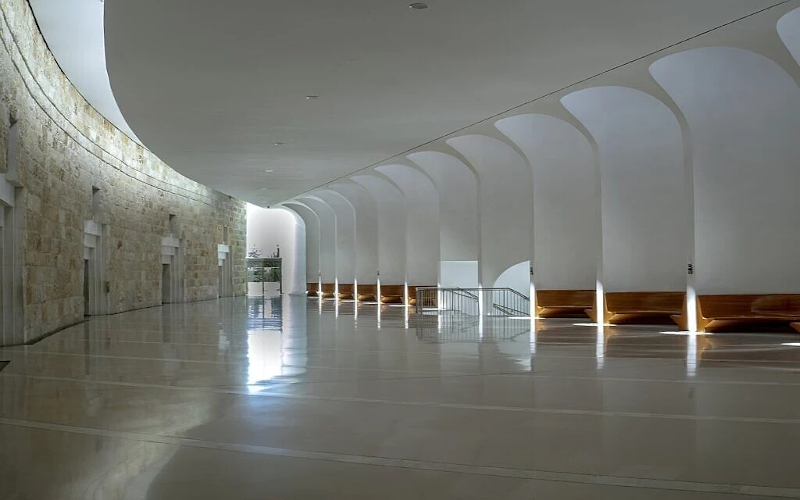
When the building was opened in 1992, in the Yitzhak Rabin years, it received rave reviews for its architectural vision. The New York Times’ then architecture critic Paul Goldberger, interviewed here, talked about the potential of public to express a culture’s highest aspirations. He laments what has happened to Israel in the intervening years to compromise that altruistic vision. (Note: at risk of stating the obvious, feature film production is not like filming a news bulletin, where you can get footage on camera and out on the airwaves today – a feature can take months or even years to put together, and this particular completed feature has been knocking around in UK distribution limbo for over a year.)
The film seems to lose its way a little here, with a nevertheless visually striking sequence of daughter Yael looking through portfolios of her mother’s architectural drawings. Ada worked with a pencil where everyone else in her office would design buildings on a computer. Freehand was quicker. More significantly, computers possess a kind of discipline that freehand lacks, yet there#’s a pleasing quality to the physically drawn pencil line that computers are unable to replicate.
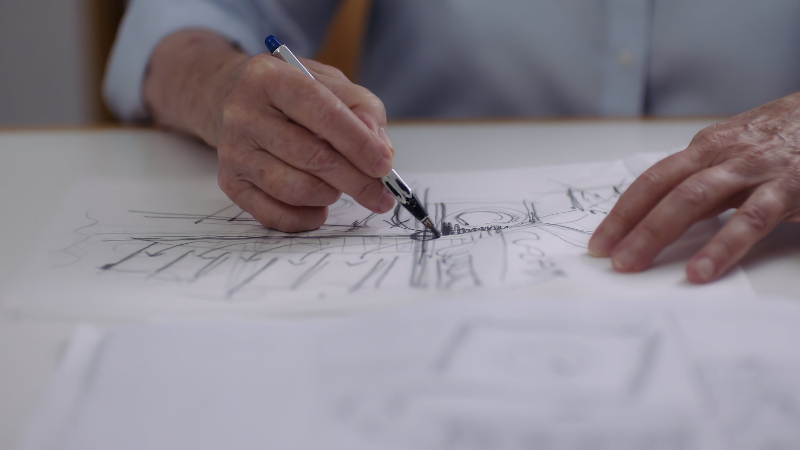
Ada also states that a single beam of light can completely alter a building. To illustrate the point, she talks admiringly about the Pantheon (in Rome), “the most important building of all time, as a space messed with by a beam of light. One beam of light simultaneously pulls you up and pulls you down.
She discusses the bright intensity of light in Israel, and the consequent need for louvers, blinds, curtains or double walls to facilitate its mediation. “She always said that, the cheapest building material is the light,” as Ada’s former student Sharon Harari puts it. Ada goes on to talk about the role of light and shade in architecture, and following some brief musings on bereavement, that of time and architecture.
Ada takes Yael to Jerusalem’s Western Wall Heritage Foundation, where no building work could be done until archaeologists had dug through the area. They found an old section of Roman wall, which Ada incorporated into her architectural design. “So, we created a building that doesn’t make any concessions to what was here before, and they have nothing in common.”
In a postscript shot three months after the rest of the film, a zoom call between daughter in New York and mother in Tel Aviv, sparked by a thirty-year-old letter Ada wrote that Yael recently found, Ada talks about the then (early 2023) current protests at the Supreme Court, how the country is torn between democracy and dictatorship. It provides a fitting ending to a fascinating look at this singular architect’s life and work.
Ada – My Mother the Architect is out in cinemas in the UK on Friday, May 1st.
Trailer: