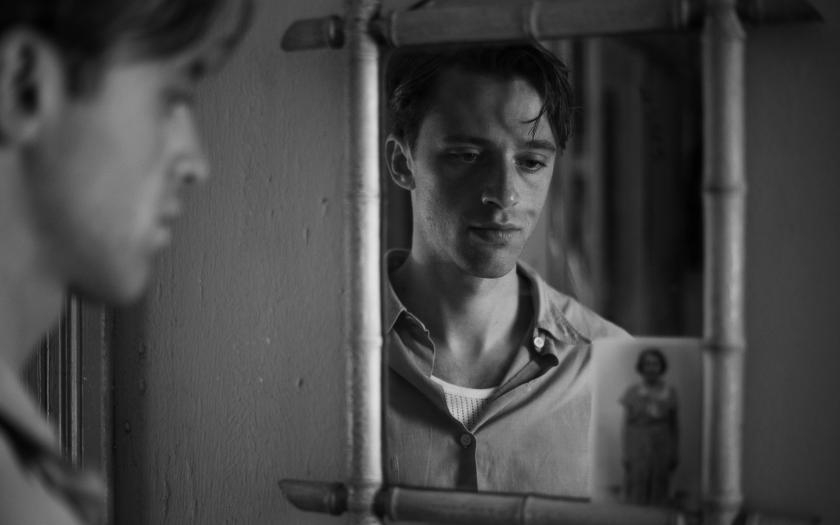
Director – François Ozon – 2025 – France – Cert. 15 – 120m
*****
A Frenchman living in French Algiers with an attitude of detachment is arrested following a violent incident with an Arab – adaptation of Albert Camus’ existentialist novella is in UK and Ireland cinemas on Friday, April 10th
Albert Camus’ 1942 novella is a character study of a non-conformist to the widely held ideals of the day. Ozon’s film adaptation roughly follows its template, making some subtle changes which alter its overall stance and meaning.
The following synopsis contains spoilers, but, to be honest, given that this is an adaption of a significant work of French literature, and that you’ll get just as much if not more out of it if you read the book beforehand, I’m not convinced that knowing the plot in advance is a bad thing.

The novella has a two-part structure. First, it follows the life of its main, French Algiers-based protagonist Meursault from his receiving news of his mother’s death and taking time off work to attend her funeral, through his embarking on a relationship with the besotted Maria, to his involvement with his friend the local pimp Raymond Sintès and Meursault’s fatal shooting of an Arab, who has been following Raymond with murderous intent after Raymond mistreated his sister. Second, it charts Meursault’s imprisonment and trial for his crime, with various characters from the first section testifying at his trial. While in prison, after an unexpectedly harsh judgement has been passed involving the death sentence, despite Meursault’s attempts to prevent any contact with the prison chaplain, the latter comes to talk to him about spiritual matters.
Additional characters include Meursault’s boss, and Salamano, an elderly neighbour in Meursault’s apartment building who beats his dog, then becomes distraught when it goes missing.
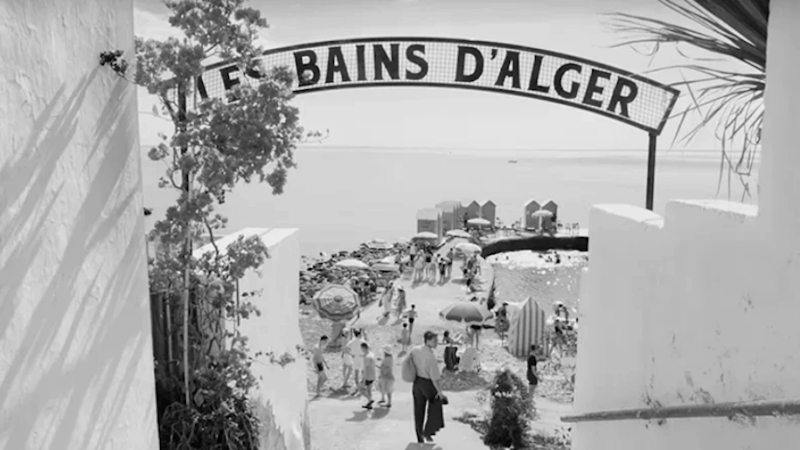
Ozon adds an opening of a jocular period newsreel promoting French Algeria which segues into a man (Meursault) taken into a prison between two prison guards. This recasts the book’s first half as a flashback.
His other major change is to include an Arab name and some Arabic language. The opening features the name of the film in both French and Arabic, while the final shot names the anonymous Arab murder victim by having his sister visit his grave on the headstone of which the man’s name in Arabic, subtitled for audiences as Moussa Hamdani, is clearly visible.
By not naming any Arab characters, the book robs its Arab characters of a basic human dignity. By naming one of them, and showing the film’s title in their language, them, the film restores something of that dignity.
The shooting of the film in black and white makes it feel like a film made in the 1930s before the advent of colour film stock. (Ozon previously shot his post-W1 bereavement drama Frantz, 2016, in black and white.) However, some lengthy sex scenes when Maria sleeps with Meursault would have been unthinkable in mainstream French cinema either in the 1930s when the novel is presumably set or in the early 1940s when it was first published.

The novella seeks to express an absurdist world view. Meursault goes through life in a state of detachment. He doesn’t seem particularly bothered by his mother’s death, although he attends her funeral. He allows himself to enter into a relationship with Marie, and agrees to marry her without objection, but only because she asks him to do so, not because he sees any significance in it. His boss criticises him for a lack of ambition when the offer of a promotion doesn’t seem to bother him one way or the other. He seems to lack any moral scruples, and helps out Raymond in setting in motion the latter’s scheme to punish an Arab girlfriend by sleeping with her, beating her, then throwing her out. The Arab who starts following Raymond around with a knife is the brother of the wronged woman. In prison, under sentence of death, he shows no interest in talking with the chaplain, taking steps to avoid any meeting taking place.

Film is a different medium from the written word, and Ozon achieves something extraordinary translating book onto screen. He has chosen well in casting his lead. Benjamin Voisin i(from The Happy Prince, Rupert Everett, 2018) s utterly believable as Meursault, giving a mannered performance of a man going through the motions of life without apparently caring about them one way or the other. He shakes hands with mourners at his mother’s funeral, including her clearly distraught fellow care-home resident and alleged lover M. Perez (Joël Cudennec) with total emotional detachment, not even attempting to say anything to those who shake his hand.
He embarks on a relationship with Marie (Rebecca Marder from The Crime is Mine, François Ozon, 2023) to whom he seems strangely indifferent; Marder’s portrayal of a woman clearly in love with a man who’ll stand by him whatever happens stands in marked contrast; you wonder what the character’s limits are when she questions Voisin’s Meursault as to what he knows about the Raymond / Arab girl argument when the police are called in.
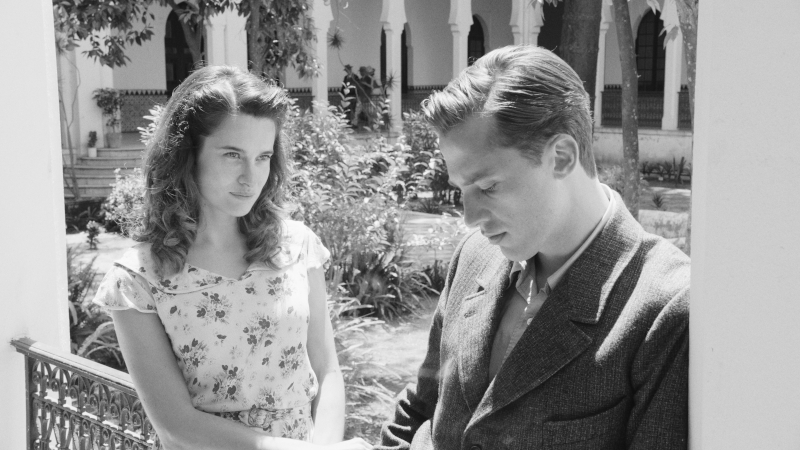
Voisin’s performance might reasonably be described as deadpan. It’s an extraordinary portrayal, and direction of an actor, given that no-one else here is acting in that way. That deadpan attitude, given that it’s made from Meursault’s point of view, extends to the entire narrative. And yet, even as the audience is invited to side with Meursault by all this, some of the other actors’ less distanced, more normal, arguably more human, portrayal of their characters, and the film’s occasional use of Arabic and its naming of the dead Arab on his gravestone, give us space to identify with different characters.
That said, neither the alleged pimp Raymond (Pierre Lottin from When Autumn Falls, François Ozon, 2023, Lupin, TV series, 2021-?) nor the dog-beating Salamano (Denis Lavant from Redoubt, John Skoog, 2025; Night of the Kings, Philippe Lacôte, 2020; Holy Motors, Leos Carax, 2012) are particularly sympathetic – the first a low life, criminal type who could have wandered in from a crime movie, the second an unpleasant sort even if we feel for him at the loss of the dog he’s previously beaten.
It’s no surprise that Ozon has sufficient cultural awareness to run Killing an Arab by The Cure over his end credits, a decision which pales beside his naming of the Arab murder victim. He is to be congratulated for making a revisionist film version of the novel which stands against French colonial racism whilst retaining the qualities that made the book remarkable in the first place. Highly recommended, although worth reading the novella first.
The Stranger is out in cinemas in the UK and Ireland on Friday, April 10th.
My shorter review for Reform magazine can be found here.
Trailer:
One reply on “The Stranger
(L’Étranger)
(2025)”
Saw it last night, loved in. Great performances, well filmed and held my attention through out. Read the book ages ago on the back of seeing the Cute perform the track back in the late 70s…..