Director – Oliver Hermanus – 2025 – UK, US – Cert. 15 – 128m
****
A Kentucky man falls for a music professor in Boston and accompanies him on a field trip recording folk songs – out in UK cinemas on Friday, January 23rd
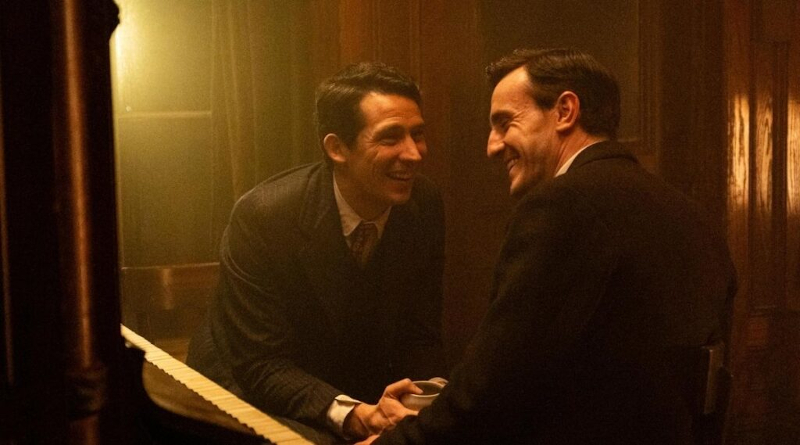
In 1917, having grown up on a farmstead in rural Kentucky and his remarkable singing voice being noticed by a local schoolteacher, Lionel Worthing (Paul Mescal from Hamnet, Chloé Zhao, 2025; Gladiator II, Ridley Scott, 2024; All of Us Strangers, Andrew Haigh, 2023) gets a student scholarship to Boston’s New England Conservatory of Music. One Saturday evening in a Boston pub with friends, he makes the acquaintance of David White (Josh O’Connor from La Chimera, Alice Rohrwacher, 2023; Mothering Sunday, Eva Husson, 2021; The Crown, TV series, 2019-20; God’s Own Country, Francis Lee, 2017) who is playing folk songs on the piano and, it turns out, is a tenured academic with an obsessive hobby: travelling around the country collecting, recording and cataloguing folk songs. David has what Lionel describes as the sound equivalent of a photographic memory: he can remember word for word and note for note, any song sung in his presence.
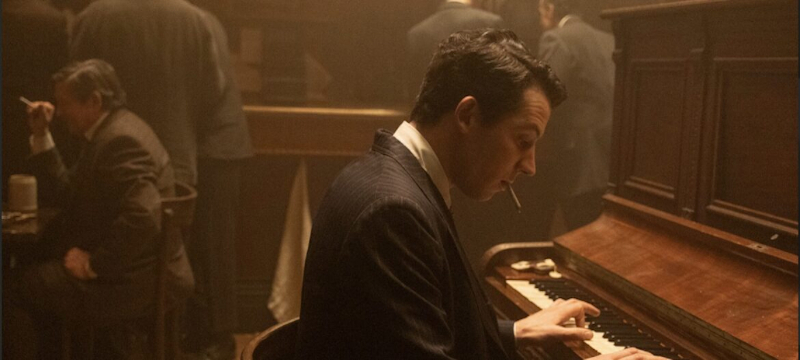
After they compare notes about songs from Lionel’s Kentucky home, David gets the pub clientele to be quiet so Lionel can sing a song David has never heard, Silver Dagger, which performance generates rapturous applause. At the end of the evening, Lionel goes back to David’s flat and sleeps with him, beginning a series of weekly visits which is cut short when David is drafted into the army for World War One. Lionel is excluded from the draft by virtue of his poor eyesight.
Back home at the family farm, where his ageing mother (Molly Price from Roofman, Derek Cianfrance, 2025; God’s Pocket, John Slattery, 2014; Kiss Me Guido, Tony Vitale, 1997) coughs a lot (presumably from tuberculosis), his father keeps working the fields until Lionel finds him one day collapsed, dead, on a small tree. In 1919, Lionel receives a letter from David asking him to be his assistant recording indigenous folk songs on 36 wax phonograph cylinders on a field trip through Maine during the academic holidays, a task to which Lionel readily signs up dismissing his ailing mother’s protest that she will be unable to run the farm without him.
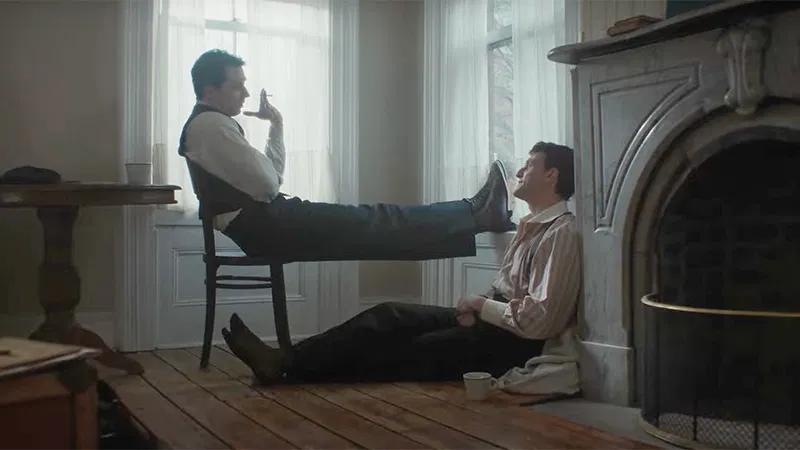
The field trip involves walking by day, pitching a tent at night, and sweet-talking any locals encountered into performing and recording their songs for posterity. David does the talking, and is very good at it. He is less forthcoming about the war. Towards the end of the trip, the sight of a group of policemen due to remove locals from their land opens a rift between the two men, Lionel saying he learned growing up to keep away from the police, and David having an outburst about Lionel’s ignorance as to the way things work.
After the trip, which he later comes to realise as the happiest time of his life, Lionel achieves great success with choirs in a church in Rome, Italy and the University of Oxford, England, becoming involved with a male lover Luca in the former location and a socialite female student Clarissa (Emma Canning from Dune Prophecy, TV series, 2024) in the latter. Both relationships end badly, the first due to his unannounced move to England, and the second to his sudden departure for Kentucky when his mother dies a month before the end of the university term.
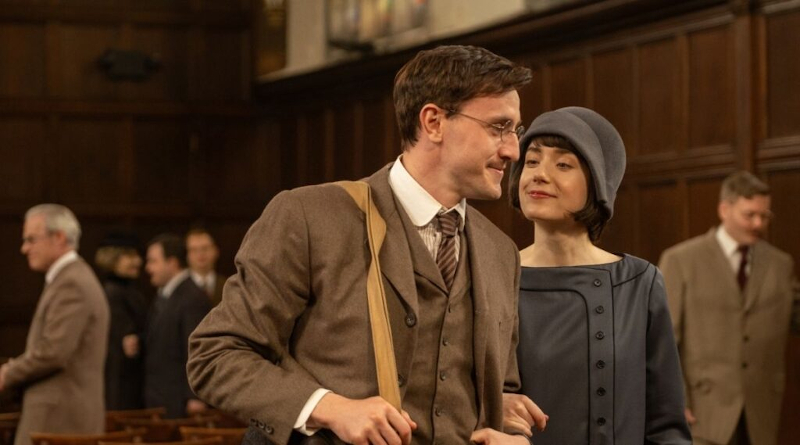
Even though he wrote letters to David for a year and got no reply, in 1924 Lionel decides to take up David’s suggestion that he find work at David’s college, only to learn on arrival of David’s death which was related to shell shock. He visits David’s widow Belle (Hadley Robinson from The Boys in the Boat, George Clooney, 2023; I’m Thinking of Ending Things, Charlie Kaufman, 2020; Little Women, Greta Gerwig, 2019), now married to brutish fireman Bob Sinclair (Michael Schantz) by whom she has a small child. Bob tells Lionel not to do anything with Belle while he is out at work. The subdued Belle perks up once alone with Lionel, returning his letters which she has read and promising to return the wax cylinders should they ever turn up.
In the 1980s, a TV appearance to promote his book by ageing ethnomusicologist Lionel (Chris Cooper from Little Women, 2019; Where the Wild Things Are, Spike Jonze, 2009; October Sky, Joe Johnston, 1999; Lone Star, 1996; Matewan, 1987, both John Sayles) prompts the new owner of the former Sinclair house to send him the suitcase she found on the premises containing the 36 wax cylinders, which include a recording made by David for Lionel the day he died.
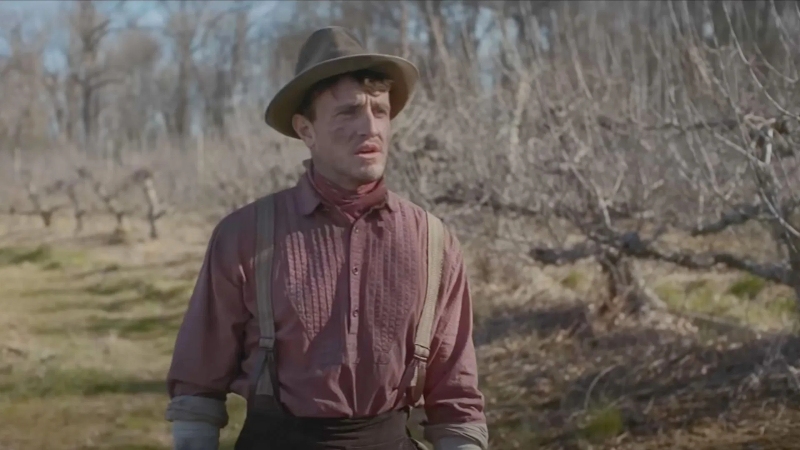
If more good than bad, this film is a mixed bag. For the film to work, its two leads, particularly the main lead Mescal, need to captivate us and carry the film, and they do so. The piece deftly sketches Lionel’s unhurried Kentucky background and family, although we never meet the local schoolteacher responsible for his scholarship. We watch him as a child (Leo Cocovinis) with his father (Raphael Sbarge) at table lighting a paper candle which burns down until its glowing remnant floats up ethereally into the air, a little piece of visual, folklorish magic which the adult Lionel takes with him as a [piece of amateur showmanship on David’s song collecting tour.
The various folk songs played are undoubted highlights. There’s an ethnic authenticity to the music, a grounded truth, which is much more compelling than the twee songs on offer in The Ballad of Wallis Island (James Griffiths, 2025). If there is any single reason to see The History of Sound, the songs would be it. South African-born director Hermanus even ups the ante by including a visit to Malaga Island, a mixed black and white ethnic community about to be evicted by cops with truncheons (the ones whose presence sparks the rift between Lionel and David). There, the duo encounter a black couple Will (Dion Graham) and Mary (Briana Middleton); she, it turns out, sings a memorable folk song that borders on being a spiritual. A further, nice touch comes towards the end, when Lionel’s Kentucky homecoming after visiting David’s widow sees him run into a couple playing folk songs on their porch, who he persuades to continue after the woman stops playing out of embarrassment.
Molly Price convinces as Lionel’s increasingly sick and strangely distant mother. Emma Canning, on the other hand, can’t do much with the stereotypical rich 1920s socialite love interest, a lazy screenwriting trope that perpetuates the myth that all English people, like lords and ladies, live in big, stately mansions. (Surprising that this should come from a screenplay so clearly interested in America’s poor. To be fair, it is later contrasted with a comparatively ordinary rural couple Lionel stumbles upon in a farmhouse England’s Lake District.) The best performance in the film comes from Hadley Robinson who, in her all-too-brief scene as David’s widow Belle, breaks your heart as a woman trapped in an abusive relationship who has known better times.
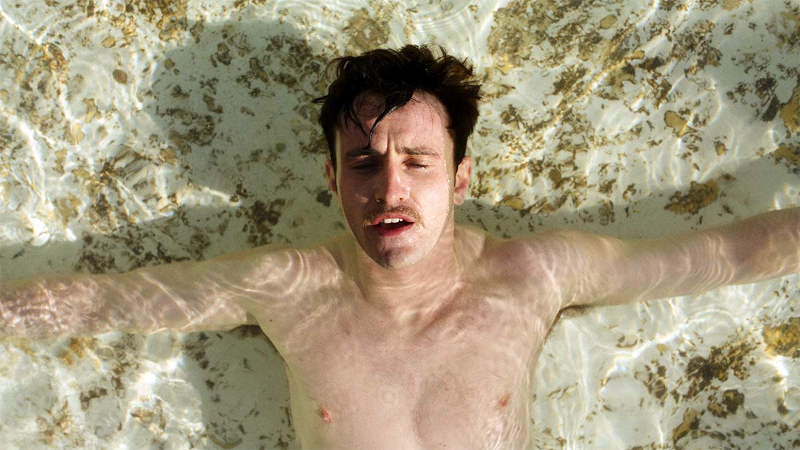
Once Lionel goes on his travels through Rome, Oxford and the Lake District in the film’s final third, that section of the narrative feels convoluted in comparison to what came before. Overall, the film feels about twenty minutes too long. It’s hard to believe this is the same director who made the perfectly judged Living (2022).
As for the gay relationship, which is of itself convincingly portrayed and performed, one wonders – and this is a query aimed at short story and screenplay writer Ben Shattuck, since it’s his story – whether it’s needed when the two men clearly already bond deeply over singing and talking about folk music. Could the two men equally well have gone on a tent-pitching, song-collecting trip on the strength of the music alone without being all over each other? Perhaps I’m being unfair here, because these characters and their motivation clearly came out of the writer’s head, but completely leaving the sex aside, I found the song gathering aspect compelling in its own right. I suppose one answer to why the gay relationship would be, why not?
Mescal delivers an opening voice-over, accompanied by light reflecting off a woodlands river, about being able to see sound. This fascinating concept, ripe for exploration in the cinematic medium, which consists, after all, of sound and image, is quietly dropped and never explored, which seems something of a waste, especially given how amazing the performed songs are.
Despite its flaws, there remains much that is good in The History of Sound. Worth seeing, but perhaps not the film to put at the top of your want-to-see list.
The History of Sound is out in cinemas in the UK on Friday, January 23rd.
Trailer: