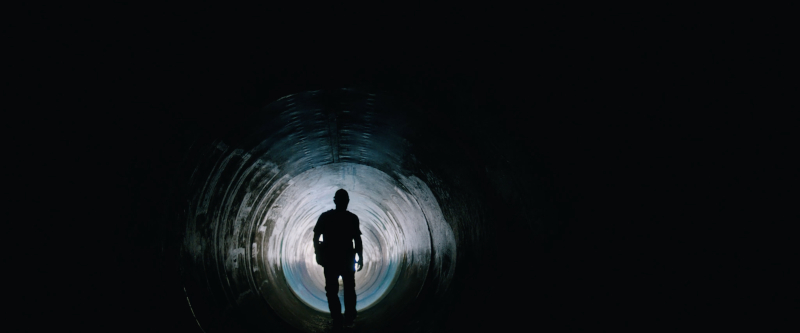
Director – Rob Petit – 2025 – US, UK – Cert. 12a – 79m
***
Three separate journeys beneath the Earth’s surface in the company of an archaeologist, a particle physicist and anurban explorer – had its sold out UK Premiere at the Barbican on Tuesday, March 24th and is out in UK cinemas on Friday, March 27th
Why do we seek the void, asks a narrator (Sandra Hüller from Project Hail Mary, Phil Lord, Christopher Miller, 2026; The Zone of Interest, Jonathan Glazer, 2023; Anatomy of a Fall, Justine Triet, 2023) as the camera descends into an Academy 4:3 image of an orifice within an ash tree, a portal to the world below. In a letterboxed image, we’re in a car passing the garish lists of Las Vegas entertainments, then on to breach a wire fence on the outskirts of that city. Then with a group of women cavers in a jungle, possibly South America somewhere, near a tree on the edge of a vast hole in the ground. Another group of cavers stand around in a room in readiness. A further caver walks down an urban street and starts to lift a manhole cover.
In terms of following what’s going on, apart from the idea of people in different places possessed of a desire to penetrate the Earth’s surface, and exciting, pulsating music by Hannah Peel, all this is really hard to follow; the viewer’s brain is overloaded.
The narrator describes the alien nature of the natural world a few metres beneath our feet, accompanied by images of strange, vegetable life-forms navigating their way through the darkness, beams of light on animated stalks. One by one, the different caving outings from the pre-credits sequence are labelled.
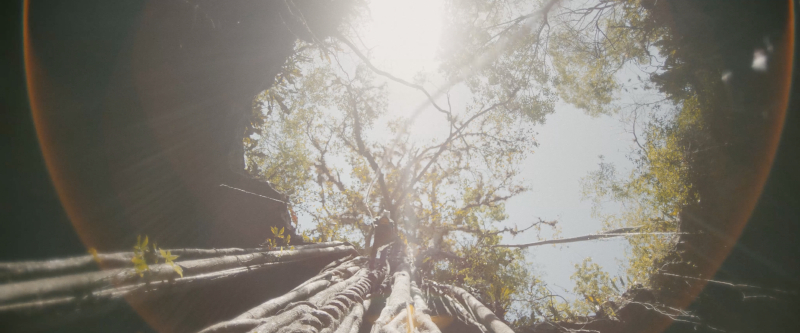
The sound, that’s what hits you first, says Fátima Tec Pool, the Mexican lady archaeologist, as we watch her and others descend into the hole by the tree in Yucatán Peninsular, Mexico. She grew up in this area; her fascination extends beyond its numerous caves to the peoples that lived in them thousands of years ago, who considered the caves the entrances to the Underworld.
This contrasts heavily with the man-made storm drain tunnels beneath Las Vegas. Waling along a tunnel, writer and urban explorer Bradley Garrett describes the mixed odours of wet concrete, trash and possibly sewage as “the smell of a cave in the making.” After years of underground exploration, he associates such smells with the feeling of freedom. When it rains on the surface, he continues, the system’s veins start pumping turning the place into a flash flood in an instant.
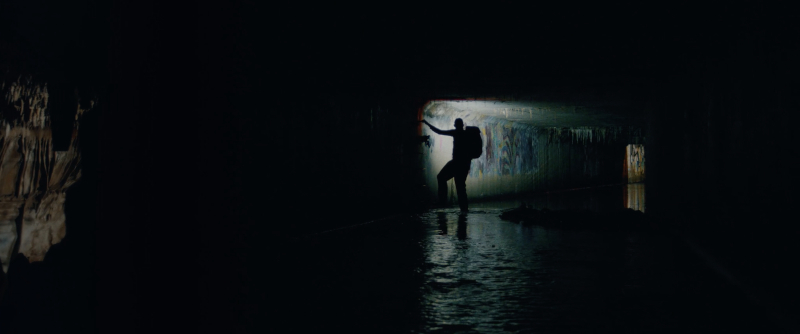
He began as an archaeologist before getting sucked into the not entirely dissimilar world and methodology of urban explorers. One day, he adds, the parts of human buildings and cities that are under the ground will be all that’s left. What will such places say about human beings as a species?
As she descends in a mining cage with a number of colleagues, “most people who go underground never go two kilometres down”, says theoretical particle physicist Mariangela Lisanti. She has spent her life trying to make sense of the world around her. Today, she works at Canada’s SNOLAB underground research facility on experiments so sensitive that you can’t do them on the surface – because of all the interference from radiation bombarding the planet, which you can mostly filter out at the bottom of a deep mine. She is looking for something that has never been detected: dark matter.
Fátima Tec Pool and her colleagues use technology to map out the networks of caves that earlier generations could only have explored in darkness by firelight. Visually, they are juxtaposed against the images of the light beams on navigating vegetable life-forms seen earlier.
Bradley Garrett talks about evidence that people lived in the storm drains. Just as wealth rises up in cities into skyscrapers, so poverty sinks below the ground. Which means that, when it rains, people die. A global community of people are now documenting such stories, he adds. Tantalisingly, the film edits in images of an abandoned London, UK, bomb shelter, with newspapers dating the place at 1978.
There are stories of people getting trapped in narrow passages which, according to Fátima Tec Pool, juxtaposed with images of her and a colleague worming their way through narrow spaces with a low oxygen quotient, “mess with your mind”. At the first sign of water gushing from as drain in the Vegas drains, Garrett says hat he and his accompanying cameraperson need to get out.
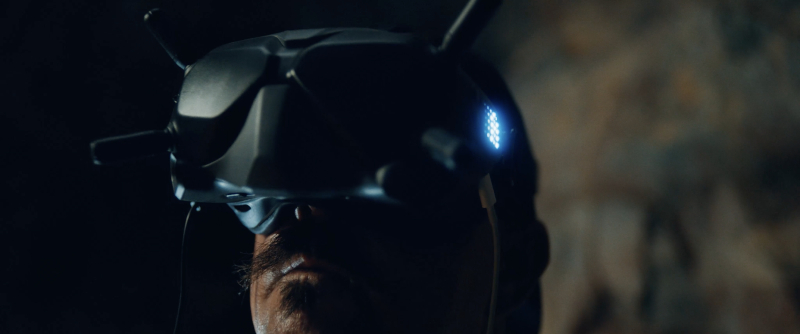
Hüller is given a speech about the boundaries between the living and the dead. Garrett says he goes underground to find what we’ve tried to forget. Looking at an underground pile of broken fridges and cars and the like, Garrett comments that we’ve plundered the Earth for its treasures, then thrown it back down holes as trash. This pales beside the plundering of Uranium, leading to the atom bomb and nuclear waste requiring storage, the latter requiring burial deep within the Earth.
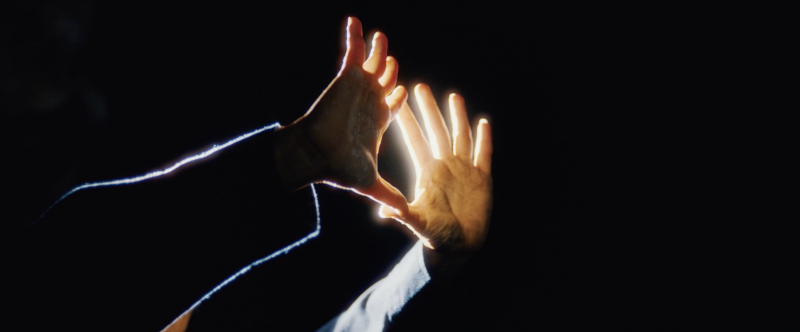
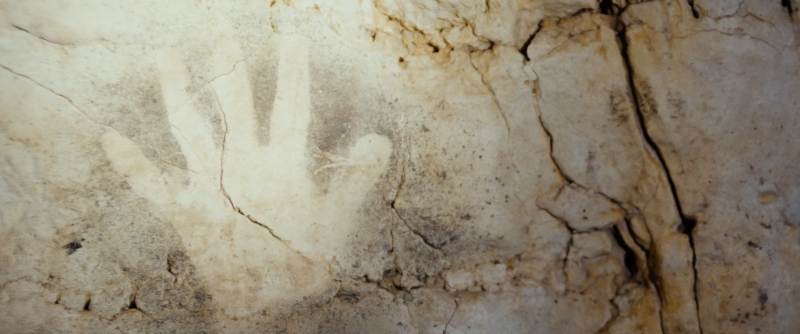
Fátima Tec Pool is disturbed by a recurring dream of failing to save a cow falling deep into the Earth. Physicist Lisanti discusses the frustration of complex experimental searches that find nothing. Pool comes across a chamber where (probably) charcoal has been used to make impressions of people’s hands on walls, summing it up as “a way of being able to touch the shadows”.
Garrett talks about his hope when he sees warning signs from our civilization to future generations not to dig our toxic waste up. A montage sequence attempts to show us how all the images in the film are interconnected, but I’m bound to say, I couldn’t see it. Maybe the film set itself too monumental a task; maybe it worked better as a book. Either way, something that began as a promising exploration into what for most of us remains the unknown seems to get lost in the space between its several voices.
What you’re left with is some extraordinary underground / underworld footage and Hannah Peel’s majestic score, a sensory experience unlike any other even if, at times, it doesn’t seem to quite come off.
Underland had its sold out UK Premiere at the Barbican on Tuesday, March 24th and is out in UK cinemas on Friday, March 27th.
Clip:
Trailer: