
Director – Mona Fastvold – 2025 – US, UK – Cert. 15 – 130m
****
In the mid-eighteenth century, wishing to preach her unique take on the Christian Gospel, Ann Lee crosses the Atlantic with a small party from from Manchester, England, to establish a Shaker community in America – unlikely religious musical is out in UK cinemas on Friday, February 20th
This review is written after seeing this film for a second time. On my first viewing, I went in cold, knowing a great deal about both Christian history and the Quakers, but nothing about the Shakers (‘the Shaking Quakers’) around whom the historical side of this film is based. As far as I can tell, the historical portrayals of the Shakers here, and their leader Mother Ann Lee (Amanda Seyfried in a career-defining role), are pretty accurate.
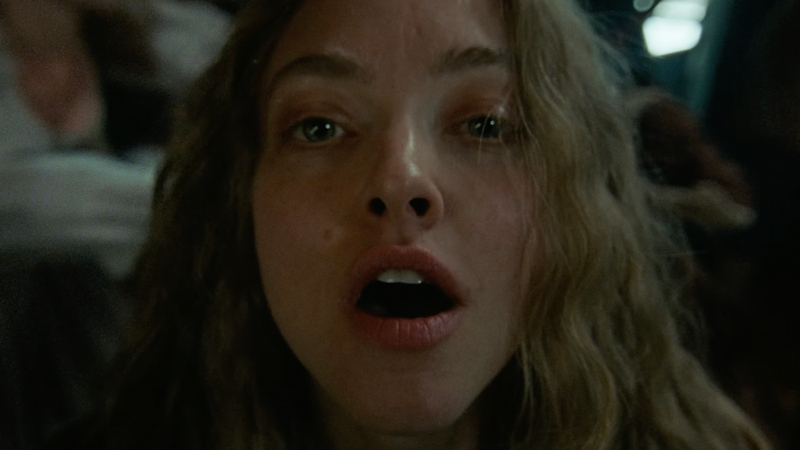
This is to leave aside the fact that this is also a musical, the genre in which people suddenly burst into song, and we somehow accept it. In real life, people generally don’t burst into song in the ordinary run of things. And yet, it’s a genre convention we accept, and as a genre the musical has a perfectly respectable history. That said, if you’ve been brought up within any sort of English protestant Christian church tradition, from C of E to house churches, you’ll be familiar with people singing hymns as part of their religious worship. Many of the songs (which are also song and dance numbers) in this film are worship songs, some original and some based on Shaker worship songs of the period. So their use here makes this musical a lot less ‘unreal’ than most musicals. More on this later.
Back to the Shakers of history, as portrayed here. The working class Ann Lee and her devoted brother William grow up in mid-eighteenth century Manchester during the Industrial Revolution. She avoids factories by working in a hospital. The siblings are two of eight children. Observing her parents at night, young Ann comes to the conclusion that her father visiting sex on her mother is a form of abuse, and when she isn’t backward about coming forward to her father on the matter, he administers corporal punishment, beating her hands with a strap. As a child she is forthright and immovable in her views, and that attitude carries through to her adulthood.

She often hears a Methodist minister preaching on the steps of the cathedral, however she only really feels that she has come home in a religious sense when she attends the house meetings of James (Scott Handey) and Jane Wardley (Stacy Martin), where people confess sins (often quite sexual in nature) to the gathered attenders and engage in extremely physical forms of worship involving singing and dance which almost resemble orgies with the physical sex element removed. The meeting might today be described as a charismatic house church, but such terms likely didn’t exist back then.
She marries Abraham (Christopher Abbot), a member of the group with an interest in the mortification of the flesh (which gives rise to some fairly extreme S&M sex scenes). She has four children with him, none of whom survive very long, some dying in childbirth.

The Wardleys and their followers believe that Jesus’ second coming will be in the form of a woman. Ann, who sometimes has visions, comes to believe, with the other followers, that she is that second coming of Christ and adopts the name Mother Ann Lee.
Their meetings are subject to raids by the authorities. Ann is imprisoned on account of her religious activity, and while in her cell she levitates and has visions involving, among other things, Biblical tableaux resembling close ups of then contemporary paintings including (brief inserted shots of) a large, coiled snake. (These aren’t always that easy to read in terms of what’s going on; visions looking like episodes in the Western History of Art are pulled off far more effectively in the somewhat dubious but far more entertaining Benedetta, Paul Verhoeven, 2021). This and other, similar visions convince her that any form of sexual congress is sinful, including marriage, and must therefore be renounced to achieve Godliness.

Believing God is calling her to America – the land of free religious expression – to preach the gospel, she acquires financial backing from farmer John Hocknell (David Cale), a quiet man who attends the Wardleys’ meeting. She William, John and five others set off on the perilous journey across the Atlantic aboard the Mariah, during which the captain and crew’s irritation at their constant singing is quelled when prayer causes a loose board on the hull to be pushed back into place, preventing the vessel’s sinking.

Sex rears its ugly head again in New York where Hocknell’s son and Ann’s niece are discovered having sex in a lavatory. They leave the group to marry. Abraham, meanwhile, has endured having no sex with his wife for six years and threatens to leave if she doesn’t relent. That brings the party’s number down to five. The men set off in a boat up the Hudson in search of suitable land to settle, believing God will show them. This leads to an incident in which Hocknell’s finger, divinely possessed with a song to accompany the scene, points him as he runs in serial directions until he ends up in a perfect clearing in Niskayuna, New York State (only named in the end credits, as far as I can tell), where the group settle, sending for the women to join them. Under Mother Ann Lee’s ethic of hard work and chastity, they construct buildings while William is sent out to preach in the surrounding area, which brings the numbers in.

The community thrives, but there are threats of war and conscription, and later the community is attacked for Mother Ann’s alleged witchcraft (completely unfounded). Eventually, Hocknell, William and mother Lee pass away, leaving behind her friend and companion Mary Partington (Thomasin McKenzie) who has been narrating the film. The end titles relate various Shaker settlements and population statistics, noting that in 2025, one settlement was down to two people. Which begs to bring up the obvious theological flaw here: where Jesus died, rose again and ascended into Heaven circa 33 AD, as laid out in the Apostle’s Creed, Mother Ann just dies. Which doesn’t sound much like the Second Coming to me. Especially since the Shakers, adhering to celibacy, inevitably drop in numbers, suggesting that if this is a plan to bring about the Kingdom of Heaven on Earth, it’s unlikely to be very effective.
The Second Coming and celibacy notwithstanding, other ideas in Shaker theology impress – the setting up of a community where all are welcome and to which all equally contribute seems to work well, and the idea of having both male and female preachers and leaders is way ahead of its time (and the reason, at one point, their buildings get burned down by more traditionally-minded folk). There is much building construction and furniture-making. The piece doesn’t so much explore these ideas, rather, it presents them in its wider portrait of the character of Mother Ann and the Shaker community she establishes and nurtures. Although, to be honest, it doesn’t go into that much depth.

Once you get past the theological problems with the Shakers, and the gentle gliding over their organisation rather than going into it in any depth, Fastvold’s film has much to offer. The songs and the dancing accompanying many of them are really the reason to see (and hear) the film, The opening scene, a curious flash forward to the woods in Niskayuna, shows the Shakers, led by Mother Ann, rhythmically beating their torsos, singing, and leaping around in a fashion that is at once orderly and disorderly.
That’s a foretaste of what is to come, as the film proper starts in Manchester and works its way through the Wardleys meetings, the voyage of the Mariah, and settles on the community building in Niskayuna. Some of the singing and dancing taking place in their large Niskayuna central gathering hall is much more orderly, almost in the manner of a regular church service (although with far more movement and choreography). There are more intimate scenes too, such as when Ann Lee expresses spiritual longing by singing that she hungers and thirsts.

As for the extraordinary music by Daniel Blumberg which accompanies all this, it never follows the obvious template of, say, underscoring a barn-raising scene with uplifting music, as was done in Witness (Peter Weir, 1985). Using jazz voice improvisers Phil Minton, Maggie Nichols, and Shelley Hirsch, as well as a host of mainly British additional improvising musicians, Blumberg slowly builds up his accompanying soundscape in layers to create something which, on subsequent viewings, may well turn out to be as distinctive as the performing singers and dancers seen on the screen.
Spiritually and religiously, a pretty strange film, then, which raises more questions than it even begins to attempt to answer; in terms of performance, dance and music, however, it’s an absolute triumph.
The Testament of Ann Lee is out in cinemas in the UK on Friday, February 20th.
Teaser Trailer:
Trailer