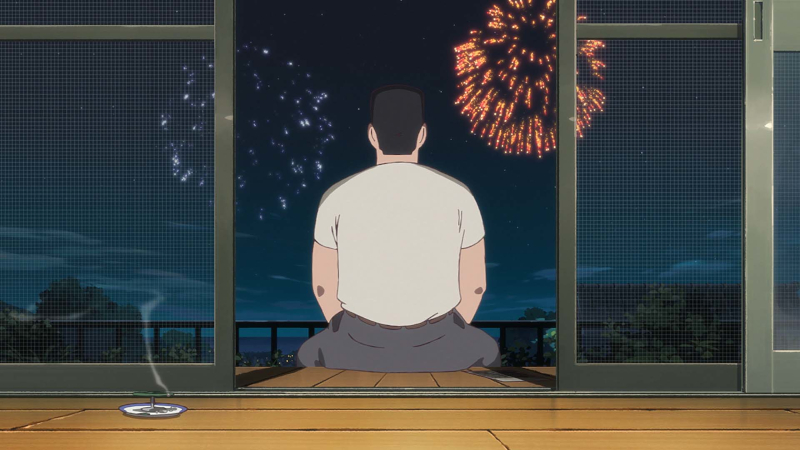
Director – Baku Kinoshita – 2025 – Japan – Cert. 15 – 90m
*****
A man lives with his wife and child… only they are not really his wife and child – out in UK cinemas on Friday, March 27th
Here’s a movie that breaks all the moulds. I could (and will) tell you several things about it, any of which would (and will) immediately spark preconceptions about what it is. And those preconceptions would (and will) be wrong.
If we start off with it as a drama about family life, which it arguably is, that doesn’t quite give you the full idea. This is a pretty strange family: it’s effectively a single parent mum Nana (voice: Hikari Mitsushima) and her baby son Kensuke who have been taken in by the kindly Minoru Akutsu (voice: Junki Tozuka) who wants to help them. Akutsu is in love with Nana, but he’s the quiet type and can’t bring himself to verbally express his love for her. (Which, I guess, makes this into a romantic drama of sorts. Certainly a tale of unrequited love, albeit an odd one.) And over the years, as the boy grows, the man comes to think of the boy as his own son. But, again, he can never find a way to express this.
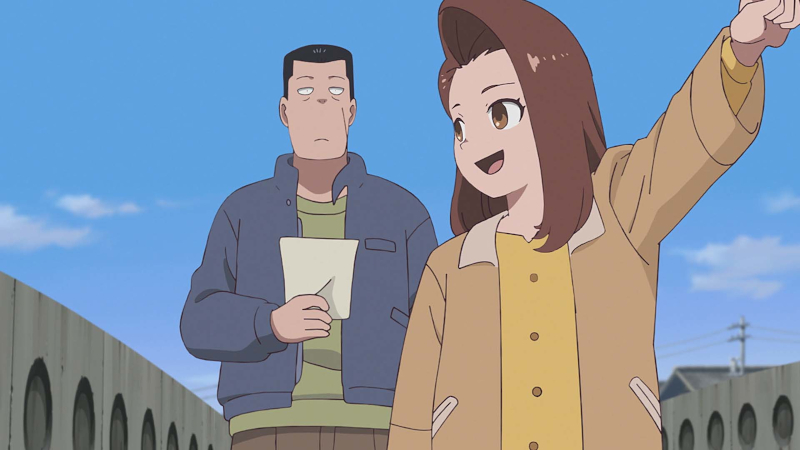
The strange family is not a thousand miles from the more extended family in Shoplifters (Hirokazu Kore-eda, 2018), who have been thrown together over the years by circumstance rather than blood ties. Indeed, there’s something of the feel of a Kore-eda drama to all this – you can imagine it playing well to an audience appreciative of his movies as diverse as After the Storm (2016) or Like Father, Like Son (2013).
Or, again, delving back further into film history, one can imagine this being the sort of darker, popular drama that the director Yasujiro Ozu liked to make.
Akutsu has a friend Tsutsumi (voice: Hiroki Yasumoto) who has helped him out by finding him and his ‘family’ a modest apartment in which to live. This friend will play an increasing important part in what follows.
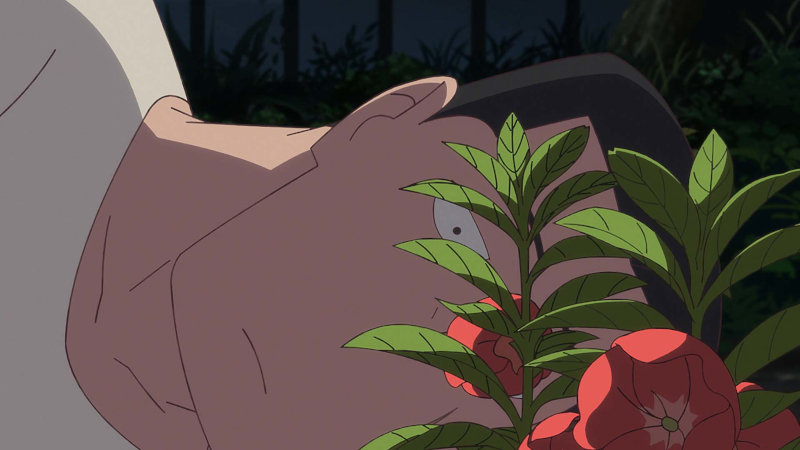
The movie gets stranger still if we start off with its frame story. This has the elderly Akutsu (voice: Kaoru Kobayashi) as a prison inmate of some thirty years standing looking back on his life. Instead of simply using the obvious cinematic device of the flashback, the script gives Akutsu a bizarre confidante in the form of a talking plant, specifically a Balsam or, as per the film’s Japanese title, a housenka, which has been potted in a tin can. The balsam lives not so much for itself as for its species, viewing itself as part of a continuity, i.e. it feels and experiences the collective memory of all balsam plants. It originally grew outside the family’s back door, before later being potted by Nana and somehow finding its way to the cell of the incarcerated Akutsu.
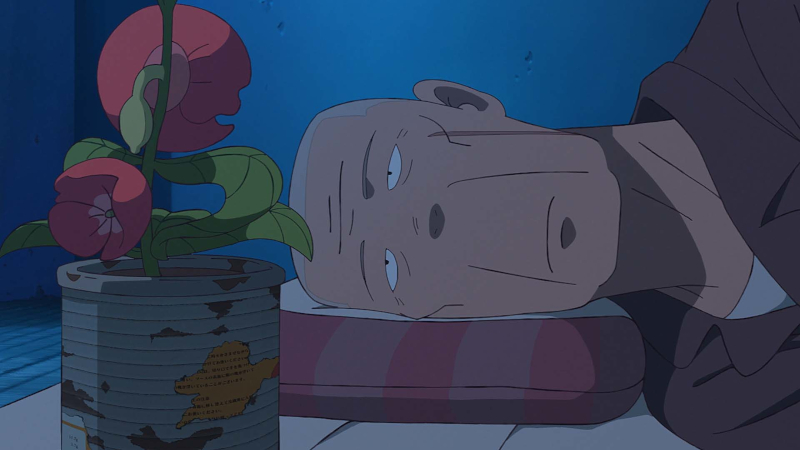
Thus the man finds himself in conversation with the plant, telling it the story of his life and ‘family’, as the plant goads him for being less forward in his attitude to the woman than he might have been. You might think the plant is a bit like Jiminy Cricket in Disney’s Pinocchio (Norman Ferguson, T. Hee, Wilfred Jackson, Jack Kinney, Hamilton Luske, Bill Roberts, Ben Sharpsteen, 1940), yet it’s not exactly a conscience character and is arguably closer to the talking cockroach of Joe’s Apartment (John Payson, 1996) or the talking boil that develops on the shoulder of the ad executive in How to Get Ahead in Advertising (Bruce Robinson, 1989).
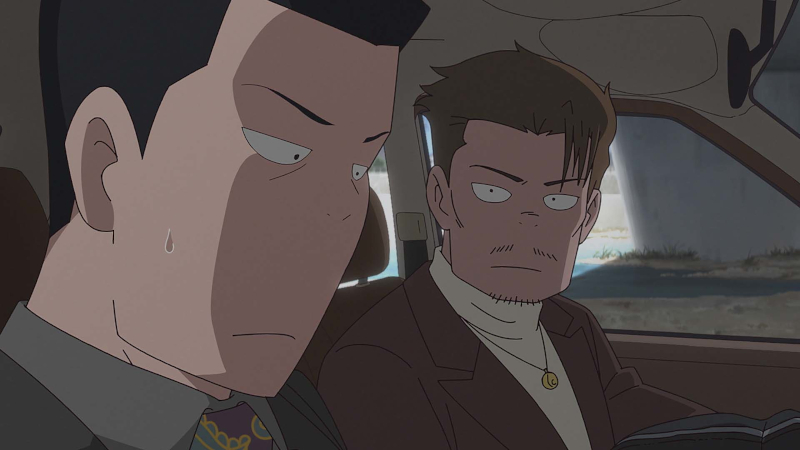
The Last Blossom hails from Japan, so comparisons to dramas about families by Ozu and Kore-eda may be apt. It’s obvious from fairly early on that both Akutsu and Tsutsumi are yakuza (Japanese gangsters), yet while you could reasonably describe this as a yakuza or gangster movie, it’s for the most part like watching a movie about a yakuza’s home and family life where we rarely see him doing what he does for a living. Those rare scenes do put in an appearance here, and when they do, they are devastating; but to describe this as a gangster film might give completely the wrong idea. In this respect, The Last Blossom is not that far removed from the upcoming Kokuho (Lee Sang-il, 2025), the biggest box office live action film of all time in Japan, about a boy from a yakuza family who becomes a Kabuki actor; there are yakuza elements, but if you went in expecting a yakuza movie per se, you’d be disappointed. Yet in that film, as here, there is so much more.
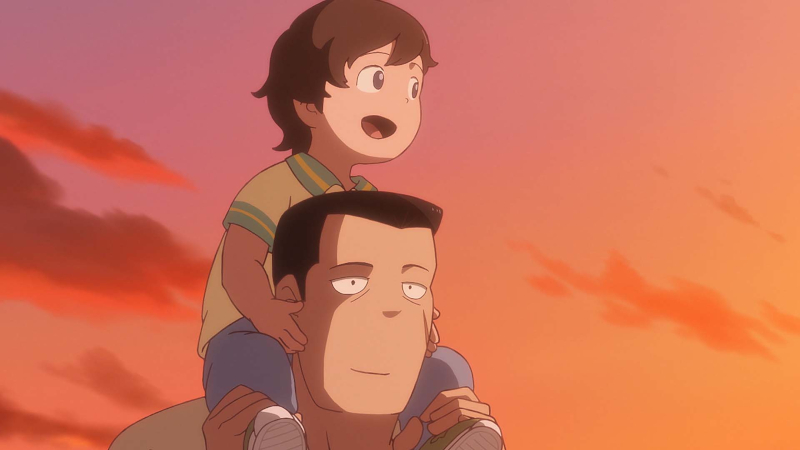
As well as hailing from Japan, The Last Blossom is animated. We have already mentioned the talking plant and Pinocchio, but this is most definitely not a film for children, and has about it an existentialist angst not that far removed from that of the more action- and violence-oriented Chinese epic Have a Nice Day (Liu Jian, 2017). Visually the use of the animation medium makes The Last Blossom pleasing to watch. Take the characters: the men’s faces are curiously and distinctively designed with their mouths positioned a long way below their noses. The mise-en-scène is memorable too, for instance shots in moving cars where the background pans past have a quality all of their own. The grown up level of the storytelling here may throw for six anyone who still thinks animation is for children, or teenagers. Altogether, this is a remarkable piece of work: a film that transcends its anime production origins to deliver something extraordinary to a far broader audience for those willing to take a chance on it.
The Last Blossom is out in cinemas in the UK on Friday, March 27th.
Trailer: