
Director – Lee Sang-il – 2025 – Japan – Cert. – 175m
*****
The son of a murdered yakuza is taken under the wing of a respected kabuki actor, who trains him alongside his own son – out in UK cinemas on Friday, May 8th
In kabuki theatre, an onnagata is a man who performs women’s roles, following the banning of women performing in kabuki by the shogunate, who feared it would result in moral decline, in the 17th century.
In 1964, as the snow falls outside, a large, new year restaurant meal for his yakuza family in Nagasaki turns into a pivotal event for teenager Kikuo Tachibana (Soya Kurokawa from Monster, Hirokazu Kore-eda, 2023), for two reasons. One, he is able to perform as an onnagata in a kabuki play, The Snowbound Barrier, for visiting celebrity actor Hanai Hanjiro (Ken Watanabe from Fukushima 50, Setsuro Wakamatsu, 2020; Pokemon; Detective Pikachu, Rob Letterman, 2019; Inception, Christopher Nolan, 2010; Letters from Iwo Jima, Clint Eastwood, 2006; Tampopo, Juzo Itami, 1985); two, a rival yakuza group bursts in and wipes out his family. He vows revenge, but fails in his attempt to murder the killer of his his father (Matsatoshi Nagase from The Box Man, Garyuku Ishii, 2024; Paterson, Jim Jarmusch, 2016; Sweet Bean, Naomi Kawase, 2015; Gojoe, Sogo Ishii, 2000; Cold Fever, Fridrik Thor Fridriksson, 1994; The Most Terrible Time in My Life, Kaizo Hayashi, 1993; Mystery Train, Jim Jarmusch, 1989).
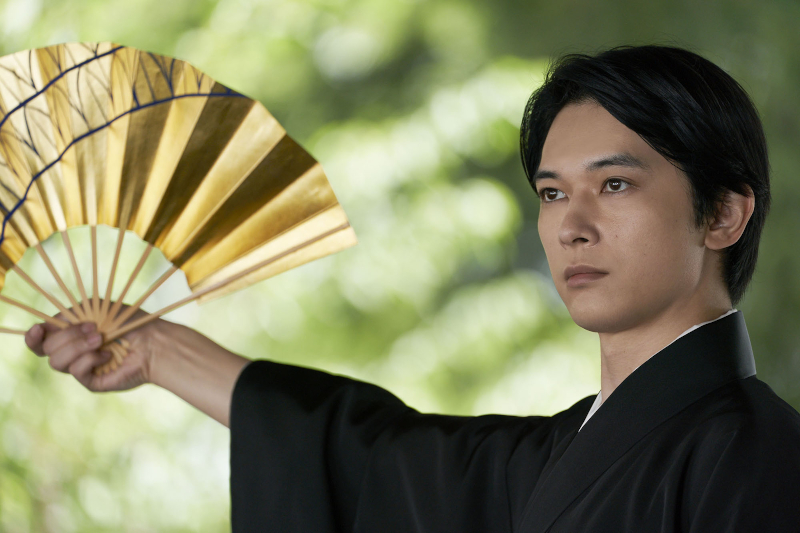
For the benefit of English-speaking audiences, who may be less familiar with kabuki plays than their Japanese counterparts, the subtitles include helpful, concise synopses of the plays featured. For instance,
The Snowbound Barrier:
A princess disguised as a courtesan avenges a villain disguised as a barrier keeper.
Prior to his father’s killing,There’s something very affecting about watching the two lads, post-performance, running through their parts again as they remove their stage makeup.
After his father’s killing, Kikuo conceals from his girlfriend Harue (Mitsuke Takahata from Monster; Napping Princess, Kenji Kamiyama, 2017) his plan to avenge his father’s killer, for which he and his amateur kabuki co-star acquire a handgun and a blade.
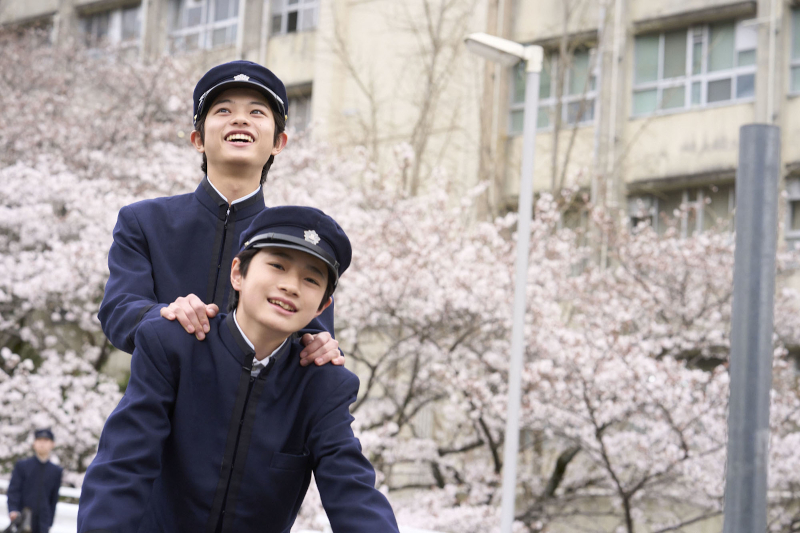
Hanjiro, who protects the boy by hiding him in an adjacent room during the attack, is impressed with Kikuo’s performance enough to take on Kikuo (Ryo Yoshizawa) as an onnagata (stage name: Toichiro Hanai – number one man of the east) alongside his own son Shunsuke (stage name: Hanya – half a guy, later to be Hanjiro the Third) a year or so later in Osaka. (It’s common practice for onnagata to train their sons to succeed them.) Hanjiro disagrees with the unease of his wife (Shinobu Terajima) at the family taking in the boy, but while Kikuo’s attempt at revenge may have failed, it took guts to try and suggests a certain strength of character.
He has his wife take Kikuo to watch a himself and his son perform a kabuki play. Kikuo doesn’t keep up, instead finding himself entranced in the wondrous world of backstage and the performance seen through curtains at the stage side.
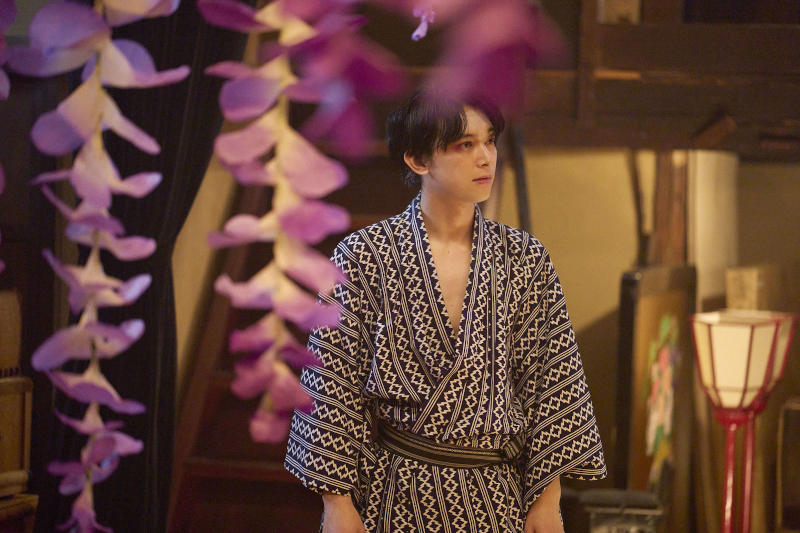
Two Lions:
In this dance of lions, the stern father shows his love for his son by kicking him off the cliff.
As time goes by, the wife begins to suspect the boy possesses considerably more talent than their own son. The couple decide to pair the two boys as onnagata. At a geisha house, one of the geishas (Ai Mikami) propositions the boy to be his mistress because she believes he’s destined to be a great actor.
Hanjiro introduces the two boys to top onnagata Mangiku Onogawa (Min Tanaka from Perfect Days, Wim Wenders, 2023; Twilight Samurai, Yoji Yamada, 2002), about to play in a performance of Heron Maiden. As stage snow falls around Mangiku’s Heron Maiden, Kikuo is transfixed. The taciturn assistant to Mitsutomo Corporation’s President Umeki (Kyusaku Shimada from Shin Godzilla, Hideaki Anno, 2016; Doomed Megalopolis, Rintaro, 1991), a major backer, warns Kiku that because this is a family business, and he is an outsider, that his downfall will come.
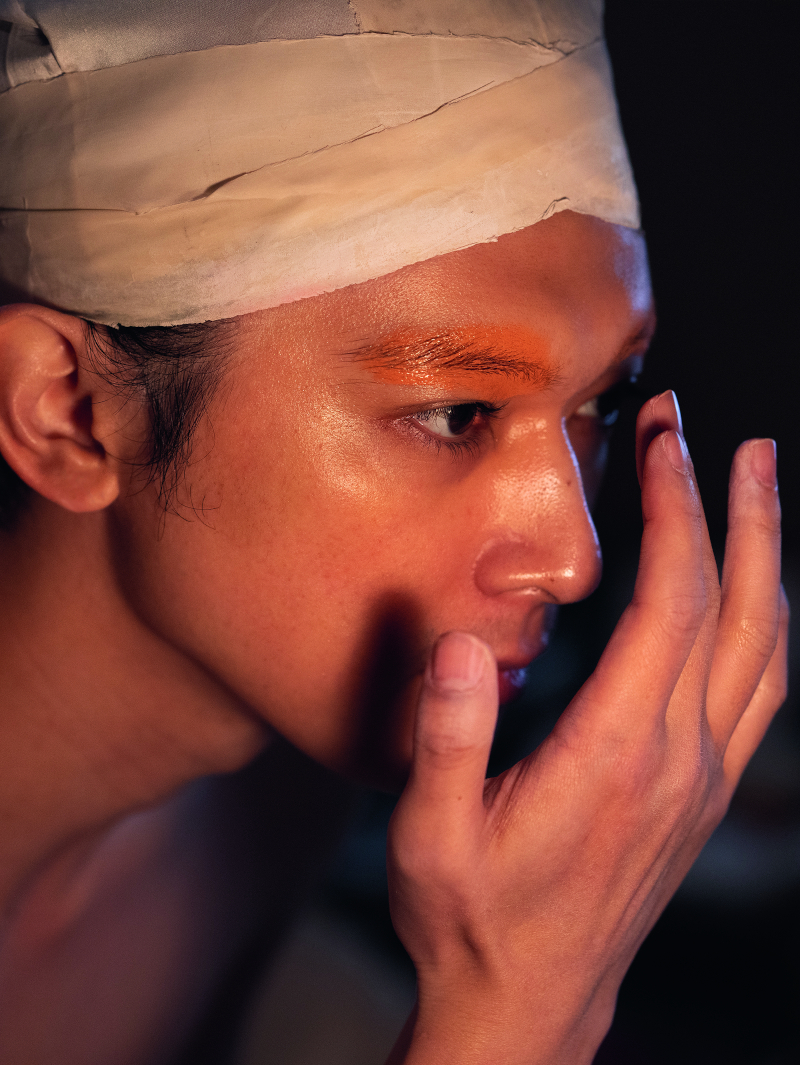
Due to appear without Shunsuke, Kikuo gets stage fright, telling Shunsuke that he wishes he had Shunsuke’s blood to protect him.
Two Lovers:
Two Lovers,conned and unable to marry each other, commit suicide so as to be united in the next life.
As Kikue goes through the speech about her lover possessing the resolve to go through with the suicide, Harue, who has followed Kikuo from Nagasaki and is in the audience, observes Shunsuke, also in the audience, get up and leave. She follows. I’m not running, he tells her: I want to be a real actor – not a pretend one. As she takes his hand and leads him out of the theatre, they mirror the couple on stage in the play. They disappear.
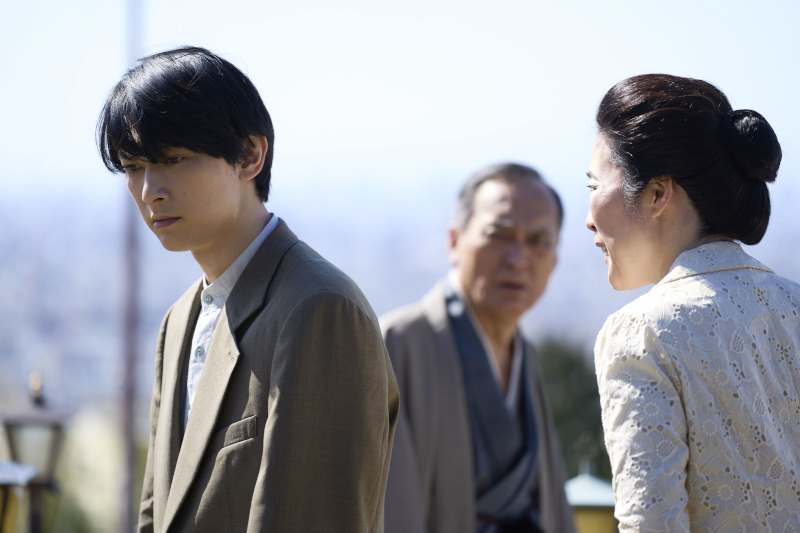
Eight years later, 1980. The ageing Hanjiro and his wife visit. Hanjiro tells him to take his name and become Hanjiro the Third. Shunsuke has been gone eight years, so presumably doesn’t want the family name. His wife, however, sticks up for their son, calling Kikuo a filthy thief to his face. During the ceremony for the handing over of the name from actor to apprentice, Kikuo says his part, but then Hanjiro starts spewing blood and collapses.
Mangiku and the kabuki world subsequently disowns Kikuo and, worse still, supports the clearly less gifted Shunsuke iin a career when he returns to claim his birthright (because he wants to provide for his son with Harue). As his career nosedives, Kikuo makes things worse by sleeping with Akiko (Nana Mori), the young daughter of a theatre promoter (real life kabuki actor Nakamura Ganjiro IV)…
From its opening – snow falling in what will become a repeating motif, followed by a restaurant sword fight / shoot out as violent and bloody as anything in samurai or yakuza cinema, unrepresentative of anything else that follows here – through its drama about two boys training to become kabuki actors, this presents a memorable picture of the world of kabuki theatre and the life of a would-be kabuki actor, a great introduction for anyone unfamiliar with this particular aspect of Japanese culture.
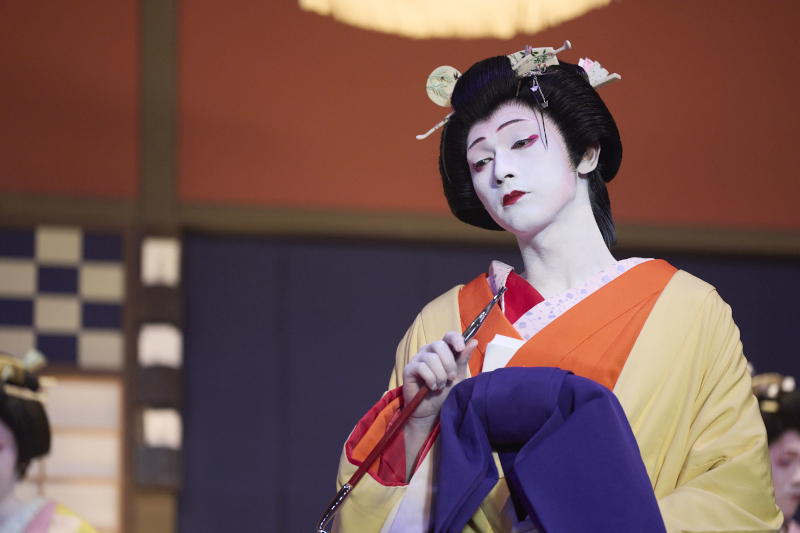
To punctuate all this with what are effectively vignettes of kabuki plays, with (in the subtitles) a brief verbal synopsis to help you enjoy the plays themselves, is a master stroke, enabling the viewer to see or hear and appreciate the stage backdrops, the incredible costumes (the lengthy wigs of the Two Lions springs immediately to mind) and the distinctive musical accompaniment, not to mention the extraordinary performances of the kabuki actors themselves.
Outside of the plays, several fine performance take us inside the various characters. The two boys are particularly good, as are the two actors playing the established kubuki actors. Particularly impressive is the dying Mangiku, who visited at the end of his life tells Kikuo: You know, I feel like I don’t have to try any more.
The film has done incredible business in its native Japan, and it’s not hard to see why: like our own Hamnet (Chloe Zhao, 2025), it grapples with the complexities of lives in and around a deep-seated, national cultural institution without, incredibly, ever becoming stage bound. Director Lee’s filmography includes the tremendous thriller Villain / Akunin (Lee Sang-il, 2010), and as in that film has has a deft grasp of both character and storytelling. Highly recommended for anyone interested in either Japan and the Far East, or theatre and culture, or for anyone prepared to commit three hours viewing time to a rattling good yarn.
Kokuho is out in cinemas in the UK on Friday, May 8th.
Note; the verbal capsule reviews of kabuki plays are from the films subtitles.
Trailer: