
Director – Ido Fluk – 2025 – Germany – Cert. 15 – 112m
*****
How an 18-year-old girl came to stage what would become the biggest selling jazz album in history – narrative feature is out in UK cinemas on Friday, June 5th
At a party honouring her career as a music promoter, 50-year-old Vera Brandes (Suzanne Wolff) is upbraided by her dentist father (Ulrich Tukur from The White Ribbon, Michael Haneke, 2009; The Lives of Others, Florian Henckel Von Donnersmarck, 2006; Solaris, Steven Soderbergh, 2002; Lulu, George Moorse, Peter Zadek, TV movie, 1991) that she never amounted to anything. In a quasi-documentary sequence, she intervenes as narrator to talk about this being a really bad start, and proceeds to play, like a presenter in a music documentary, some music takes abandoned by bad starts from, among others The Cramps and Bob Dylan.
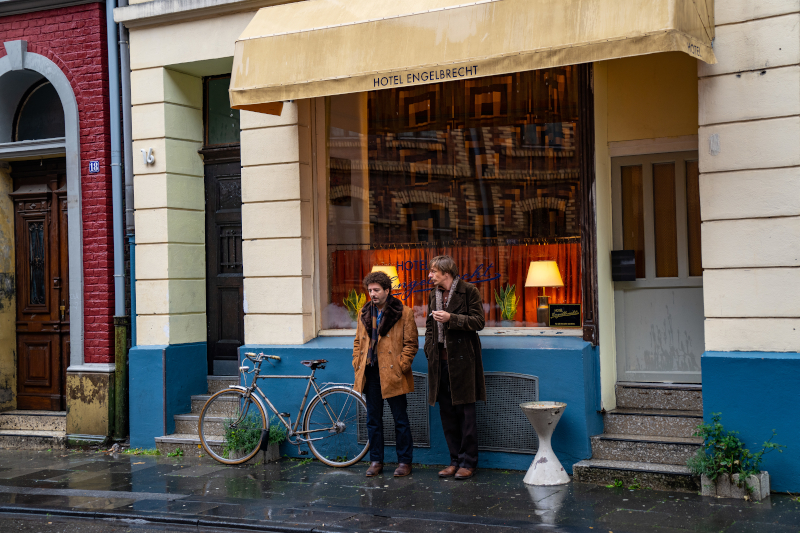
The film starts again, this time with 18-year-old Vera Brandes (Mala Emde) who enjoys hanging out with friends at jazz venues, such as the one where English club owner Ronnie Scott (Daniel Betts from September 5, Tim Fehlbaum, 2024; Alien Romulus, Fede Alvarez, 2024; Allied, Robert Zemeckis, 2016) is playing. Getting his attention by buying him an ice cream cone, Vera chats with him and, by the time she has walked her bicycle with him to his hotel has been commissioned to book him a European tour “because I can’t imagine anyone saying no to you.” Working out of her dad’s clinic, which has its own phone line, she learns the business from scratch, but is smart, and the tour gets booked. She’s so good at this, and the money side of the business, that soon she is renting her own flat for business purposes without the knowledge of her parents (she is still ostensibly living at home).
There is considerable tension between the free-thinking Vera and her conservative family.
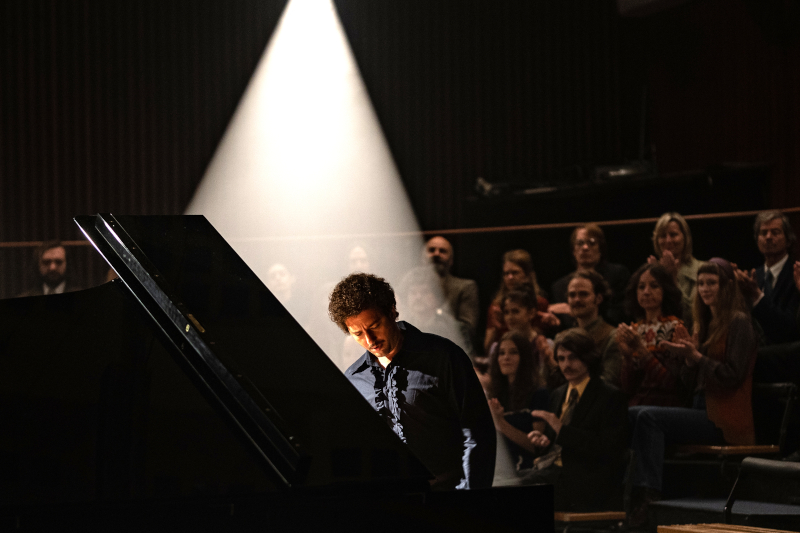
Everything changes for her the night she goes to see Keith Jarrett (John Magaro from September 5, Past Lives, Celine Song, 2022; First Cow, Kelly Reichardt, 2019) play. Another quasi-documentary sequence ensues as music journalist Michael Watts (Michael Chernus from Orange is the New Black, TV series, 2013-19; Captain Phillips, Paul Greengrass, 2013; The Messenger, Oren Moverman, 2009) breaks the evolution of jazz down into four simple stages. One, jazz based on predetermined standard tunes or standards when the soloist would play a solo within a predetermined time of a number of bars. Two, jazz based on standards when the soloist would play a solo without a predetermined time of a number of bars; this was concurrent with band size reducing to quintet, quartet or trio. Three, free jazz, or free improvisation, when musicians played from scratch, but playing with other musicians. Four, free improvisation, solo.
The fourth stage is what Jarrett was doing. He would sit down at the piano with no idea beforehand what he was going to play, then play for maybe an hour. After playing, he would have no idea whether or not that particular gig had been any good.
Vera is so enthralled that she books him into the 1, 300 seat capacity Köln Opera House at 11pm on a Friday night after a performance of the opera Lulu, the only time the institution can offer her due to its full schedule, agreeing to pay them an upfront fee of 10, 000 Dm to do so. When she asks her father to advance her the money, at a bad time since he’s already furious that she’s spent the night out of the house, he refuses point blank. So now she has to find another way of raising the money. She does at least manage to get the DJ who runs a music show show on the local radio station to plug the show, as an artist who will play but no-one knows in advance what will happen, even though the station has a “no jazz” policy.
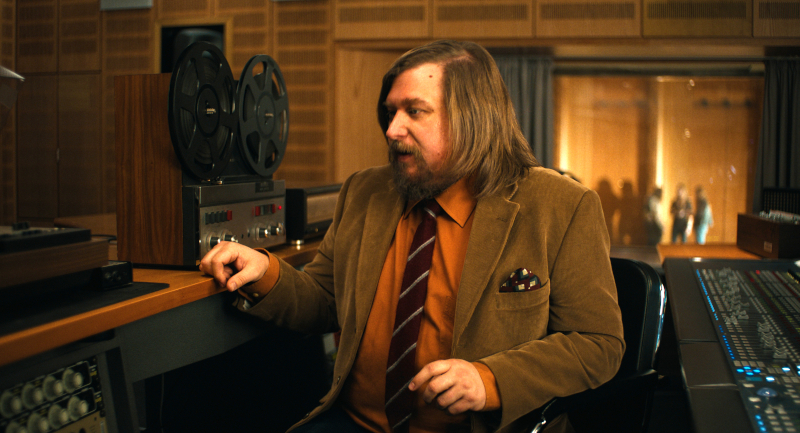
The narrative switches over for a while to music journalist Watts, who turns up at Jarrett’s hotel room to do an interview, having been commissioned to write a piece on him, just as Jarrett is having back problems so severe that he’s thinking about not playing the Köln gig. He and manager Manfred Eicher (Alexander Scheer from From Hilde, With Love, Andreas Dresen, 2024; Lulu, Uwe Janson, TV movie, 2006), famously the founder and boss of jazz label ECM, a fact never mentioned in the film, are using Eicher’s small car as their tour bus, and the driving is taking its toll. Although Vera has provided them with air tickets to fly to the gig, they will cash these in at the airport to replenish their depleted funds. With Jarrett unable to do the interview that evening, and Watts offered one the next day after Köln gig, the journalist now has another problem; how will he get to Köln? Eventually, the pair relent and agree to take him in their car.
The proviso is that Watts ask no questions, but inevitably he does so, and gets some great answers with the rider, “of course, you can’t use that”, a phrase he repeatedly encounters under similar circumstances at various subsequent points. It seems that, in order to play, Jarrett has to completely empty his mind to let come musically whatever will come. Muttering or coughing in the audience are a distraction. As morning breaks, they stop the car and Watts stands alongside Jarrett in a field, at his invitation, with instructions not to say a word but simply listen.

The narrative switches back to Vera as she attempts to surmount various obstacles which look set to prevent the concert from happening. Jarrett’s contract states he must have a Bösendorfer 290 Imperial concert grand piano for the hall, but owing to a mix-up the opera house staff have supplied an inferior practice piano. Not only that, but the instrument needs tuning and one of its pedals is broken. Vera manages to find a pair of piano tuners / technicians who may – or may not – be able to get the instrument concert-worthy in time. But that presupposes Jarrett can be persuaded to play the inferior instrument, even assuming they manage to fix it while the evening’s performance of Lulu is going on.
So, with the emporium’s head man unreachable on Friday afternoon and only the lady who runs the opera hall office present, she commandeers the premises with four friends manning phones trying to track down another Bösendorfer 290 Imperial… By the end of the evening, following various attempts to fix the gig’s assorted issues, Vera is reduced to handing out last minute fliers outside the building, unaware that the event has already sold out…
Eicher has arranged a for sound recordist to record the gig, and the resulting album would go on to become the bestselling jazz album in history.
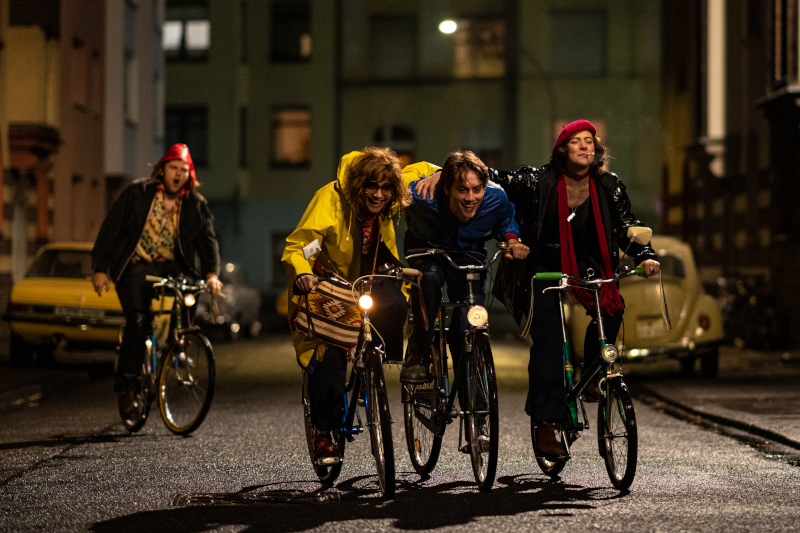
A strong supporting cast also includes Shirin Lilly Eisa, Enno Trebs (from Miroirs No. 3, Christian Petzold, 2025; The White Ribbon), Leo Meier (from The Zone of Interest, Jonathan Glazer, 2023) and Leon Blohm as Vera’s per group. And the real Vera Brandes appears briefly towards the end.
As is stated at the start, this is not a film of the concert, or of the musician. Using the analogy of Michelangelo painting the Sistine Chapel ceiling using a scaffold, this is a film about the scaffold. As such, told largely from the point of view of a young promoter new to the game and additionally from that of a journalist who was present, it provides a fascinating primer on a scant explored subject. Also lurking in here is the oft-encountered issue of artist and creatives everywhere that society tells them they should get a proper job. While Vera’s father remains intransigent, her mother Ilsa (Jördis Triebel) proves more sympathetic and helpful, discovering a bond with her daughter since both are smokers, a habit of which Vera’ father disapproves.
In fact, it is so much not a film of the concert itself, that once we get to it, we don’t hear a note played. But that doesn’t matter, because the concert itself is not the subject of the film so much as how it came to take place – or very nearly didn’t.
Köln 75 is out in cinemas in the UK on Friday, June 5th.
Trailer: