Director – Jethro Massey – 2024 – France – Cert. 15 – 109m
****
A young American photographer in Paris runs into a girl obsessed with the darker side of French history – out in UK cinemas on Friday, September 5th
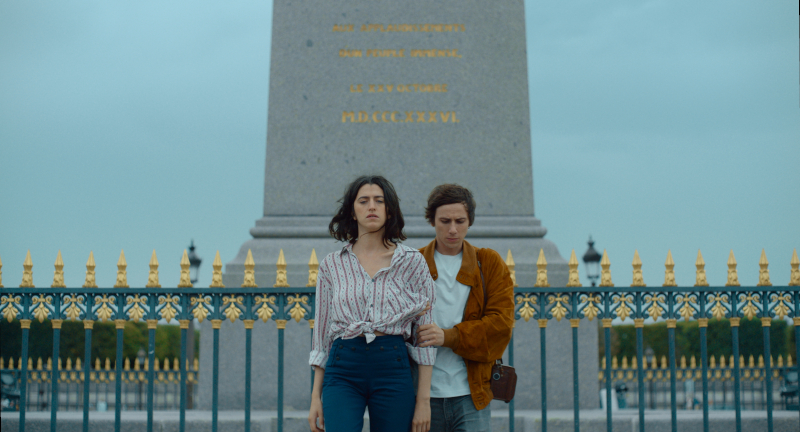
Opening with sepia-toned engravings then photos depicting the last couple of centuries of Paris, this switches to an image of a girl walking and kneeling and a male “Once there was a girl” fairytale voiceover about a girl who would immerse herself in history, who was drawn both to the stars and the gutter, who liked Bad Things. Immediately, it’s juxtaposed with a female “Once there was a boy” voiceover about a boy who came to Paris with a camera around his neck. He photographs the girl. She confronts him. He points out that before her execution (on which site the girl has been kneeling, as if awaiting execution) Marie-Antoinette would have had her hair cut so as not to impede the blade. The girl has long, black hair.
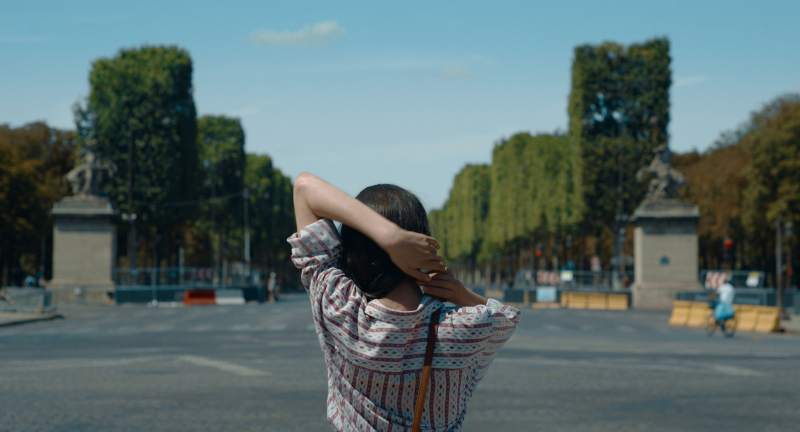
In voiceover, she talks about how a spoon’s meaning changes once you know that Marilyn Monroe ate ice cream with it on the last day of her life. They visit a church which appears to contain the site of Marie-Antoinette’s cell. She finds a courtyard where she thinks the hair would have been cut, and hands Paul (Jérémie Galiana) a pair of scissors. There’s some confusion as he thinks her head would have been completely shaved, but switches to “above the neck.”
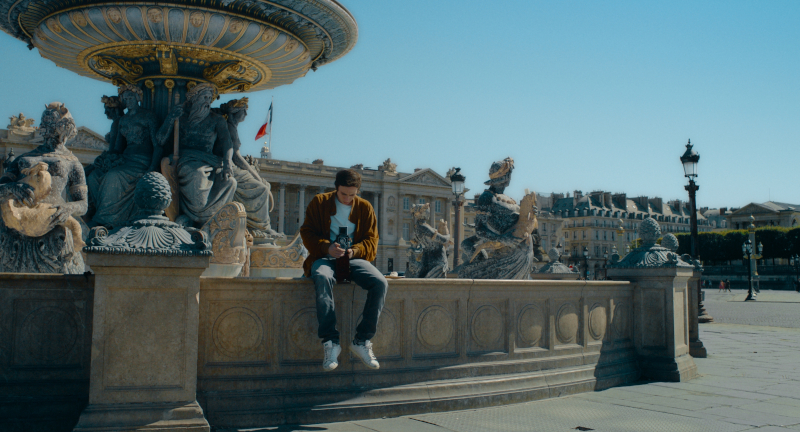
They return to the scene of the execution, which she re-enacts with the help of guillotine sound effects on the soundtrack and a swift edit (cut) to a contemporary print of Marie-Antoinette having just been executed. For the girl, it’s a liberating experience (which is bizarre, because for the historical figure, it was the end of her life). Paul gives Paulette (Marie Benati) his number (which she playfully refuses to reciprocate) and an invite to his upcoming exhibition. In which the black and white, framed image of Paulette kneeling, features. No one shows.
He pawns his camera gear. He dons a suit. Gets a real estate job working for a boss, described by his male co-worker Alex (Isham Conrath) as a real ballbreaker. She’s an old flame, Valérie (Laurence Vassiere), and she still has a thing for him, it seems. Paulette, meanwhile, spends time with George (James Gerard from Emilia Pérez, Jacques Audiard, 2024; Spencer, Pablo Larrain, 2021) who has made her up a bed in a murder apartment. I need to spend more time with platonic male friends, she tells him. And with her lover – or perhaps ex-lover, Margarita (Margot Joseph). Who wants her to move her stuff out of the flat.
Paulette phones Paul. She makes herself over as Monroe, complete with beauty spot and blonde wig. “These walls are witnesses”, she tells him on arrival, describing France’s first murder celebrity Gabrielle Bompard who, together with her husband, despatched her unsuspecting male victims in the famous murder case of 1890 christened the Bloody Trunk Affair. When Paul asks about her family, she stonewalls. Except to say she was raised a Catholic, which leads to a dodgy (and potentially offensive to those of us who are religious) discussion of transubstantiation. And she won’t let him touch her.
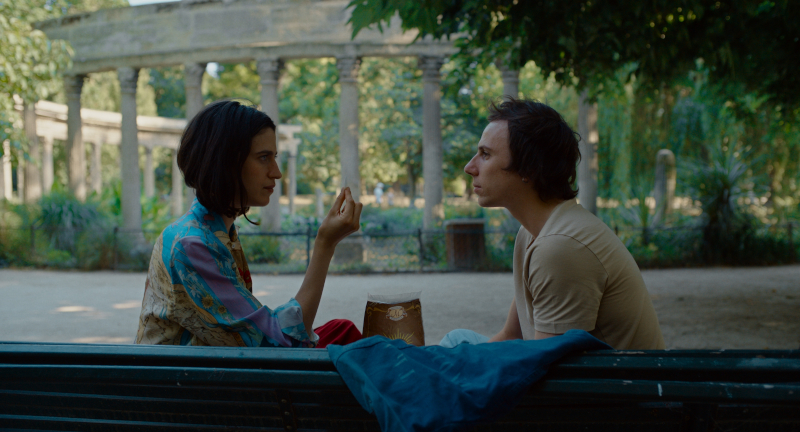
They feed each other communion wafers, to describe the taste not only of Jesus Christ, but also or such cultural and historical figures as Elvis Presley, Adolf Hitler and Kim Jong Un. To satisfy her craving for crime scenes, he takes her to the site where the Communards – the members of the Paris Commune – were shot by firing squad. He shows her the bullet holes in the walls, feeling them (my religious background immediately made me think of Thomas being instructed to feel the wounds in the risen Christ’s body). Paulette mock shoots Paul after he declares himself a Communard, but after being mock shot, he simply gets up again… To the pair of them, all this is a game. There’s a sense that neither of them takes it very seriously. And certainly, religion isn’t taken seriously, given Paulette munches a packet of Communion wafers as if they were a bag of crisps.
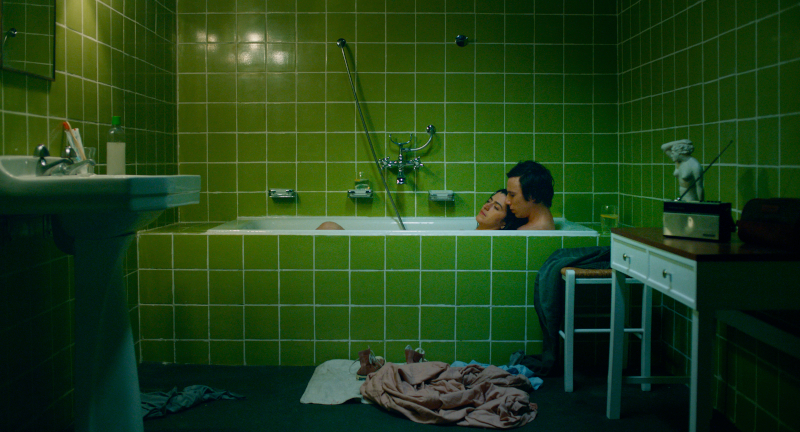
Paul rekindles his relationship with Valerie, largely at Paulette’s urging, then takes the week off work to drive Paulette to her parents’ in Salzburg since she hates flying. En route, they finally sleep together. Then he takes her to an apartment formerly owned by Hitler. Where they take a bath (he as Eva, she as Adolf). In a voiceover, she talks about “reaching into the abyss that is in every one of us.” She talks about her parents, and reveals that her father is a murderer.
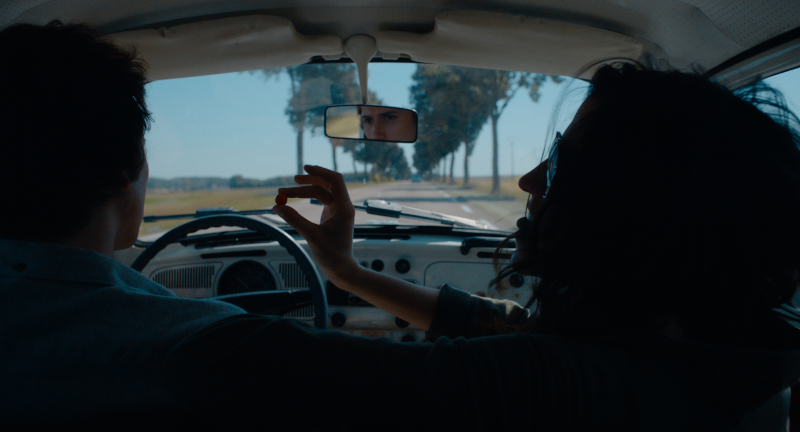
At her parents, in a bedroom, he discovers her old Pentax camera, rigs up a makeshift pedestal (like the one she asked him not to put her on) and stages an impromptu photo shoot. She has told her parents Charlotte (Fanny Cottençon) and Gilles (Gilles Graveleau) that Paul is a friend, not a boyfriend, but then her mother discovers the two of them in bed together. From there, things only get worse, Paulette coming out as a lesbian to them. On the drive back, her relationship with Paul starts to fracture – he reveals that Hitler’s apartment wasn’t really Hitler’s apartment. She accuses him of wrecking a perfect memory.
Dumped by Paulette, who returns to Margarite, he in turn dumps Valerie, renting the apartment of the Bataclan killer. When Paulette visits him there, it’s like walking into the scene of a real life crime…

Essentially an indie US movie set in France, rather than a French movie, this is executed mostly in (American) English and suggests an idealised American view of Paris, in this case one laced with dark historical incident and true crime, which even extends to the French heroine’s father being a murderer. It seems at first glance to be balanced between male and female, Paul and Paulette, but he, not she, is the protagonist while she, ultimately, is the one of them in control. The US is out of its depth in Europe, while the French have genuine historical roots and an authenticity the Americans lack.
Jérémie Galiana’s Paul is likeable but ineffectual, while Marie Benati’s Paulette seems happy-go-lucky but is in fact calculating. And the serial scenes of historic criminal incident, which eventually become personal with the visit to Paulette’s parents’ given that her father was a killer, slowly draw you in, despite suggestions that they may not possess quite the authenticity they initially claim, with hair cut above the neck substituting for Marie-Antoinette being shaved bald prior to execution, and Hitler’s apartment in Salzburg not being Hitler’s apartment in Salzburg at all.
Playing out like a European art movie, it’s actually a journey through the American mind and its internal, imagined European landscape. Nevertheless, there’s something captivating about the journey, and the film is quite unlike anything else out there in contemporary cinema at the present time. Like the outside Paul stumbling upon the always just out-of-reach Paulette, you’ll be glad to spend time in the company of these two characters, but you may come away from the piece with a feeling that, ultimately, it’s not quite as radical and daring as it appears to be on first viewing.
Paul & Paulette Take a Bath is out in cinemas in the UK on Friday, September 5th.
Trailer: