Director – Óliver Laxe – 2025 – Spain, France – Cert. 15 – 115m
*****
Young son in tow, a man goes in search of his daughter who has gone missing at raves in the North African desert – 2025 Cannes Jury Prize Winner is out in UK cinemas on Friday, February 27th
Luis (Sergi López from Pan’s Labyrinth, Guillermo del Toro, 2006; Dirty Pretty Things, Stephen Frears, 2002; Harry, He’s Here to Help, Dominik Moll, 2000) and his son Esteban (Bruno Núñez Arjona) are searching for his son’s elder sister who vanished five months ago. Believing she is headed to a rave in the Moroccan desert, they turn up there to hand out Missing fliers and ask people there if they have seen her.
No-one has seen her.
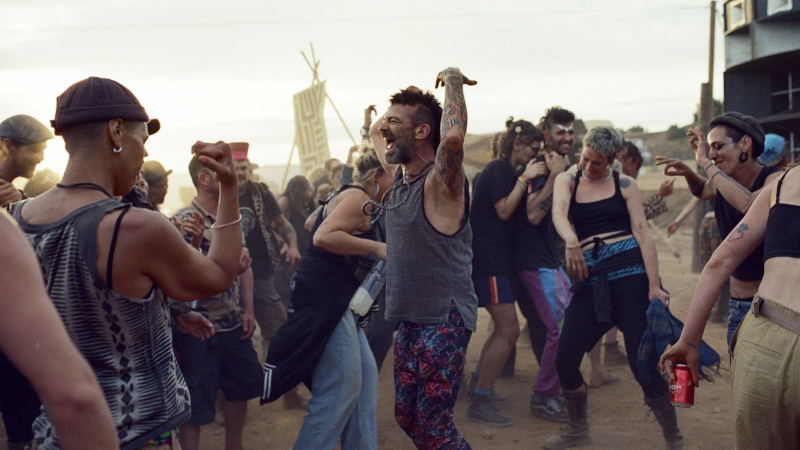
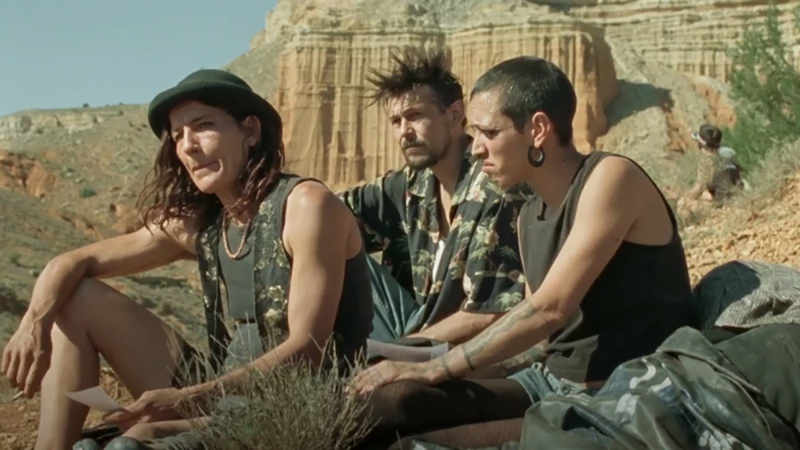
They start off asking among dancing revellers, but soon move on to try people resting or on the fringes of the event. One group of three people halfway up a hillside, seem more sympathetic than most, but they’ve not seen the daughter so there isn’t a lot they can do to help.
The rave is an illicit event not sanctioned in any way by the authorities, so it’s perhaps not surprising that on maybe the second day… time can be hard to keep track of at these events… soldiers turn up to close the event down.
As Luis, Esteban and their dog Pipa are stuck in the unending, gridlocked vehicle queue to leave the location, several much larger vehicles suddenly seize the opportunity to take an alternative route cross country and escape the queue. Esteban shouts at his dad to “Go, dad, go!,” and before you know it, they’ve joined the escapees.
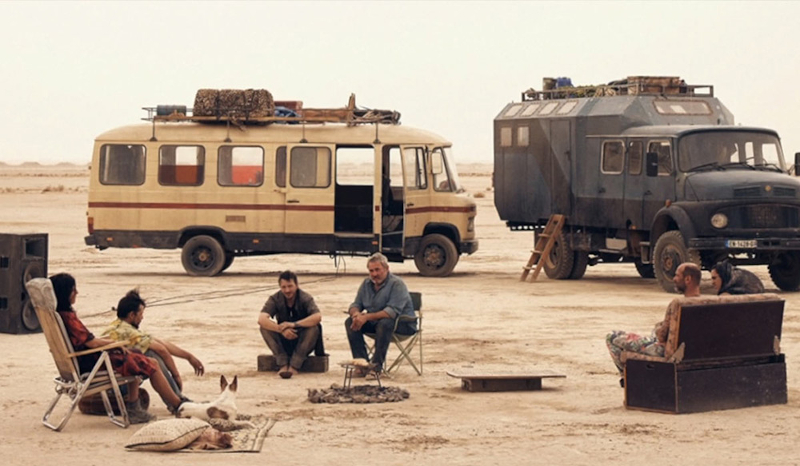
The convoy soon thins out to the family van and two much larger vehicles. When they stop to quiz Luis, he sheepishly admits to following them, yet they allow him to join them anyway, warning him that his vehicle may not be up to the demands of their route.
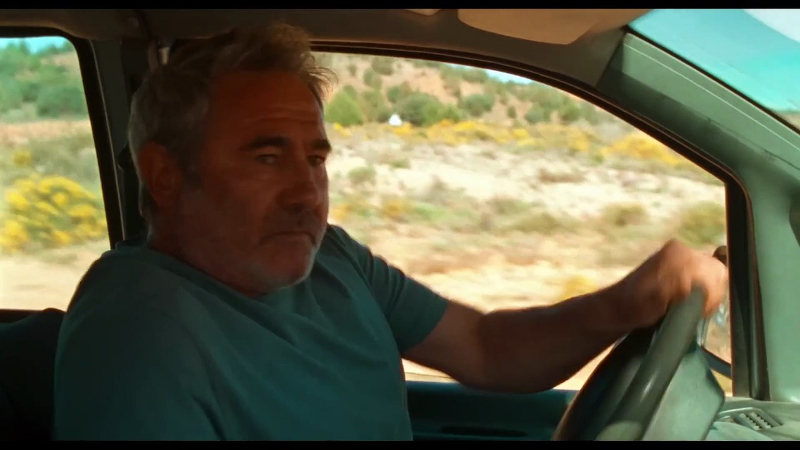
Although this started out as a search for missing persons drama, by this point, the film has morphed into something different, a cross between a road movie and a quest. What the object of that quest might be, you’ll have to work out for yourself. Perhaps it relates to coming to terms with loss.
As they journey desert across country, Luis must learn to trust those he’s following. A river seemingly too deep for his comparatively small van to get through gives them the opportunity to tow him across after he initially feels they’ve abandoned him. Later, Pipa falls sick, most likely after eating the shit of one of the ravers who has taken LSD, and must be nursed to recovery.
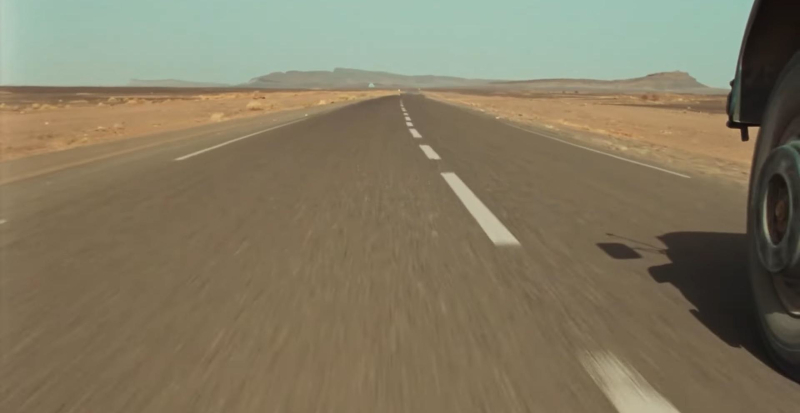
Further challenges and crises beset the travellers as they journey on. The first time you watch the piece, you have no idea what’s coming; your second viewing is filled with anticipation and dread at what you know to be coming.
Clever strategies draw us in. An initial title card informs us that Sirāt is the bridge between hell and paradise. The subsequent opening features the near silent setting up of a vast bank of speakers for he desert rave, then the sound of techno pumping through it as nearby cliffs stand impassively, then on to shots of ravers immersing themselves in the rhythm and the beat. This is when Luis appears as he tries to pigeonhole the event’s punters.
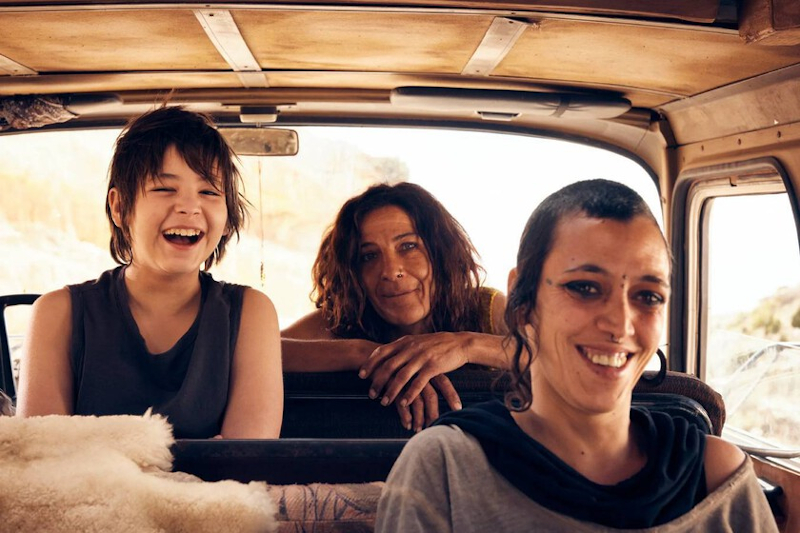
Slowly, we get to know Luis and family’s fellow travellers, who speak French after first communicating with him in his native Spanish. Jade (Jade Oukid) is the one who asks Luis in to her van when, prompted by Esteban, he brings over a bar of chocolate. Her partner Bigui (Richard ‘Bigui ‘ Bellamy) has a false lower leg and at one point uses his upper leg as a muppet type singer playing her detached prosthetic like a makeshift guitar.
Others include Josh (Joshua Liam Henderson) , Stef (Stefania Gadda) and Tonin (Tonin Janvier), who inspired Esteban by riding in between the two big vans, a foot on each footplate.
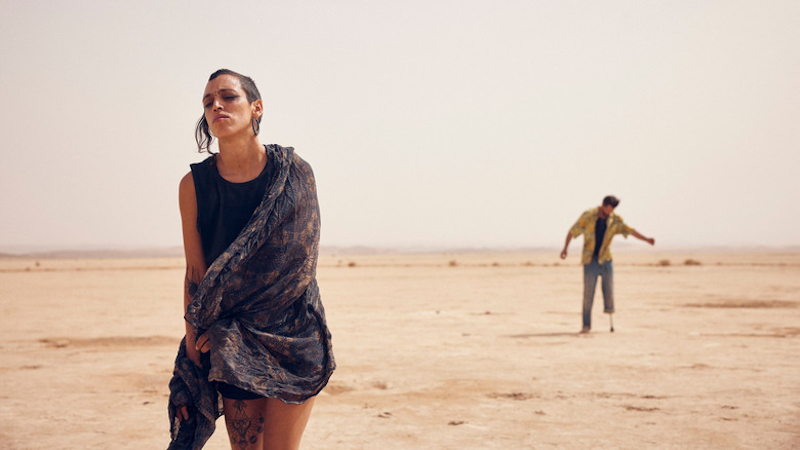
These five ravers are all played by first-time actors, who are arguably playing themselves, They are very much secondary characters, although they increase in status as the film goes on, and when they’re on the screen, you can’t take you eyes off them. Equally watchable are the child and, believe it or not, the dog. But the one towering presence at the centre of it all is veteran actor Sergi López, who starts off a broken if optimistic man before undergoing a series of emotionally and spiritually crushing experiences through the course of his journey.
By the end, there a feeling that Luis and the others have lost their much cherished freedom; the final image is of train tracks proceeding towards an unseen vanishing point somewhere ahead of us in the desert.
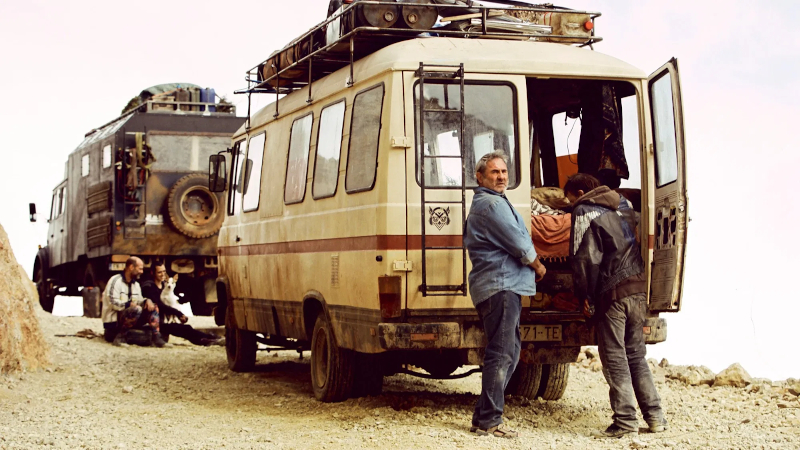
Filmed using real vehicles crossing a real desert, this is also a landscape movie, with many of its landscape vistas breathtaking. These include one scene in a heavy rainstorm where water dribbles down a vast windscreen obscuring the road ahead, and another where the two huge vehicles are reduced to two tiny pairs of headlights on the screen in the darkness as they traverse one of many perilous mountain roads.
I’ve always been drawn to myth, and this has about it a mythic quality. These figures are larger than life and embody various archetypal virtues (the father searching for his lost daughter, the group of friends who offer to help a stranger, and so on).
It’s an electrifying and incredibly powerful experience likely to leave you with more questions than answers, and packed with images which will stay with you long after the end credits have rolled.
It’s a film unlike anything you ever seen. A masterpiece, and likely to be one of the year’s best films.
Sirāt is out in cinemas in the UK on Friday, February 27th.
Sirāt won the Jury Prize at the 2025 Cannes Film Festival.
Trailer: