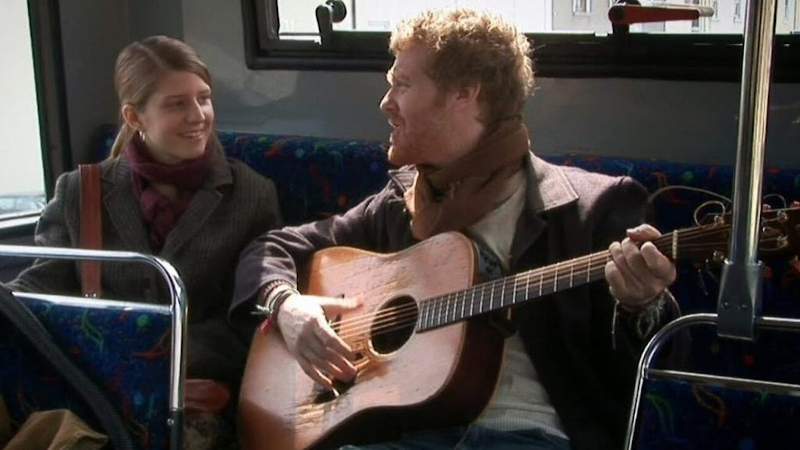
Director – John Carney – 2006 – Ireland – Cert. 15 – 90m
*****
Two musicians fall for each other on the streets of Dublin… – review originally published in Third Way magazine, October 2007
UK release date 19/10/2007
This brilliant film is a reviewer’s nightmare because a thumbnail synopsis on paper sounds incredibly bland and clichéd – something the actual film isn’t. A busker meets a girl on the street in Dublin. He fixes her vacuum cleaner. Being a pianist, she gets involved in his newly formed band. Romantic entanglements might ensue, but they don’t because she has a husband. The band’s demo sounds impressive, and the former busker departs for London to seek his fortune – without the girl. And that’s it.
However, the above outline doesn’t tell you two things.
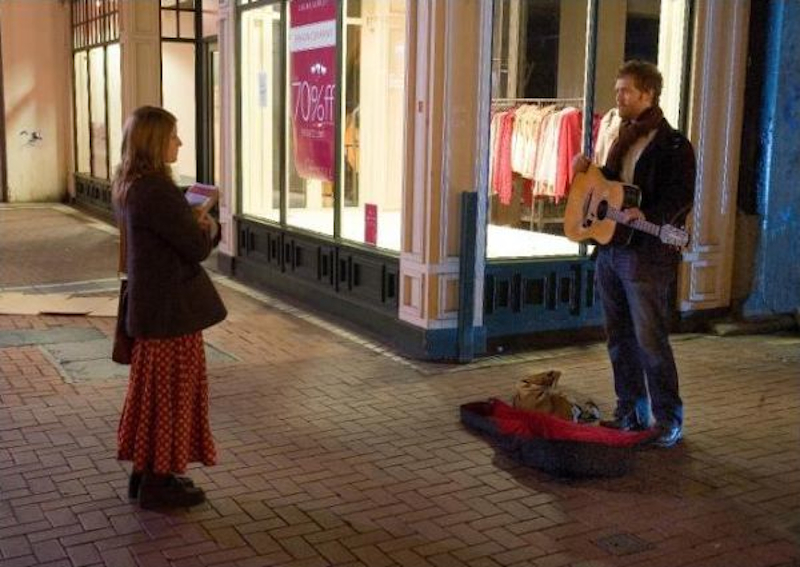
One, there are a lot of songs. As in, the narrative stops so a character or characters can sing a song. This is not the case of, as in the classic movie musicals, the invisible orchestra swells and the character or characters can sing, but something more naturalistic. For instance, the first song occurs when the busker, on the street, picks up his guitar and sings a song. Right the way through. And, again, that’s it. Except that, once you’ve got past the shock that the narrative has stopped dad in its tracks, singer and song are both extraordinarily captivating. Which is the case with all the film’s musical numbers and their performers. And despite initial impressions, perhaps these songs actually do serve to advance the narrative. It just doesn’t feel that way at the time, at least not to start with.
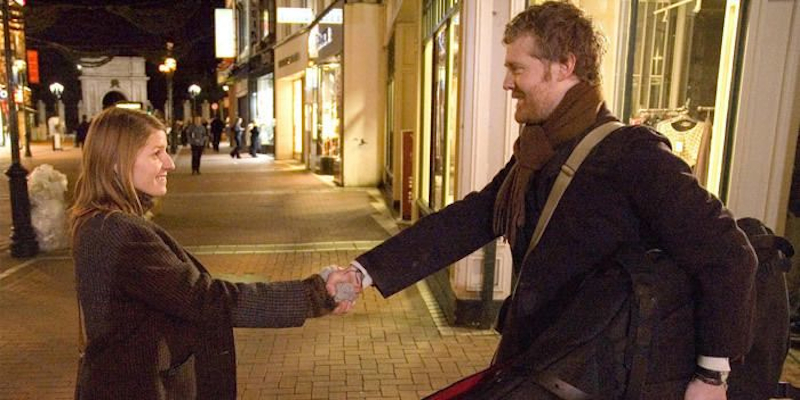
Two, this is a musical. In the sense of a classic musical. With big production numbers. Only, its big production numbers aren’t big production numbers in the all-singing, all dancing, cast of thousands sense. The mise-en-scène relates rather to the cultures of both singer-songwriter picking up a guitar and plugging it in and band recording a song together in a studio. The classic musical is, in its broadest sense, a thumbnail narrative interspersed with songs that move that narrative along. The current film does this, but in a beguilingly deceptive (Irish?) way that makes you think you’re watching performances of/listening to songs that aren’t advancing the narrative one jot. Only, in actual fact, they are advancing it, almost without your noticing it. Did I mention this before?
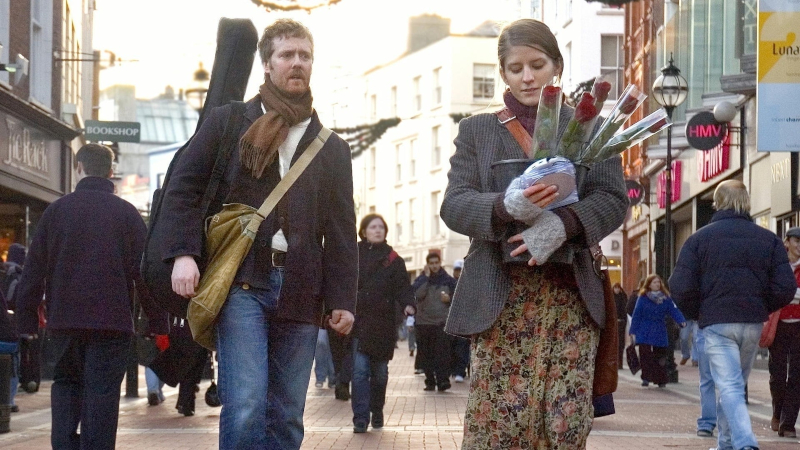
Between 1991-1993, director Carney was the bassist with Dublin band The Frames, they being the band founded by Glen Hansard who plays Once’s busker. (The Frames incidentally are still going strong.) The screenplay developed from a synopsis by Carney and a series of songs developed by Hansard as a result of brainstorming over a long period of time. Eventually, the director opted to cast Hansard and other musicians rather than actors who could sing because it seemed to better serve the material.
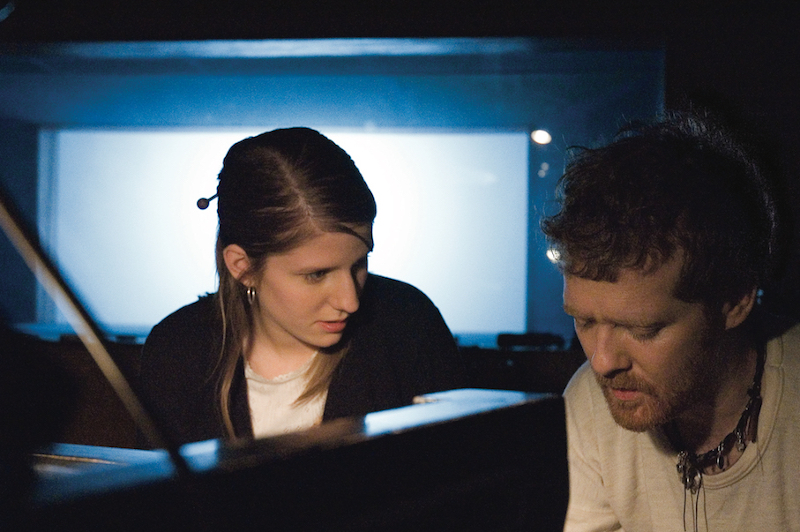
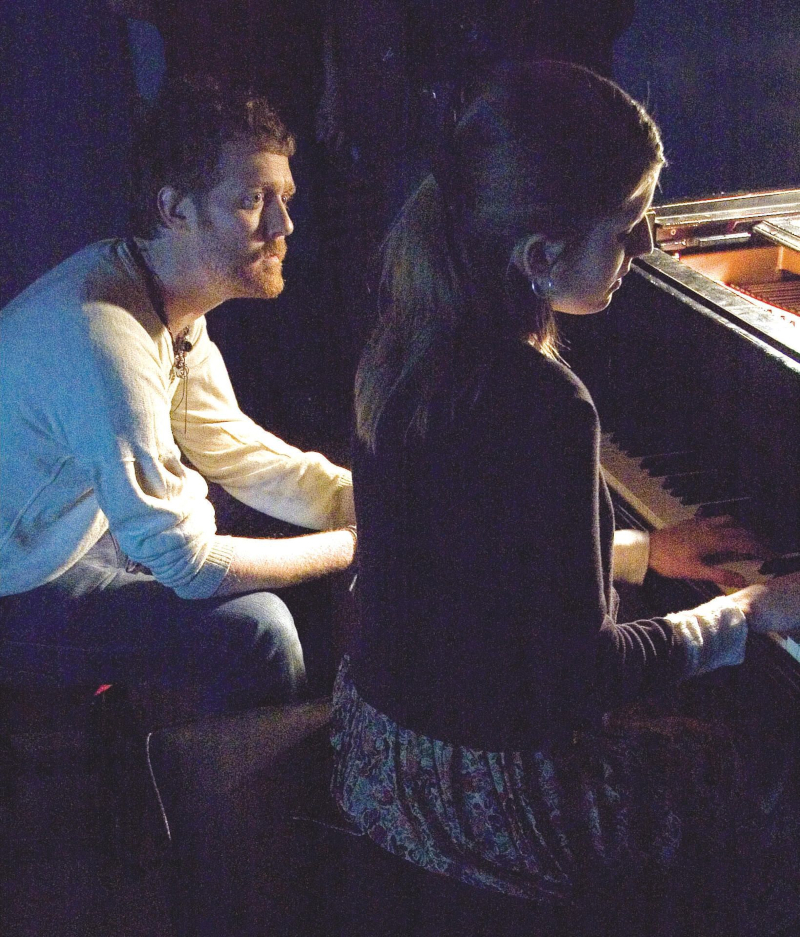
Thus, opposite Hansard’s busker, we find Czech multi-instrumentalist Marketa Irglova as the girl. Both musicians produce incredible performances. In terms of their roles, they are basically non-actors playing themselves. Their performances derive power, however, from their singing and playing which, in a very real sense, is a form of acting in front of the camera. So when the pair sing, for instance, “Take this sinking boat and point it home / We’ve still got time”, it’s profoundly moving, not simply in terms of the song but also in terms of their performance of it, all of which is underscored by the wider narrative context.
It’s been said that the best ideas are the simple ones. Watching this remarkable, unique and optimistic offering, you can’t believe that no-one’s ever made anything quite like it before. But no one has. Once has therefore carved itself a respectable niche in film history. Unlike the brilliant but ultimately bleak Control (Anton Cobijn, 2007), it’s a life-affirming experience. Defying easy categorisation, it’s that rare film which deserves to have audiences from all walks of life and every generation flocking to see it in spades.
The film went on to win Best Original Song (for Falling Slowly) at the 2007/8 Oscars.
UK release date 19/10/2007.
Review originally published in Third Way magazine, October 2007.
Trailer: