
Director – Petra Blondina Volpe – 2025 – Switzerland – Cert. 12a – 92m
****1/2
An experienced and competent nurse in a hospital in the Western world endures a particularly gruelling night shift – out in UK cinemas on Friday, August 1st
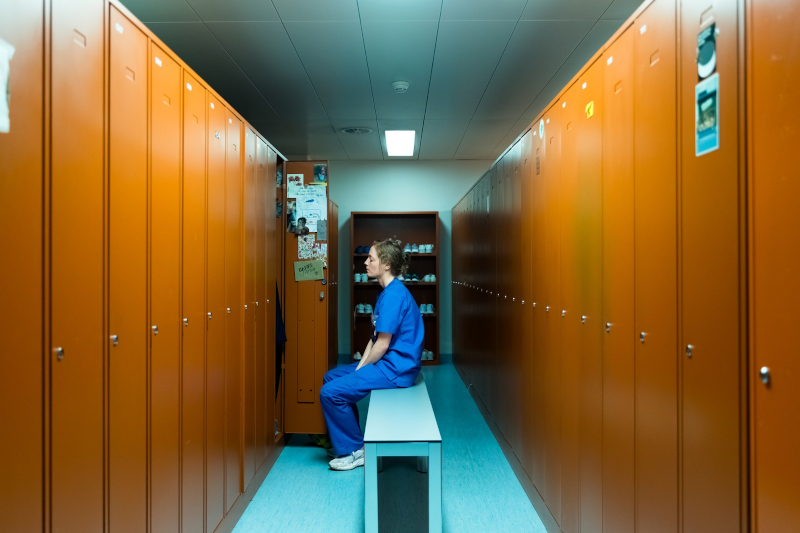
There’s a moment of calm at the start of Late Shift… Scrubs going through a laundry system… Floria Lind (Leonie Benesch from September 5, Tim Fehlbaum, 2024; The Teachers’ Lounge, Ilker Çatak, 2023; The White Ribbon, Michael Haneke, 2009) on the night bus to her shift… She and a colleague making small talk whilst changing at the lockers… (The film ends similarly, with a reverse of this bookend, peace after the night shift is over.) And then, they’re on shift.
As soon as Mrs. Lind comes into the ward, the chaos starts. She helps a male colleague (bilingual in German and, for the patient, French) lift the demented Mrs Kuhn (Margherita Schoch) out of her wheelchair so Floria can change the lady’s underwear (and, quite literally, clean her shit off the floor). This evening, it’s Floria, one other nurse (Sonja Riesen), and Amelie (Selma Jamal Aldin), an inexperienced med student. Handing over, a colleague runs through by name the patients on the ward this shift and their various medical needs.
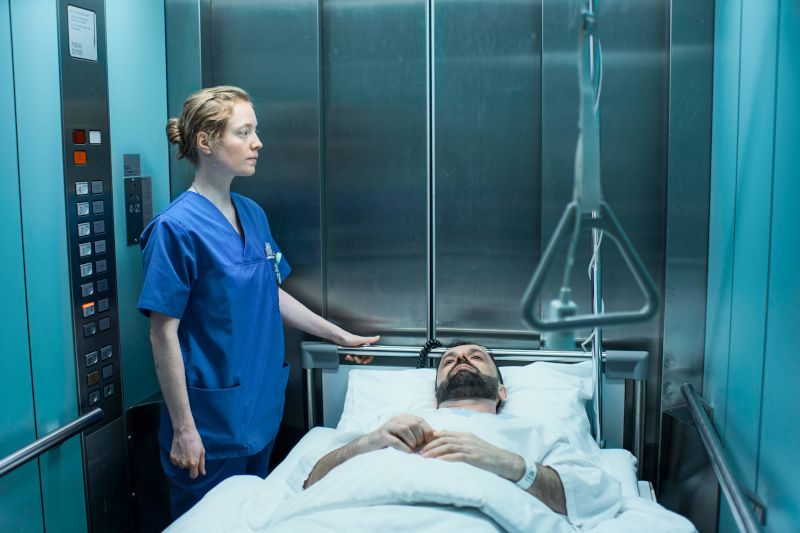
Mr.Osmani (Ridvan Murati) is due in surgery for a gallbladder op. He and his wife (Albana Agaj) have a business, so he must instruct his son what to do in his absence by phone. She has just delivered him to surgery – and discovered he hasn’t changed into the requisite mesh underwear – when she’s cornered by Mr. Leu (Urs Bihler), who is distressed that he’s been waiting six days now for a diagnosis from Doctor Strobel (Nicole Bachmann). She talks and jokes with Mr. Nana (Urbain Guiguemdé) who doesn’t want a gastric tube because he’s scared.
She visits Mr. Schneider (Heinz Wyssling), whose daughter (Doris Schefer), sitting by the bedside, says he comes and goes. She just wishes he could let go. She has to leave to take Mr. Nana to a CT scan, which means the awakening Mr. Schneider will have to wait for his painkillers. Then she gets a call from the relative of a discharged patient who left her reading glasses in a room. A private patient buzzes her because he needs painkillers. In the ‘poison cabinet’ room, she prepares various medications.
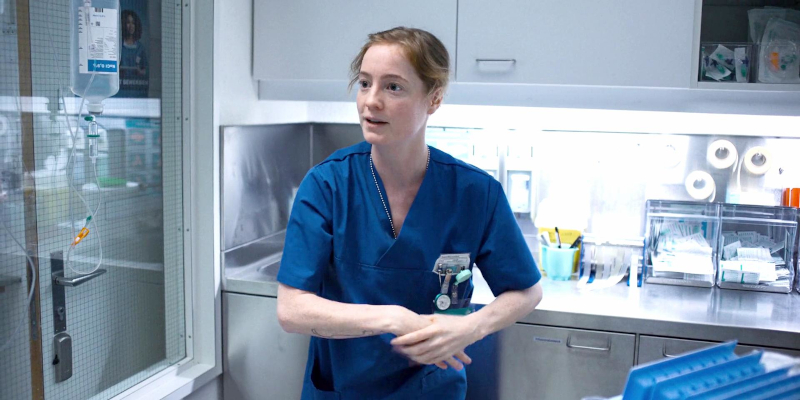
And so it goes on, patient after patient, demand after demand, need after need. A multiplicity of little dramas, each based around Lind and an individual patient, but all mixed up together in the course of her night shift. Moments of kindness and genuine warmth from patients. Moments of life and death, in which at least one patient dies of predictable causes. Moments of guilt when she blames herself for not having checked in on a patient often enough. Moments of stress, such as realising she’s mixed up two different patients’ pills.
Moments of respite, calm and clarity after an attempt by paramedics have failed to resuscitate a patient, and Lind stands alone by the window of the room with the corpse lying on the bed beside her feet away. By the time this arrives, the whole experience has been increasingly full on, without a breather.
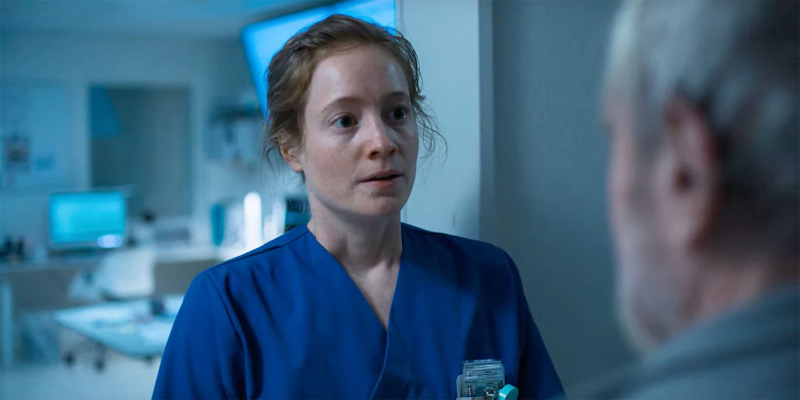
And then, there’s the private patient (Jürg Plüss), cushioned from the chaos in a single room while others must share with at least one other patient, demanding that Lind make him a cup of peppermint tea NOW!!! The film is set in the Swiss healthcare system, and I should point out, in case anyone is interested, from my personal experience, that in at least one NHS Hospital (University College Hospital, London, for the record), peppermint tea can be obtained from the tea ladies when they come round by the simple expedient of asking for it – they don’t tell anyone, but they carry supplies of peppermint tea bags!
After a death on the ward of which he knows nothing, when he drives her beyond what she can take, she takes his watch and hurls it out of the window, It cost 40 000 Euros. She will be in debt, paying it back for years. She goes outside to find it, searching through the undergrowth, but it’s nowhere to be seen. It’s hard to imagine a better illustration of the difference between the average Western worker and the well off, privileged, parasitic few.

The pace is relentless, and Benesch is terrific as the put-upon nurse, but being set inside a hospital, the piece never quite achieves the frenetic thriller energy of the working mum for whom everything but everything goes wrong in Full Time (Eric Gravel, 2021). Sure there are problems, and everyone is overstretched, but Lind is well-trained and most of the staff around her – the other nurse and the doctor on the ward (Anna-Katharina Müller) – provide support at well needed moments, even if the inexperienced student nurse on her first night proves a bit of a handful.
The other recent film that springs to mind is All We Imagine as Light (Payal Kapadia, 2024), which portrays the everyday struggles of nurses in the Indian healthcare system, yet which broadens out to show more of their lives outside their work shifts.
Still, Late Shift is about health services in crisis in the West, and as such represents both a hymn of praise to the staff that do everything they can to keep the understaffed and underfunded system running against the odds and something of a call to action to preserve the public health services before the right wing clowns attempt to covert them to a US style, for-profit system. It’s engaging and timely stuff, and cries out to be seen.
Late Shift is out in cinemas in the UK on Friday, August 1st.
Trailer: