Director – Neo Sora – 2024 – Japan – Cert. 12a – 113m
***
Two schoolboys play a prank on their despotic principal, who turns it into an excuse to introduce a high tech surveillance system – out in UK and Irish cinemas on Friday, September 19th
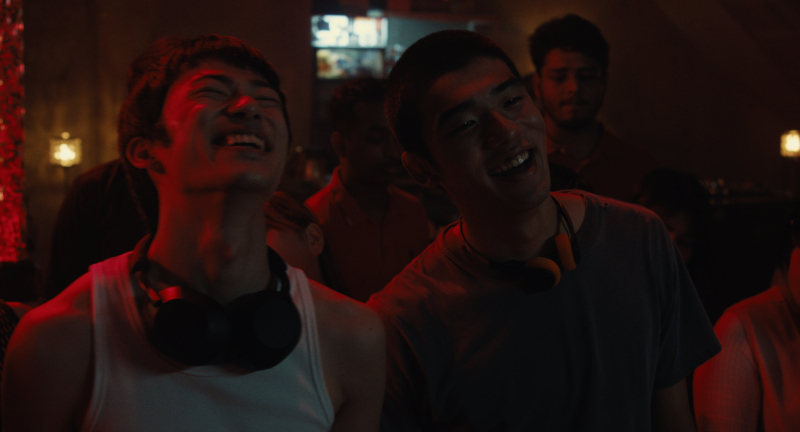
In a future dystopian Kobe, Japan, that looks remarkably like the present day Kobe, Japan, a group of highschoolers fail to get past the tough, power-dressed, Chinese lady bouncer to a club because they’re underage. A couple of the boys, Yuta (Hayato Kurihara) and Kou (Yukito Hidaka), wandering down a nearby back alley, notice a man in a dark vest taking a crate of beer into the building, strip off their white shirts to reveal similar dark vests underneath, and use crates of beer to gain back door access. Inside, the DJ is electrifying, the beat is strong and the gig is everything they had hoped. There is a police raid, but Kou can’t get Yuta to leave. Somehow, they and the DJ end up being the only ones there, and he gives them a talisman as a mark of respect and tells them to come back for the second set, which is better. But they don’t chance their luck.
Instead, they and the others have to sneak back into the school premises in the middle of the night (it’s not clear exactly why), passing a security guard by faking cat noises with a mobile phone as a diversionary tactic. Before that, the Principal (Shiro Sano from Fukushima 50, Setsuro Wakamatsu, 2020; The Most Terrible Time in My Life, Kaizo Hayashi, 1993; Zipang, Kaizo Hayashi, 1990; Violent Cop, Takeshi Kitano, 1989) comes in to school, lording it over another kid from our party’s school and insisting he park the Principal’s ostentatious, yellow sports car when his current chores are finished (the hapless pupil is carrying an impossible armful of books and other items). Hanging out on the roof after sunrise, Yuta spots the car still sitting there and, defeating Kou in a game of Rock, Paper, Scissors, gets the latter to perform a prank on it.
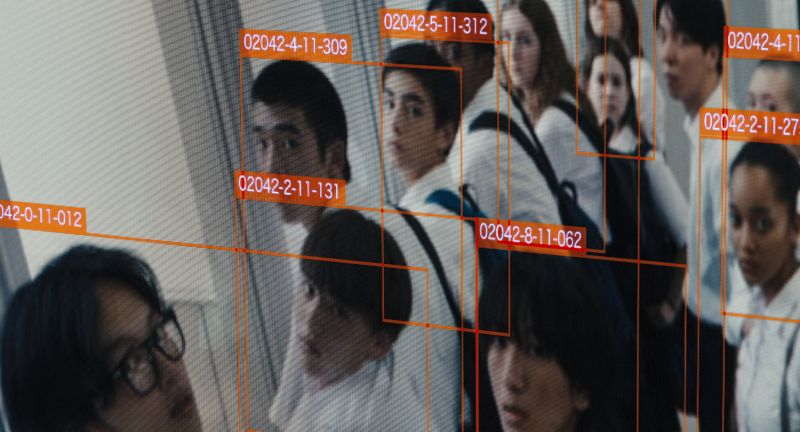
As newscasts show the PM using an unexplained ‘emergency’ to increase police powers, something similar occurs in the microcosmic world of the school where the Principal unjustifiably brands the prank as a form of terrorism as an excuse to install a highly sophisticated surveillance system which identifies unsocial behaviour and deducts points for it. It’s far from perfect – a boy and girl embracing on a stairwell have points deducted for unauthorised sexual activity, while in a rare, delicious scene, the captain of the school sports team gets done for smoking when trying to confiscate a cigarette from our two heroes as they skulk in an alley on the school premises.
After the prank incident – a very clever visual conceit pulled off with a minimum of production resources – the film struggles to maintain focus. The narrative follows the two protagonists, but occasionally drifts to others for no good reason then back again. We see little of Yuta’s home life, although an action on his part towards the end gives his mother cause to beat him in the street with her bag and later (unseen, explained in dialogue) kick him out of the family home. There is a much greater focus on Kou, whose hardworking, immigrant mother is concerned that the family achieve citizenship status and that her son gain a scholarship to higher education. The difference between the two mothers (we never see the fathers, and it’s never explained why – presumably they’ve either died, left, or in Kou’s case never came to Japan in the first place) is striking. Yuta’s mother stands her ground and speaks her mind, while Kou’s apologises profusely in the hope that this will smooth things out and make everything better.
Much is made of the group’s relation to the music room, with Yuta aspiring to success as a DJ after he leaves school. After they get banned from the room, Yuta resolves with Kou’s help to steal the music equipment so they can use it in other premises. The state has a mobile phone earthquake warning system prone to giving false alarms (Japan has actually had this since 2007!), and Yuta uses one of these to steal the keys to the room from the abandoned school office. But in a later fairly unbelievable incident, he waltzes into the fully staffed room and brazenly takes the keys from the draw, in full sight of everyone there, without being stopped. Ironically, given Yuta’s stated ambition, Kou takes a job in a music shop where at one point he, the boss (Eigi Kodaka) and a fellow employee improvise DJ-style music.
A further subplot has their classmate and friend Fumi (Kilala Inori) stand up against authoritarianism, culminating in a sit-in where she and half a dozen or so others trap the Principal in his office in an attempt to make him remove the surveillance system, bravely refusing his offer of food when they are all starving, which he has had his right hand man deliver through the window. At the school graduation day, the Principal makes an offer to discuss the removal of the surveillance system, with an impossible condition attached, only for one or two reactionary students to stand up and defend the surveillance system as a Good Thing.
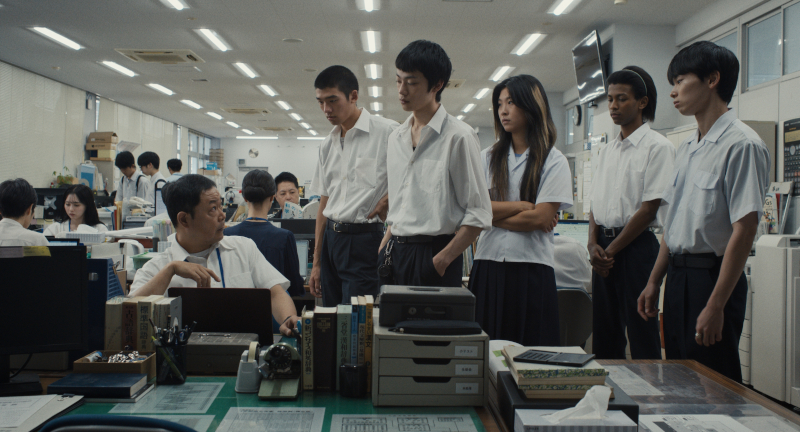
Sora redeploys the cinematographer Bill Kirstein (Mean Girls, Samantha Jayne, Arturo Perez, Jr, 2024) and editor Albert Tholen of his superb concert movie Ryuichi Sakamoto | Opus (2023) and while the former ensures the images constantly look classy – not so much a reflection on the film, just that overall it looks well shot – the latter is unable to save an ill thought-out script which attempts to turn the school into a microcosm of a society drifting toward the political right without really showing us enough glimpses of that wider society for it to make sense. The son of Ryuichi Sakamoto, Neo Sora was raised in both New York and Tokyo and would appear to have absorbed the very different cultures of both countries. So when Kou’s immigrant mother kowtows to the authorities, it’s exactly how numerous Japanese behave in numerous Japanese films; when Yuta’s native mother stands up to the authorities, it feels less a Japanese attitude and more an American one (although this is a Japanese drama).
I was reminded of three far superior Japanese high school movies: the character study of highschoolers trapped on school premises by storm conditions Typhoon Club (Shinji Somai, 1985), another character study of two high school dropouts Kids Return (Takeshi Kitano, 1996) and the brutal yet compelling high school gang drama Blue Spring (Toshiaki Toyoda, 2001). Far better use is made of the mobile phone earthquake warning system in Suzume (Motoko Shinkai, 2022).
There’s something highly depressing about seeing a director who made a terrific film in one genre (the music film) deliver a decidedly humdrum effort, which with a lot more work on the screenplay could have been something really special, in another (the Japanese High School movie). It’s made worse by the fact that this is very good in parts, not least the first twenty or so minutes. A great shame.
Happyend is out in cinemas in the UK and Ireland on Friday, September 19th.
Trailer (front end image contains spoiler):