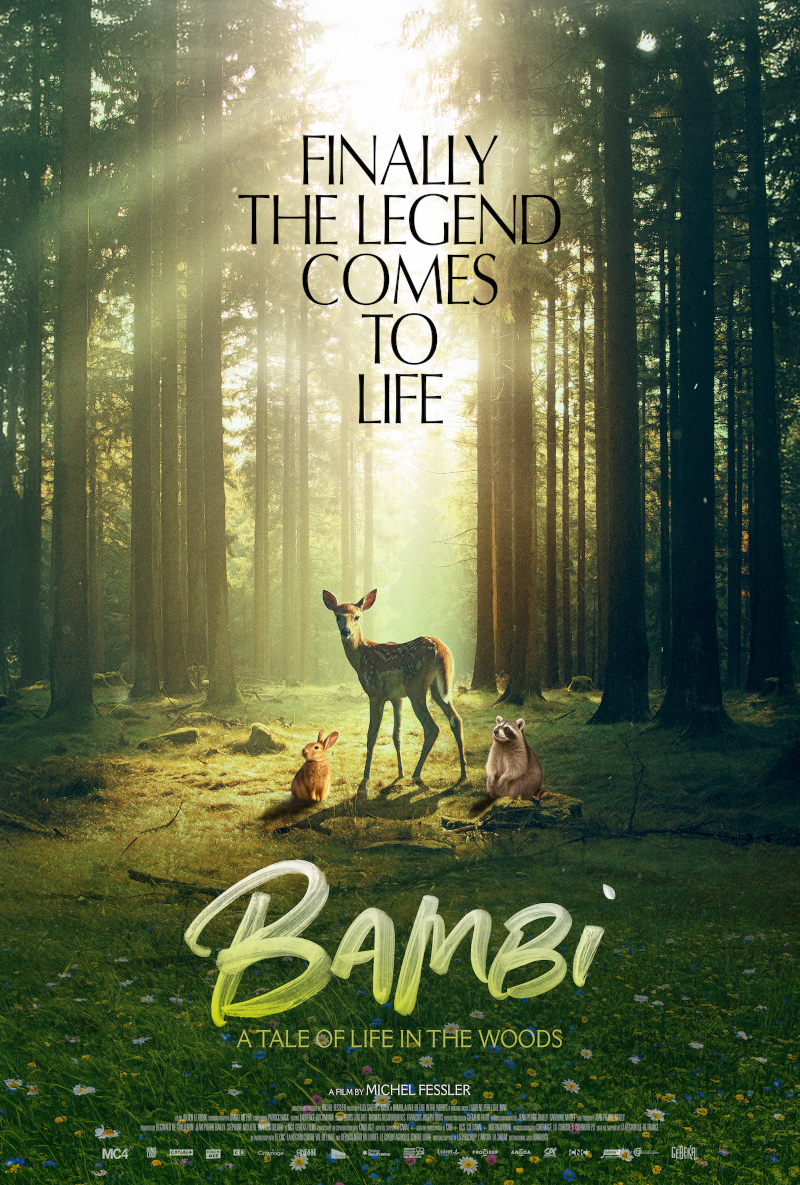
Director – Michel Fessler – 2024 – France – Cert. PG – 78m
*****
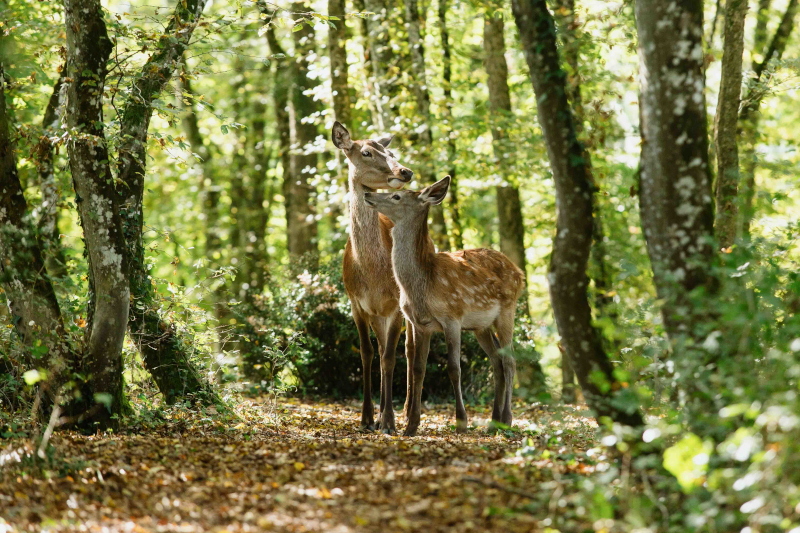
The woods. A faun is born, looked after by its mother, and learns to fend for itself – remarkable live action adaptation of Bambi, shot with real live animals, is out in UK cinemas on Friday, August 15th
It’s inevitable that any film adaptation of Austrian writer Felix Salten’s novel Bambi: a Tale of Life in the Woods will conjure the spectre of Disney’s groundbreaking, animated Bambi (David D. Hand, 1942). However, this French live action film (which opened in that country last year) takes interesting decisions from the get go. For a start it’s live action, so straight away we’re in the quasi-documentary area of animals being photographed, and it’s unclear to what extent these performers or their environments are being augmented by computer animation. (A couple of wide, establishing drone shots in the opening minutes, too far away to show animals, looked to this writer to incorporate CGI. But perhaps that’s just my imagination, and there’s little or perhaps no computer animation here.)
Then we have the addition of a narrator (this is the English language version, so the narrator (NAME) speaks in English – one would hope that the French soundtrack with on / off-able subtitles would be included on any forthcoming Blu-ray or DVD release, which perhaps might even have an option to switch the voice-over off altogether and just play the sound effects and the music, or even better, have a music only track available as well.)
That means the film isn’t quite as brave as that bona fide French documentary Heart of an Oak (Laurent Charbonnier, Michel Seydoux, 2022) which avoided voice-over and instead related its narrative in sound effects, music and even utilised the occasional popular song – and for which, it must be noted, Michel Fessler wrote the screenplay. This film will be recalled in a later autumn sequence featuring falling acorns and a red squirrel.
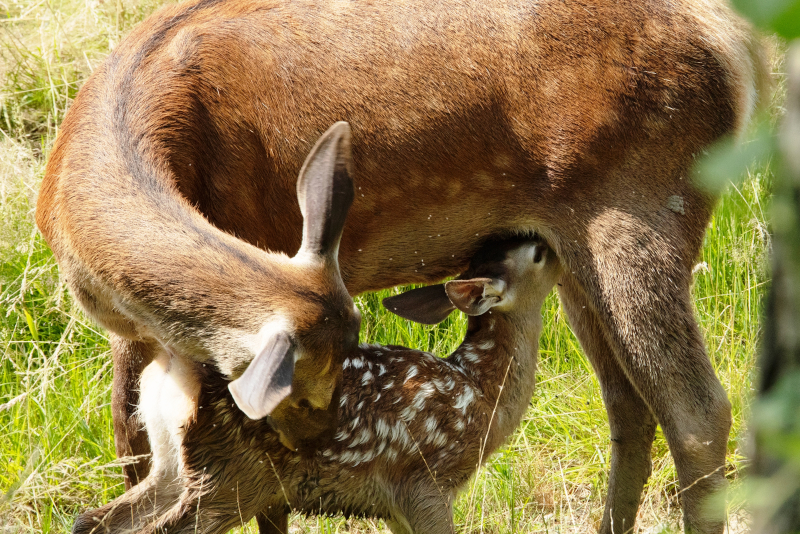
Barely has the film got going, with shots of Bambi being cared for by his mother, than an adder (incidentally, the UK’s one native poisonous snake, although this is shot in France) is spotted slithering through the undergrowth towards Bambi (by clever editing / juxtaposition of shots of the snake or the faun, with finally both appearing together in one brief, single shot) before the faun decides to run away back to its mother.
An early sequence in the rain (with no song!) will recall the Disney feature. And the raven (which caws naturally but is thankfully, like all the creatures here, never given a human voice) is cast by the voice-over narrator as Bambi’s guardian angel, loosely reminiscent of Jiminy Cricket, the central puppet character’s conscience in Disney’s Pinocchio (Ben Sharpsteen, Hamilton Luske, 1940). We’re barely 10 minutes in when the narrator sports the line, “In the meadow, they are exposed; humans are the danger” and most viewers will immediately remember the trauma of the Disney version in which, taking its cue from the novel, Bambi’s mother is shot by a hunter.
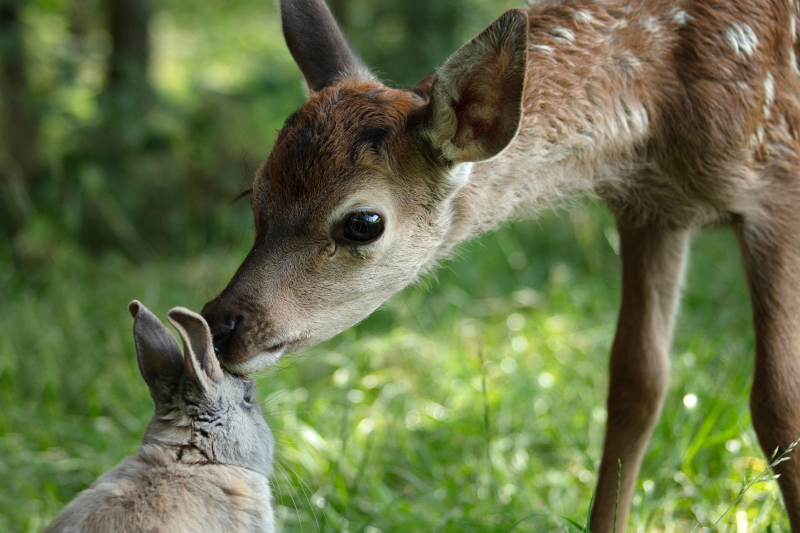
In the meadow, Bambi befriends a rabbit (again shades of the Disney film without the talking animals), but then danger appear in the form of an eagle, forcing the rabbit to bolt for its hole. Bambi sees other animals, such as a field mouse, and a raccoon which climbs a tree in futile pursuit of the ever-present raven. His mother wades across a lake, but Bambi is hesitant. He and his mother join up with her larger herd of deer in a meadow, where he gets matey with another faun and, running through the woods together, catches sight of his first human near a chopped woodpile.
As Summer continues, insects become a problem. And the sight of a snare hanging reminds the raven, whose ankle we now notice is damaged, of being caught in and escaping one. A dog with a collar appears, panting. Bambi flees, and it loses his scent when the faun crosses the river. A wolf, the dog’s ancestor, hunts Bambi in a brief sequence.
By six months, the white dappling has vanished from Bambi’s coat. All his life, his father has been watching over him. Bambi watches his father and another male, antlers in use, battle one another for the favours of a doe, something Bambi too will have to do in time. When the rabbit is caught in a snare, and neither Bambi nor the raven know what to do, his father appears and severs the snare with his antler, freeing the creature. As soon as the two fauns find their way back to the woodpile, and are chased – along with Bambi’s mother, who has come to their rescue – you know that Bambi’s mother is not going to make it out of the scene alive. Now Bambi must cope with the loss of his mother.
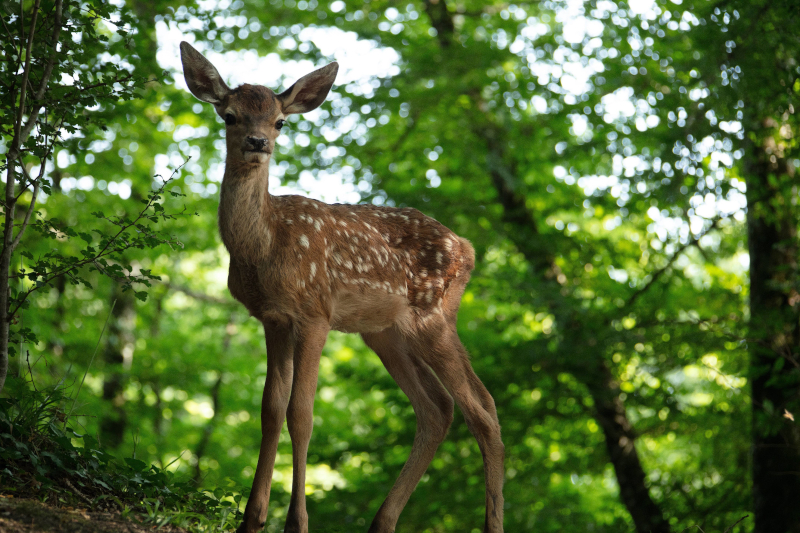
And so to winter. Bambi steps in a bear trap, but fortunately fails to get caught by it. (This is preceded by footage of a mouse crossing the same trap.) He gets a welt on his leg, though, so his father leads him to trees on whose trunks grow vegetation with restorative properties.
And in Spring, He must leave with his father to complete his apprenticeship. He will return to the forest, have a child of his own, and the whole story will begin all over again.
The whole thing gets the balance exactly right, and as an exercise in working with animals and getting them to act – thanks to the skills in this area of Muriel Bec and her company Animal Contact – it’s nothing less than remarkable. Disney’s 1942 film remains a touchstone, but the company has never attempted a live action version. It’s difficult to imagine them doing so without giving the animals human voice – not because it’s a good idea, but because it’s a hallmark of the Disney brand. This new, live action, French adaptation, going the non-voices route for the characters, is all the more powerful for the decision. Its feel for the natural world is striking.
Yet, Disney also had his animators study real animals and draw from life in order to capture their movements in drawn animation, while elsewhere his productions include such live action natural history projects as The Living Desert (Winston Hibler, 1953), which can’t quite shake off the need to anthropomorphise and turn natural history footage into cute characterisations with voice over. It’s an easy enough trap to walk into, and one that Bambi: a Tale of Life in the Woods adroitly avoids.
In short, this new film is an unmissable treat. If you’re so minded, it’s also absolutely suitable for children. Don’t miss.
Bambi: a Tale of Life in the Woods is out in cinemas in the UK on Friday, August 15th.
Trailer: