Directors – Kenichiro Akimoto, Yukinori Yakamura – 2025 – Japan – Cert. 15 – 86m
***1/2
A woman trapped in a repeating time loop dies fighting alien plant monsters, joins forces with a man in a similar time loop – animated science fiction tale is out in UK cinemas on Friday, February 27th
This began as a science fiction novel first published in Japan in 2004. Ten years later, as is the way of things in Japan, it appeared as a manga. It also formed the basis of the Tom Cruise / Emily Blunt vehicle Edge of Tomorrow (Doug Liman, 2014). The novel is about a cowardly military man killed in a skirmish with unexpected invading aliens who wakes up and realises he’s reliving that first day of the alien invasion. He gets killed over and over again, and wakes up and relives the same day over and over again. Similarly trapped in a time loop is a brave military woman fighting the aliens. It’s a military hardware alien action movie using the looped repeating day structure of Groundhog Day (Harold Ramis, 1993).
While I recommend the 2014 movie, and have no issue mentioning it in terms of contextualising the new film, I also recommend you put it firmly to one side and don’t try and base whatever expectations you might have about the new film on it. Because the new film is very, very different and you’ll enjoy it more if you watch with no such expectations. Although, like the novel and the Hollywood movie before it, it owes a lot to Groundhog Day.
For one thing, it changes the main character to the woman rather than the man. And, for another, it’s animated rather than live action. Rita Vrataski (voice: Ai Mikami from the upcoming Kohuko, Lee Sang-il, 2025) is very different from Emily Blunt’s no-nonsense woman of action. She has a shock of red hair. She seems to suffer from ennui, as does the culture around her.
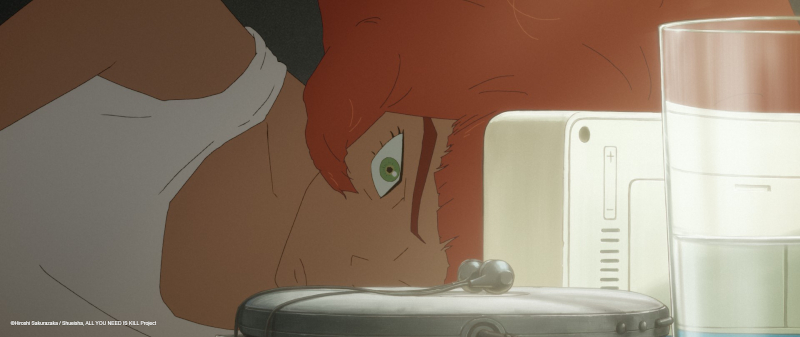
In her workday routine, Rita commutes by train from her small apartment to a canteen for breakfast. It’s not immediately obvious to what type of institution the canteen belongs – my first thought was a high school or a university, but when she sets out to work, it appears to be a form of manual labour. She is issued with an exo-skeletal suit, including protective clothing not unlike a space suit or perhaps a radiation suit, and a heavy power tool which appears to be a drill or perhaps a device for taking samples out of e.g. a giant plant stem.
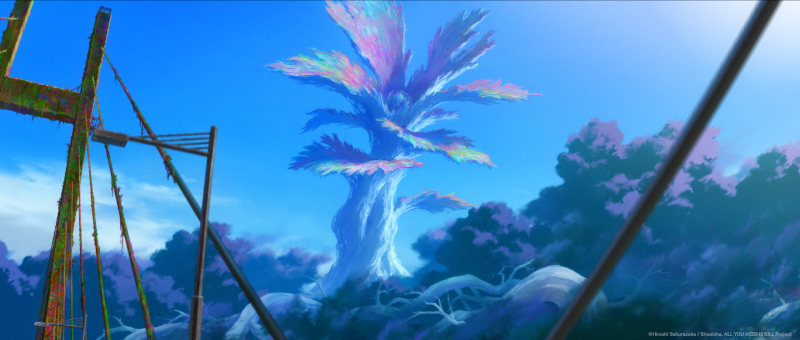
The term ‘plant stem’ is pertinent, because, as the big TV screen spewing the contents of a news channel reminds us, it’s been a year to the day since the giant alien plant Darol first appeared on Earth. (For Earth, read Japan since there periodically appear establishing shots of the Earth featuring Japan.) Darol has landed and spread out over a vast area of Japanese countryside like, to use a Western fairy tale analogy found nowhere in the movie, a giant beanstalk.
Rita’s job, like many of her similarly-tasked co-workers, is to climb up to one of Darol’s stems, four or five feet in radius, and drill holes or perhaps extract some samples (this isn’t especially clear, and since the exact nature of her task isn’t pivotal to the plot, we won’t worry about it).
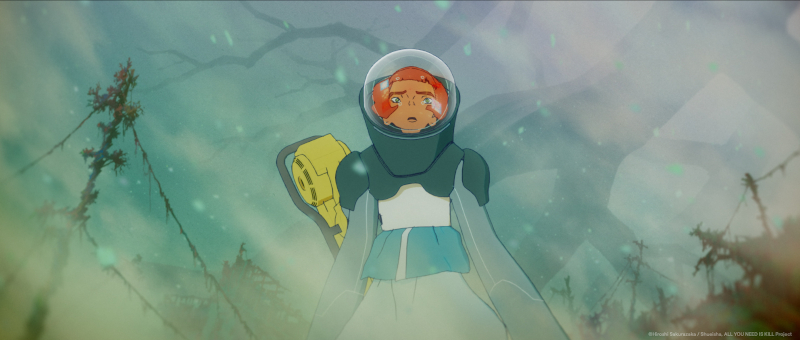
Warned of a pending explosion, her mind is elsewhere and the blast causes her to fall. She lands, is OK. Darol suddenly goes berserk and starts sending out hitherto unseen battalions of what appear to be a cross between walking sunflower heads on the one hand and malevolent bugs in the mould of both Starship Troopers (Paul Verhoeven, CG animation: Phil Tippett / Tippett Studio, 1997) and similar monsters in Edge of Tomorrow (2014). The sunflower head aspect has no obvious precursor – the creatures are nothing like the walking plants in The Day of the Triffids (novel, John Wyndham, 1951) apart from being walking plants; they are closer to the maw-type monster, the classic vagina dentata. She runs, trips over a bloody corpse. She sees a flower head-like maw engulf a vehicle. When the maw comes for her, she jabs her drill tool into it.
Her alarm wakes her up. The day plays out the same. Expecting the giant plant to come to life, she runs. But almost immediately, it strikes her down.
Her alarm wakes her up. At the canteen, she makes a speech, warning everyone about the monsters coming out of Darol. She is ridiculed. When she warns the foreman on the engineering shop floor, he has her forcibly taken to the doctor. She runs outside, finds a secluded corner of the exterior building, calls the police. Tells them the same thing. Asks them to send officers. They offer to send one. Then the signal is interrupted, the monsters attack. One comes for her.
Her alarm wakes her up. She steals a car. Drives away, but then the plant comes alive, the monster comes for her. Everything goes black. She tries catching a boat. The monsters swarm over the water. She contemplates suicide, hoping that might end it all. She remembers her mother’s cuddles, the abuse when she got older, then jumps off the side, sinks. She keeps repeating the day, writing the number of each successive day on her hand.
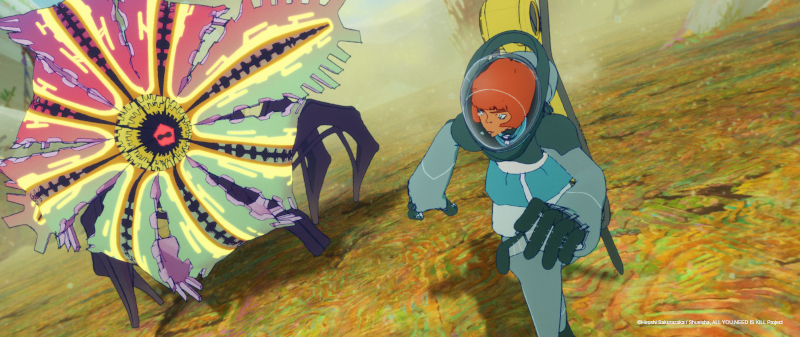
Eventually, she decides to take the offensive. She takes a blade. The blade breaks. Next time she tries with a bigger blade, an axe. She kills one. The next time, she kills more. She upgrades her axe to one so heavy she can barely drag it around; used against the monsters, it makes a highly effective weapon.
Day 92. She rants about meaninglessness and hits a window with a chair, cracking the glass. Avoiding a surveillance bot, she spots the suspicious Keiji (voice: Natsuki Hanae from Goodbye, Don Glees!, 2022; Fortune Favours Lady Nikuko, 2021), gives chase, and finds herself finding him at an abandoned observatory. It seems he, too, has been repeating the day for the last 92 days. And he’s noticed something. The first monster she killed emitted a red light, but none of the others did. So maybe the trick is to attack that one first…
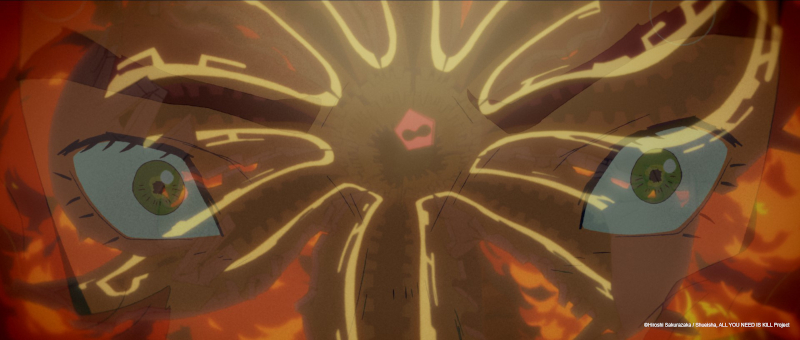
Rita is a complex character. She clearly has mummy issues – again, her flashes of memory are impressionistic rather than crystal clear. The very first shot has bubbles floating up from watery green depths, and later flashes appear to have had her mother – loving when she was a baby, less caring as the child grew – accidentally (or perhaps even deliberately… parts of the narrative are, too say the least, muddy) dropping her into deep water. This incident in Rita’s past is never resolved, but rears its ugly head at one point when, trying to outrun the monsters, she decides to jump off the side of a boat into the water.
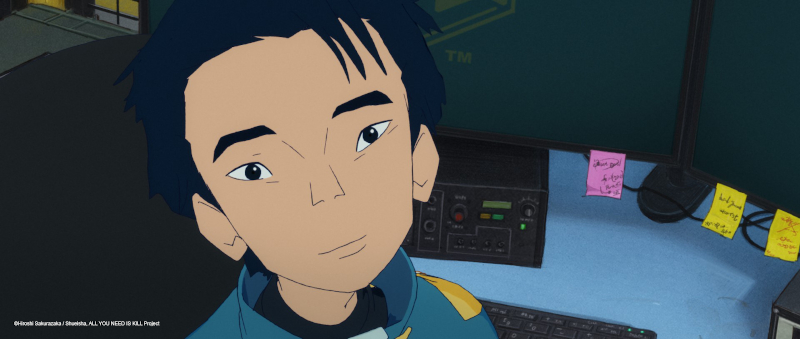
The equally complex Keiji (name anglicised and changed from first name to surname Cage in the 2014 movie) is, here, essentially a geek who would ideally solve all life’s problems from his computer, which he uses to, among other things, operate spybots to follow Rita and download programming into her programmable exo-skeletal suit to enable her to better defeat the monsters. When she finally drags him out to fight alongside her, he’s ill at ease with that situation. As Darol threatens to subsume both boy and girl towards the end, they are forced to fight one another as only one of them will be able to defeat the alien menace.
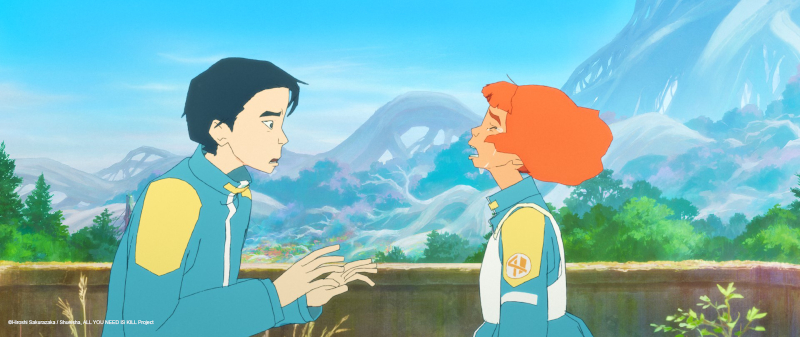
Although containing much intermittent action, the later part of the narrative essentially plays out as a romantic drama in a peculiarly Japanese mode, which seems to be couched in light science fiction trappings, of introverted boy and girl behaving deferentially to the member of the opposite sex with whom they are thrown into contact – see, for instance, The Tunnel to Summer, The Exit of Goodbyes, Tomohisa Taguchi, 2022; The Relative Worlds, Yuhei Sakuragi, 2019; Your Name, Makoto Shinkai, 2016). Which is why you shouldn’t go in expecting another Edge of Tomorrow, because despite sharing the same source material, the animated movie’s concerns are so very, very different.
Visually, the character designs are superbly idiosyncratic, with angular faces and, to the fore, Rita’s shock of red hair. Rita’s room, where she wakes up multiple times, and the works canteen she passes through every day, leave a strong impression, yet somehow the outside world infested with Darol and its marauding plant monsters never really engages the audience. Maybe it’s down to unfocused script and execution; I personally had very high hopes for this animated production, yet watching the whole thing, I felt distinctly underwhelmed.
All You Need is Kill is out in cinemas in the UK on Friday, February 27th.
Trailer: