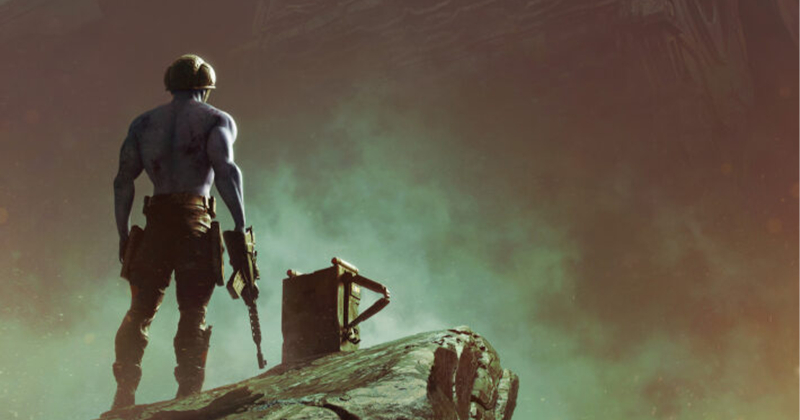
Director – Duncan Jones – 2026 – UK – Cert. 15 tbc – 90 m
*****
In the ongoing war between the North and the South, a small elite fighting unit is dropped onto the planet to clear the way for advancing forces – premieres in the Annecy International Animation Festival 2026 which runs from Sunday, 21st June to Saturday 27th June
To the uninitiated, Rogue Trooper was one of the staple strips of groundbreaking British comic 2000 A.D. I mention this because to a critic coming in cold to the script, where main characters are confusingly named as numbers like 19 or 27, it’s a near-impossible film to synopsise.
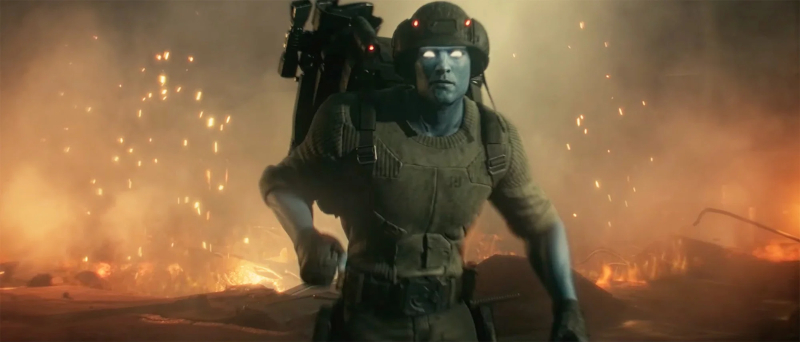
Which is not to say that there isn’t a plot – there most definitely is one – more that it’s difficult to sort out what’s going on from the get-go. Although this is essentially science-fiction, it may also represent one of the strongest, on-the-ground portrayals of the fog of war the cinema has given us, with much of the battlefield action quite literally shrouded in a permanent haze of smoke from gunfire and explosions.
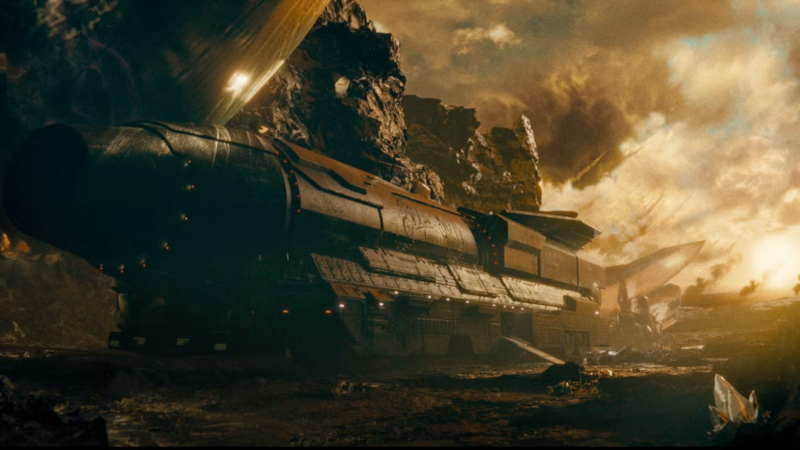
In addition, wider shots of views of the planet deliver impressive vistas which hark back to background painting effects in movies Forbidden Planet (Fred M. Wilcox, 1956) and the original Star Trek (Gene Roddenberry, TV series, 1966-69). Even though this is a world shrouded in pollution and drifting smoke or mist, skies suggest crystal formation of devastating explosions, often simultaneously.
The geo-political battle of the war in question is briefly sketched, with the fighting parties of Norts and Southers not especially well delineated beyond being them and us, but it doesn’t seem to matter that much.
Dropped in pods from the command mothership onto the planet’s surface to clear the way for advancing forces, the tiny crack squad of genetically modified, blue-skinned, human soldiers face the enemy and, before long, most of the squad are wiped out.
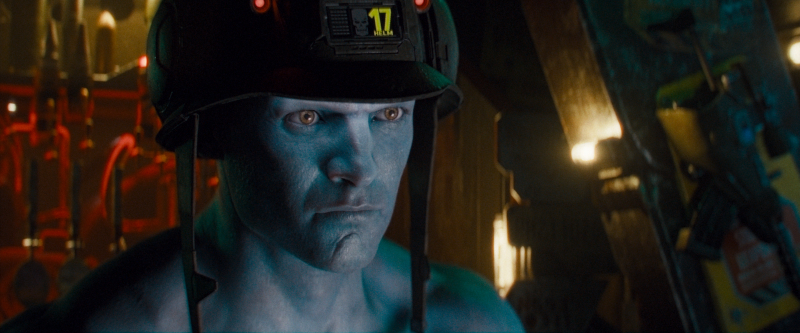
Which is not what you think: after being killed, these infantrymen have a very small window of time in which a memory chip can be removed from their skulls to be placed for preservation in a receptacles in various parts of trooper battlefield equipment for later transplant into a new trooper body held back at the mothership.
Soon, the only one left alive in the body which he landed with is 19 (voice and mocap face: Aneurin Barnard) whose journey through the battlefield and concurrent search for a suspected traitor somewhere in the command structure respectively form the spine of the narrative and drive it forward.
The character of 19 is the only one who runs through the whole film, at least in full human form; other characters pop up then disappear throughout in episodic fashion. Thus, we are presented with assorted other characters from the comic book.
These include three of 19’s fallen comrades whose memory chips have been successfully implanted into receptacles in his backpack, gun or helmet) and whose names Bagman (voice: Reece Shearsmith), Gunnar (voice: Jack Lowden), and Helm (voice: Daryl McCormack) reflect their new locations. Some are briefly seen alive before their chips were implanted, although in the opening scenes, apart from the commanding figure of Rogue, it’s often hard to tell who’s who and these characters become more distinctive following implantation.
Grisly scenes (the whole thing is actually pretty bloody and violent) include the scalping of a dead colleague’s head to access his chip and put it into a suitable receptacle in time. Some of these attempts by 19 work, and some are unsuccessful. There’s no guarantee that a chip will always be transplanted: it requires the swift action of a battlefield operative to make it happen.
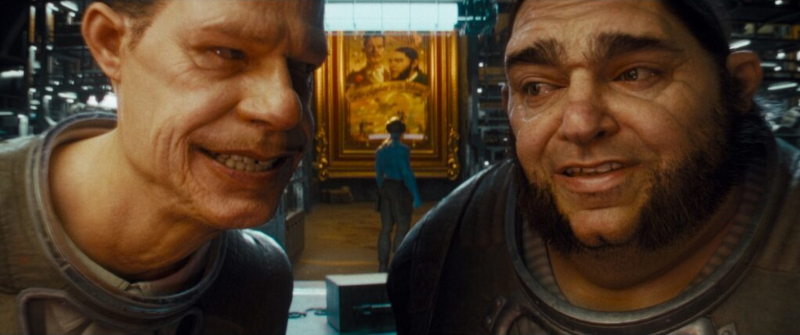
Non-partisan and therefore potentially treacherous scavengers Mr. Brass (voice and mocap face, or vamf: Jermaine Clement) and Mr. Bland (vamf: Matt Berry) provide a memorable double act. Venus Bluegrass (vamf: Hayley Atwell, adding no-nonsense, kick-ass heroine to her already impressive CV), who doesn’t appear until the film’s final third, joins the pantheon of action heroines featured in The Terminator, (James Cameron, 1984); Nikita,) Luc Besson, 1990); Ghost in the Shell, (Mamoru Oshii,1995); The Matrix (The Wachowski Brothers, 1999), and numerous 1980s Hong Kong actioners.
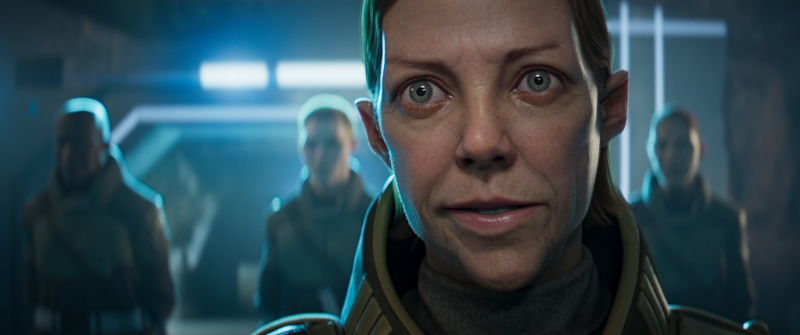
Various top brass types including Colonel Logan (vamf: Diane Morgan) are also given screen time, one or two of them turning out to be pivotal to the outworking of the plot. The vamf cast also features Sean Bean and Asa Butterfield along with British comedic talents Alice Lowe, Adrian Edmonson, Al Murray and Henning Wehn. As in A Grand Day Out (Nick Park, 1989), there are no concessions whatsoever to making the accents easy to understand for an American audience, a feature likely to prove an asset in the UK where indigenous viewer are likely to respond favourably to broad Welsh, Scots, and other accents.
The trick would be to release the film in the UK first, and letting it garner the enthusiastic reviews it’s likely to get, along with non-English speaking territories where such accents are unlikely to be a problem when subtitled. Hell, we Brits have endured US accents in movies for years, and it hasn’t put us off: why should the Americans be any different? (Just look at the Yanks’ fascination with the Yorks / Lancs border in Wallace & Gromit: Vengeance Most Fowl, (Nick Park, Merlin Crossingham, 2024) which probably wouldn’t have happened had Park not stuck to his guns on the first W&G film.)
Special effects movies made on a wing and a prayer are all too often terrible, with the feeling of the money running out before anyone got started. That, happily, is not the case here. Duncan Jones’ debut Moon (2009) demonstrated his ability to get to grips with an aspect of movie effects technology new to him – in that case the kind of vehicular model work pioneered by Gerry & Sylvia Anderson in such seminal SF puppet TV series as Thunderbirds (1965-66), Captain Scarlet and the Mysterons (1967-68) and UFO (1970-71) – and he pulls off a similar trick here with motion capture technology, working out how to put his vision of the property on the screen without always knowing precisely where he’ll end up, and going through a number of proprietary software programmes starting with Unreal Engine 5 to get there.
The anarchic nature of Rebellion Studios, the Oxford, UK-based, production facility of the Studio that owns, publishes and is understandably fiercely protective of the 2000 AD brand and its various properties probably helped in that they’ve clearly been prepared to back Jones’ vision of making something on the cutting edge of movie technology.
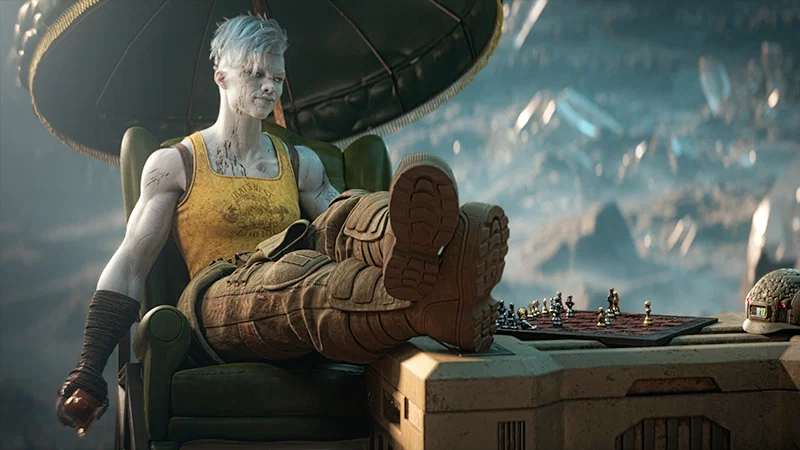
The strange thing is, you’re watching a movie you know to be motion capture, and yet where something like the groundbreaking-in-its-day Final Fantasy: the Spirits Within (Hironobu Sakaguchi, Motonori Sakakibara, 2001)feels like an animated movie, watching Rogue Trooper, so effective is the manipulation of the characters by the team of animators imbuing them with life that you keep forgetting it’s mocap to read it rather as real actors performing in an environment heavily augmented by special effects.
Provided it is marketed correctly by a team that genuinely understands the film – and that’s a huge caveat – this movie will be huge in the UK. That achieved, the world of non-English, international film distribution should be its oyster, and after that, success in the US only a matter of time.
This is a film which plunges you into a disorienting, battlefield other world which, thanks to Jones’ shrewd vision and the emotionally engaging central mocap performance of Barnard, pulls you along with it emotionally. An extraordinary and altogether remarkable piece of work.
Rogue Trooper premieres in the Annecy International Animation Festival 2026 which runs from Sunday, 21st June to Saturday 27th June.
Teaser trailer: