Director – Go Furukawa – 2025 – Japan – Cert. N/C 15+ – 125m
****
An ex-con runs a service delivering clothing, other supplies and messages from loved ones to convicted prisoners – plays UK cinemas in the Japan Foundation Touring Film Programme 2026 which runs from Friday, 6th February to Tuesday, 31st March
A young mum, babe in arms, takes bags for her husband to a drop-off facility / creche so she can visit him in prison. The helpful assistant informs her that the commissary will be unable to accept most of the contents of the bag – basically, any clothing other than underwear. And off she goes for a prison visit with her husband, who has anger management issues and takes out on her the fact that she failed to visit last month, telling her, “it’s easy for you to abandon me.” His unabated rating and verbal abuse eventually drives her to a primal scream before she walks out, leaving him to ask, redundantly, after she’s left, if their child has been born yet.
His visit isn’t from her but the self-announced “Kaneko from Hosoda’s Commissary”, who has a deliver from his wife; divorce papers to sign. He retaliates with death threats.

The Commissary is a small business Shinji Kaneko (Ryuhei Maruyama) runs from his typically modest home with his wife Miwako (Yoko Maki), helping relatives of convicted prisoners navigate the rules and regulations of Japan’s prison system so that they can deliver items to their loved ones.
From time to time, his mother Yoko (Yuko Natori) visits the home, usually when he’s not there so as to borrow (.i.e. be given) money from his wife, something the latter willingly does as a dutiful daughter-in-law even though her husband disapproves and thinks, probably rightly, that his mother is just taking them for a ride. She always seems to be pursuing some man or other, and has been doing so for as long as Kaneko can remember.
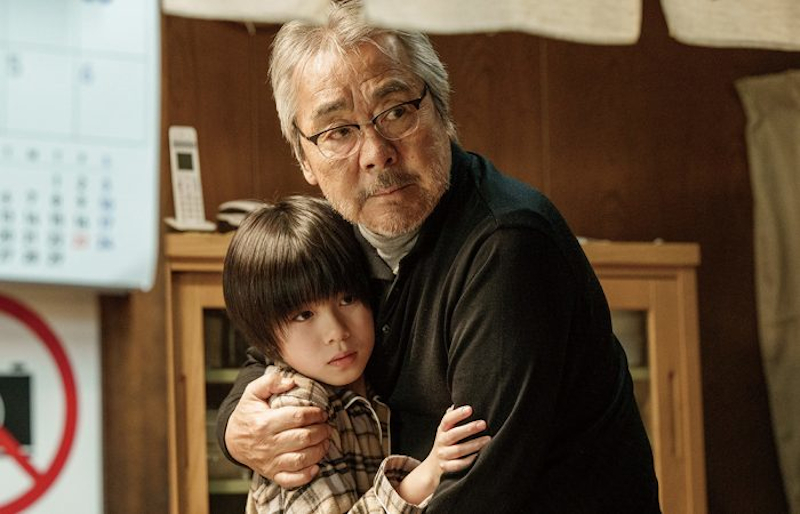
By way of contrast, Tatsuo (Akira Terao), a genial elderly relative of Miwako’s, lives with the family.
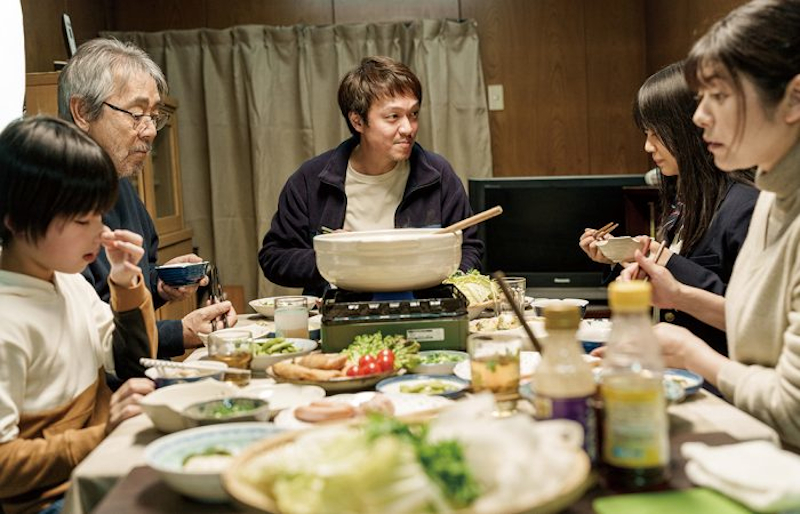
The couple’s son Kazuma (Kira Miura) is a well-adjusted, happy child who attends a local primary school and has an equally likeable best friend there, a little girl named Karin (Risa Kaneko). Kazuma finds his world rocked when she disappears. After a search in which Kazuma’s parents and various local people take part, her body is found. She has been murdered. It’s an open and shut case, and the perpetrator is caught.
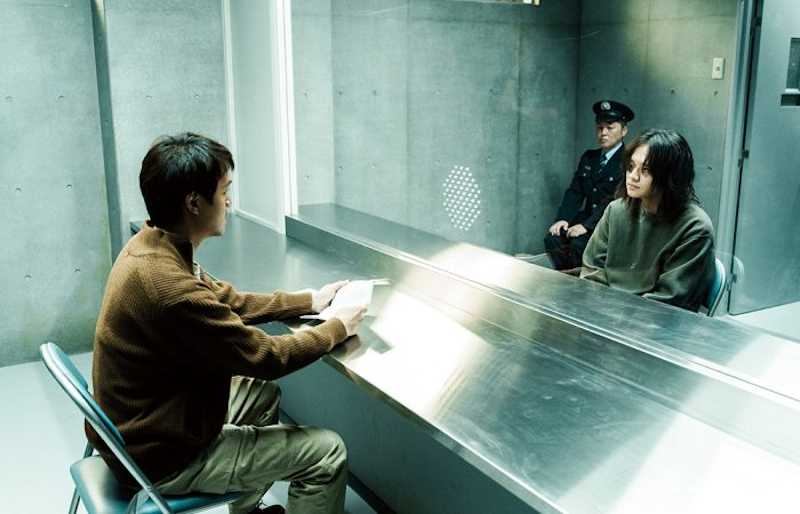
Kaneko is approached by Kozue Kojima (Toshie Negihshi), the distraught mother of the killer Takashi Kojima, to deliver some items to the latter in prison, out of which the only permissible one is a blanket from the boy’s childhood, and a letter for Kaneko to read to him. When Kaneko encounters Takashi (Takumi Kitamura) through the glass of the prison interview room, the teenager isn’t interested in the letter, rejects the blanket, and talks about taking unilateral revenge on a society which has rejected him. He lacks any sense of remorse. He talks about how any group of ants have 20% of their population who won’t work. Remove any portion of that population, and 20% won’t work. He identifies with that 20%, and his story makes clear that he doesn’t regard that group as rational.
Seeing scuff marks on Kazuma’s school bag and finding writing all over pages of one of his class textbooks, Kaneko realises his son is being bullied, ans storms into the school classroom to sort out the problem, assaulting a teacher and having to be restrained. A horrified Kazuma witnesses the incident.
Outwardly a gentle, quiet man, it emerges that Kaneko has has apparently got himself into such situations before, and, indeed, spent time in prison as a result. This is part of his motivation for his current career, helping prisoners rejected by society at large, coupled with the fact that few other employment opportunities are open to former convicts such as himself.
In his numerous prison visits, Kaneko inevitably runs into teenager Sachi Ninomiya (Mana Kawaguchi) at the welcome counter, who is trying to meet with Tetsu Yokokawa (Goro Kishitani), incarcerated Yakuza member and killer of her late mother, in an attempt at achieving some sort of closure. Usually, Sachi is the person in Kaneko’s way as he’s trying to deal with the official on duty behind the counter; eventually, however, he comes to her help and takes her under his wing, both securing her an interview with the killer and taking her on as an assistant at his commissary to give her some sort of purpose in life.

Kaneko’s lot, as portrayed, is not a particularly easy one, and while he largely has his own personal demons under control, they occasionally surface and get the better of him. Still, most of the time he appears to have successfully made the transition from prisoner to reasonably well adjusted member of society, which is clearly a good thing. Occasional outbursts aside, as performed by Maruyama he feels like someone you could trust.
It’s not clear that everyone in his neighbourhood feels the same way, given the recurring motif of a newly smashed plant pot in the group of potted plants situated just outside Kaneko’s front door.
This is a strangely affecting and engaging little film, in part down to Furukawa’s writing and direction of the main character and Maruyama’s performance, which tackles a particular social problem without ever falling into the trap of trying to make a manipulative, worthy film about it. Recommended.
Kaneko’s Commissary plays UK cinemas in the Japan Foundation Touring Film Programme 2026 which runs from Friday, 6th February to Tuesday, 31st March. #JFTFP26
This year’s programme has the overall theme:
Knowing Me, Knowing You – The True Self in Japanese Cinema