
Director – David Nicholas Wilkinson – 2025 – UK – Cert. 12a – 114m
****
The Parthenon Marbles – were they stolen from Greece, and should they be sent back? – Opening Night Film (World Premiere) Central Scotland Documentary Festival in Stirling, Scotland on Thursday, October 30th; out in UK cinemas on Thursday, November 6th.
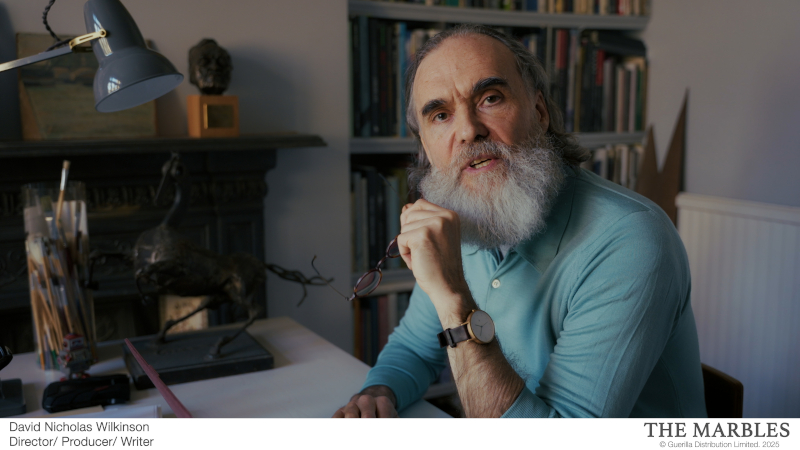
This starts with director Wilkinson, who previously made the excellent Getting Away With Murder(s) (2021), writing a letter to the Head of the British Museum asking him for an interview outlining the Museum’s position on the Parthenon Marbles. He never receives a reply.
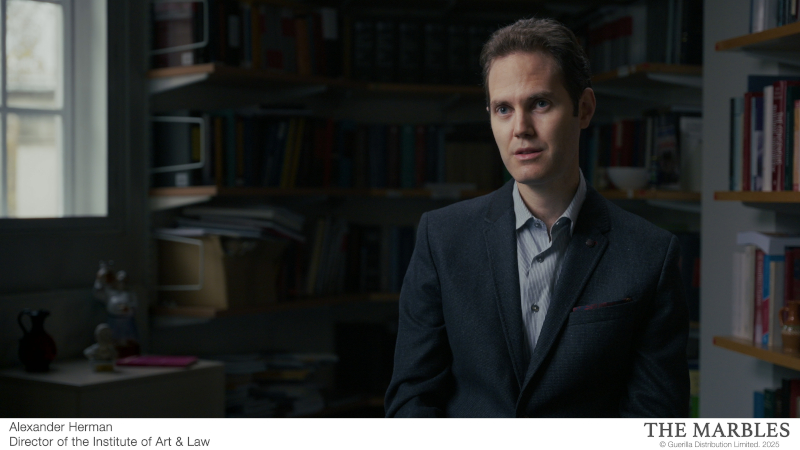
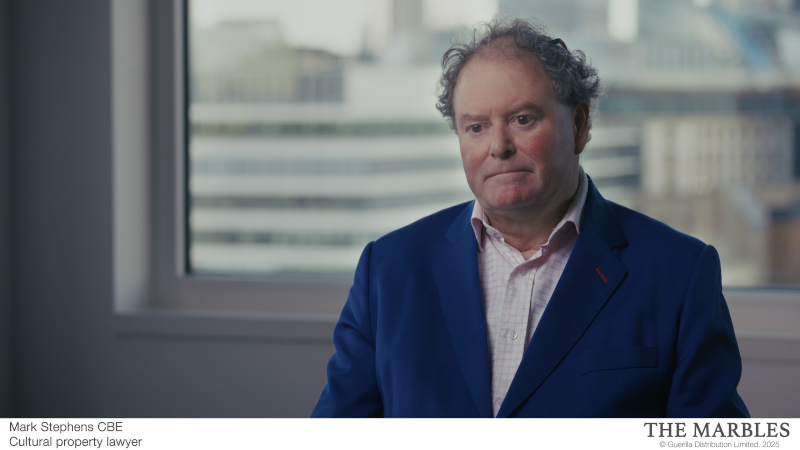
The historical and legal background is helpfully unpacked by Alexander Herman, a historian and legal expert who has written and spoken widely on the Marbles controversy, and Mark Stephens, the UK’s foremost Art & Cultural Property lawyer.
The eponymous Marbles were Ancient Greek statues and artefacts removed from the Acropolis in Athens by Lord Elgin in the early part of the 19th Century and brought over to England to adorn his newly built stately home in Scotland. In 1816, following a Parliamentary debate on the matter, they were purchased from Elgin by the British Museum where they have resided ever since, on display to the public.
Following four years around the turn of the century as ambassador to the Ottoman Empire, of which Greece was then a part, Elgin secured unprecedented access to the Acropolis which permitted him to hire artists to draw, make casts of and dig around the artefacts. The legal basis of this was a document known as a Firmin, although today there is considerable debate as to whether that document – which appears to survive only in the form of an Italian copy made by Elgin’s priest (!) – is genuine or even existed in the first place. All such documents were written with reference numbers in scrupulous numerical order, yet there is no copy of it or any obvious gaps in the Ottoman archives.
Finding many of the artefacts strewn around the Acropolis site, Elgin took it upon himself to bring some 400 of them back to the UK for safekeeping, using the Firmin as proof of his legal right to do this. Then, as now, this argument appears highly contentious. For just over 200 plus years, the British government has taken the attitude that since the Marbles are in the UK, they can stay here. Possession being nine tenths of the law.
However, this view fails to take into account the fact that, without wishing to put too fine a point on it, these objects were plundered from a foreign culture; they were, effectively, stolen goods, so the fact that the British government paid for them isn’t a convincing argument that it now owns them.
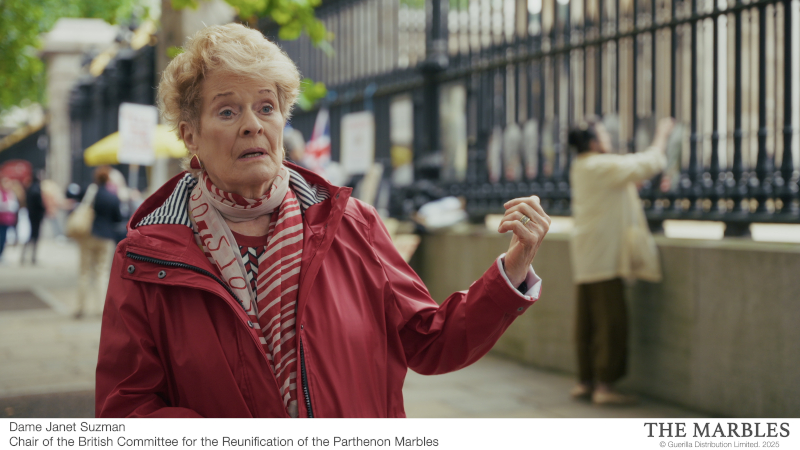
Actress Janet Suzman is the chair of BCRPM (British Committee for the Repatriation of the Parthenon Marbles), who every year stage a protest at the Museum. Lest you think the documentary is one-sided – which it is, in the sense that it’s very much taking the not unreasonable line that a great wrong has been done which needs to be righted by the return of the Marbles to Greece – other interview subjects include historian, journalist, author and barrister Dominic Selwood who wants arguments to be heard from both sides. He himself is a passionate believer in the institution of museums in generally, and is more in favour of their being able to display artefacts, regardless of how they were acquired, than he is about repatriating them.
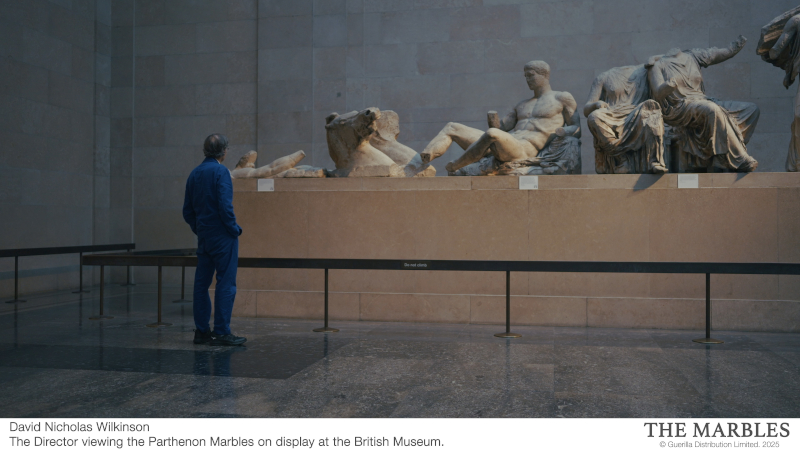
Although the Marbles are probably the best known case of one country removing cultural artefacts from another, it is by no means the only one. In 1860, as an act of revenge for the killing of British envoys, the palace at China’s Yuanmingyuan was ransacked – and artefacts removed. They ended up in some 47 museums around the world. The perpetrator was the next Lord Elgin, the son of the one who took the Marbles. Like so much else in the UK’s chequered history, this is not great PR for its rich and privileged members.
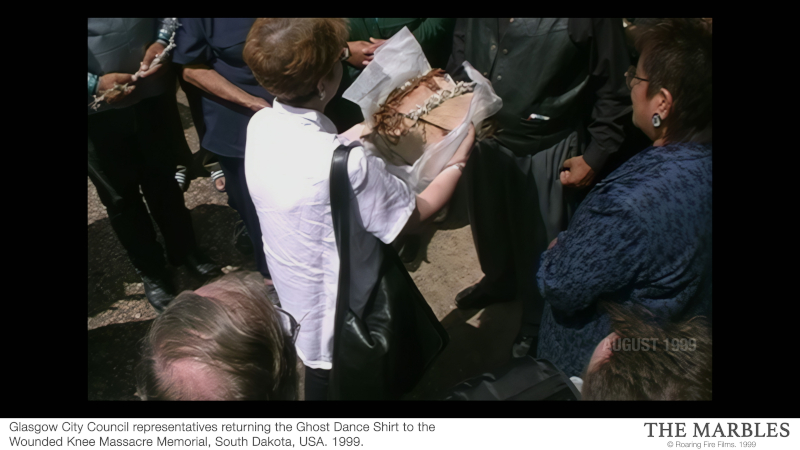
A ghost dance shirt removed from the corpse of a native American at the Battle of Wounded Knee turned up in Glasgow, Scotland’s Kelvingrove Art Gallery and Museum. It was spotted in a 1992 exhibition by a visiting Lakota lawyer, and following subsequent negotiations was returned to the tribe in 1999.
The narrative moves, as it were, sideways in order to further explore this trend. The Parthenon Marbles being the highest profile case of this kind, it’s perhaps not surprising that other smaller, less controversial cases have been satisfactorily resolved first, with artefacts returned to their place of origin. Hopefully, the Marbles returning to Greece is only a matter of time.
Time is something director Wilkinson not have. Although he has been working on this film one way or another since 2008, he has recently been diagnosed with Stage Four Bowel Cancer. For the benefit of those unfamiliar with the disease and its terminology, Stage Four is, broadly speaking, terminal. With a degree of hesitancy, he incorporates his medical situation into the last ten or so minutes of the piece. He has been hitherto acting as bearded presenter and interviewer throughout, but suddenly the beard is gone.

Gone too is the director’s ability to travel, and, specifically, to fly. His plans to visit Greece and shoot there go out of the window. Nevertheless, despite this, Wilkinson has completed his documentary.
The film has one more ace up its sleeve: a sequence which takes place just after the COVID lockdown in which everyone is wearing face masks. This may seem a strange feature to highlight, because it’s not really what the main thrust of the film is about; however, I for one am sick of a movie culture where it’s as if COVID never happened. The only other film I can think of that unashamedly represents COVID mask-wearing in this way is Bad Luck Banging or Loony Porn (Radu Jude, 2021), although I’m sure there must be other examples I’ve not seen.

Also interviewed is actor Brian Cox (who played Agamemnon in Troy, Wolfgang Petersen, 2004) while Paul McGann voices Lord Byron, one of Elgin’s many contemporary detractors, and, in the briefest of one-line, voice artist performances, Miriam Margolyes, who delivers the words of the Scotswoman who interrupted a chaired discussion on the issue with a memorable, “Oh, for God’s sake, just give ‘em back!”
Going in to this movie, the Parthenon Marbles and their history were not something I knew much about, and I found the whole thing a useful primer on both the expected subject and the wider context of cultural artefact theft.
The Marbles is the Opening Night Film (World Premiere) Central Scotland Documentary Festival in Stirling, Scotland on Thursday, October 30th; out in UK cinemas on Thursday, November 6th.
Screenings info here.
Film website here.
Trailer: