Director – Matías Szulanski – 2025 – Argentina – 78m
*****
A moneylender’s difficulties getting money owed back from clients on time cause his heart to play up – premieres in the Critics’ Picks Competition of the 29th Tallinn Black Nights Film Festival
It’s a lovely Summer day. Jorge (Fabián Arenillas) is out on the street, getting up again, gathering his briefcase. What happened? A blackout? A heart attack?
The camera follows him from behind as he enters a modern building. In the hairdresser’s, the owner asks him to come back later as he’s busy with a client. A cigarette on the go, stopping for a glass of Coke, he makes his next call. When the door opens, it’s the client’s son, who turns out not to have nearly enough money to make a significant payment.
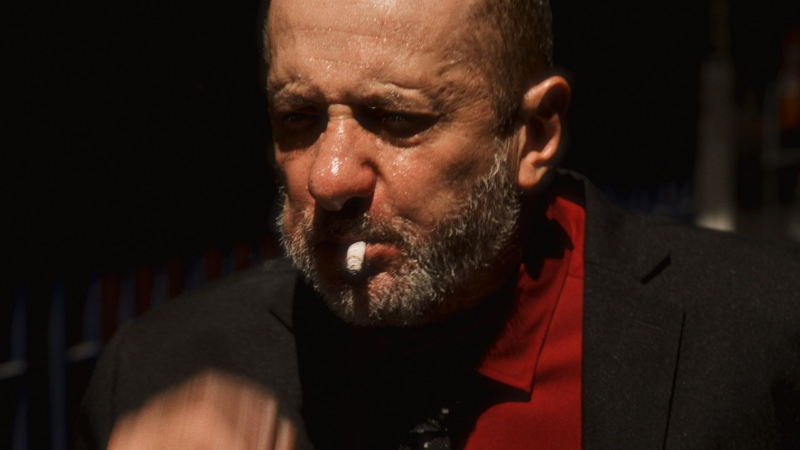
He returns to the hairdresser’s, where one of the customers heaps abuse on him. If what he had at the start was a heart attack, it’s not hard to see why. Jorge leads a highly stressful life.
Wherever he goes, he seems to want to extract money from people. A phone call to Diana (Tamara Leschner) leads to a quick meeting where he picks up $124 000 and gives her an invoice. He phones a prostitute’s card to check the going rate, then negotiates a better deal with Fran (Inés Urdinez) who is in the process of upscaling by buying a place out of town in Ricoleta.
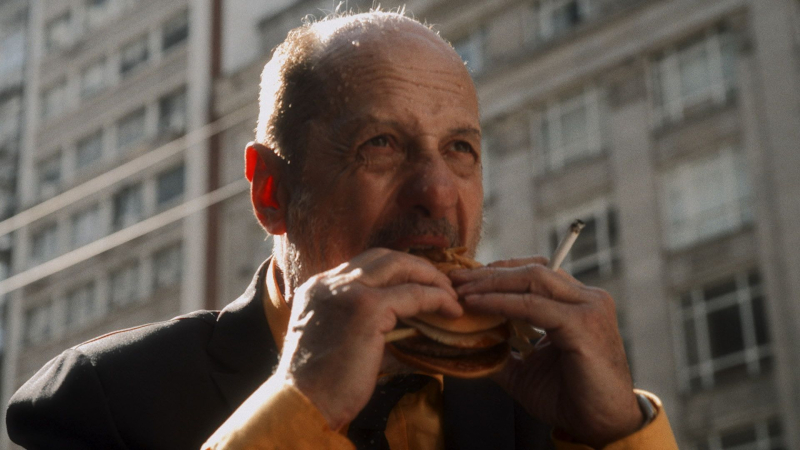
Back on the street, he accompanies another cigarette with a swiftly consumed burger, fries and ketchup on the go. He meets Flo (Sol Masaeda) who gives him $12 000.
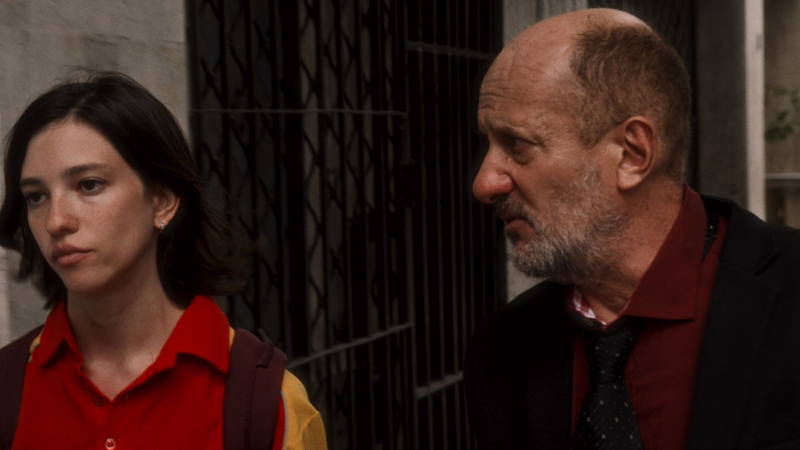
He tracks down his estranged 28-year-old daughter Romina (Lara Szlain), whose Shell hat indicates she’s working at a garage, to celebrate her birthday, improvising a cake from a burger and a candle, but she doesn’t want to know. She has won a scholarship, but lacks the money to pay for it.
Talking to people, he learns he is no longer working for Carlos. When he physically finds the latter, Carlos (Pablo Ragoni) tells Jorge about the $6 000 of his money Jorge lost. Jorge offers to get the money back in exchange for his job, getting the reluctant Carlos to shake on it. Carlos gives him two days.
He goes to see his ex-wife Gloria (Anamá Ferreira) in another attempt to borrow money, but she won’t have any part of it, explaining to him that she isn’t lending him any money because it’s her way of helping him.
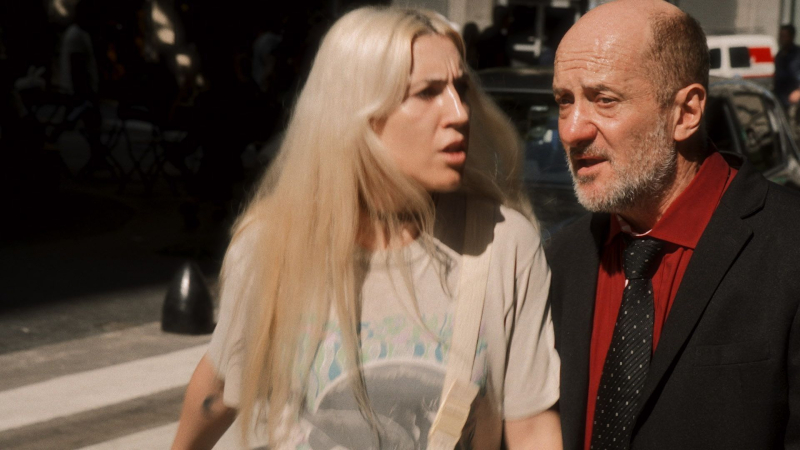
Things are not looking good when he has a stroke of luck in the form of someone else’s misfortune: he runs into Fran again, furious because it turns out that the guy arranging her new flat, to whom she paid a hefty deposit – all her savings – has scammed her. But she knows where he lives, so Jorge, feeling this is in his line of expertise, offers to help her, going there with her. However, she does most of the talking – she delivers a torrent of hard, no-nonsense verbiage – but all they can get is $10 000 and a Rolex.
Jorge offers to fence the Rolex if she’ll let him take the £10 000 as his cut. She agrees. He promptly delivers $4 000 to his daughter, who takes the money but says she still hates him, and $6 000 to Carlos. But then the Rolex turns out to be fake; saying he wants to do the right thing, Jorge decides to get the $6 000 back from Carlos, but Carlos is nowhere to be found…
As their situation becomes increasingly desperate and they go in search of something further to sell, the pair find themselves in possession of a box containing a snake…
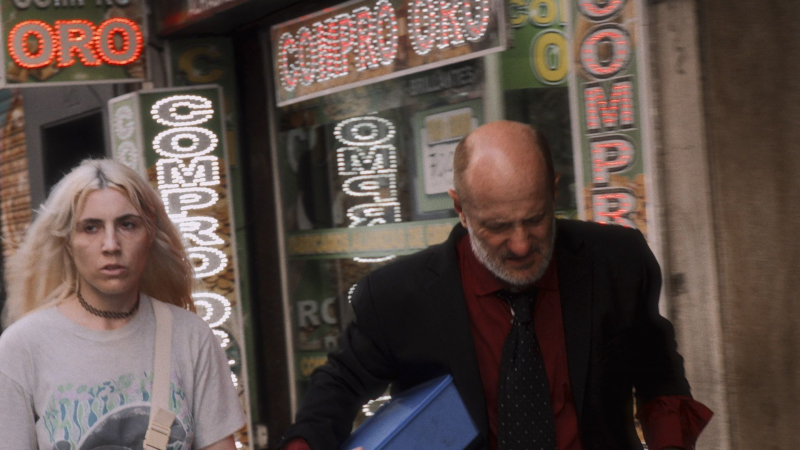
The mean streets of Buenos Aires are filled with people trying to get by, like the young man constantly cornering Jorge to sell him cut price socks, or the cabbie trying to take Jorge on a roundabout route so he can charge an increased fare.
Jorge is caught in an unsustainable lifestyle, a middle-aged man working in what is essentially a young man’s game, and his body can’t take it any more. He is scarcely helped by the string of broken or soon to break relationships with women.
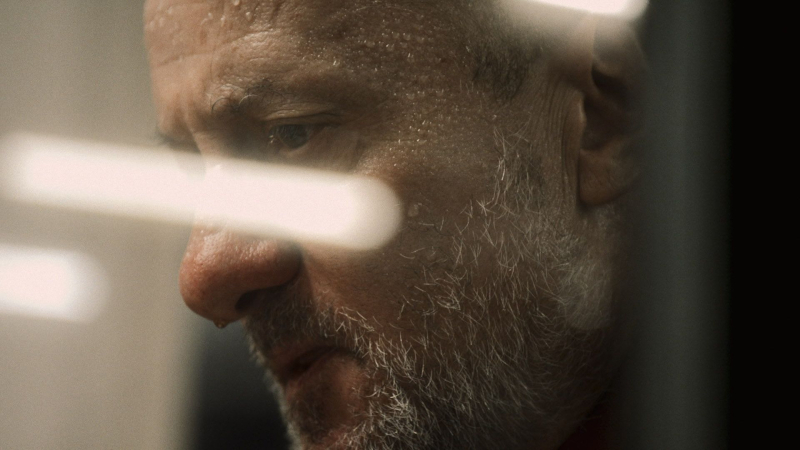
Szulanski directs and lead actor Arenillas performs all this with the interrupted, non-stop energy of the protagonist whose body is giving out, indeed whose body has given out in the first few, opening frames (we never see the initial heart attack, just its immediate aftermath). Later, he has another heart attack, staggering along streets of pulled-down shutters, of shops which have metaphorically closed for the day much as his own body is rapidly shutting up shop.
The supporting cast, who by the nature of the narrative structure appear on screen then leave, one after another, are terrific, particularly Ferreira as the ex-wife, Urdinez as the scorned, scammed whore and Szlain as the estranged daughter. The overall energy recalls the cornered drug dealer of Pusher (Nicolas Winding Refn, 1996), but Jorge is a much older man with accompanying health issues as everything closes in around him, and the narrative here consequently has quite a different feel.
It also ties in with the hostile urban environments of both Mo Papa (Eeva Mägi, 2025) and China Sea (Jurgis Matulevičius, 2025) elsewhere in this year’s Critics’ Picks strand. Except that this is Argentina, the opposite side of the work to the Baltic States, suggesting that the wider world, too, is currently succumbing to a form of dog-eat-dog global malaise as everyone out there just struggles to get by and keep their head above water, not always successfully. Truly impressive stuff.
A Summer Tale premieres in the Critics’ Picks Competition of the 29th Tallinn Black Nights Film Festival which runs in cinemas from Friday, November 7th to Sunday, November 23rd 2025.
Trailer:
Critics’ Picks mashup trailer:
Festival teaser trailer: