Director – Pablo Behrens – 2026 – UK – Cert. 12a – 61m
*****
London’s Thames Estuary filmed and edited from the point of view of an alien – out in UK cinemas on Friday, April 24th
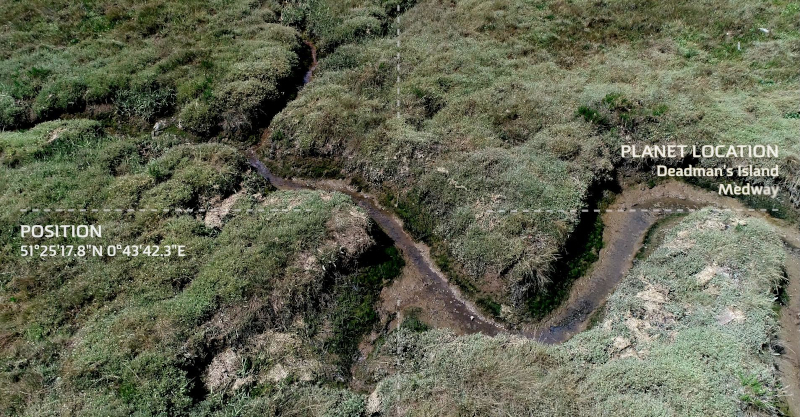
A genre bender of a documentary, this owes a great deal to Petropolis (Peter Mettler, 2009) which comprises aerial cinematography of the environmental wreck of Canada’s Alberta Tar sands. The subject of London’s Last Wilderness, however, is not an ecological catastrophe, however much its narration by intertitle might (mis)interpret it as the aftermath of a war zone. It is rather the estuary of the Thames, the river that further inland flows through London, which city puts in a brief appearance towards the end. Indeed, insofar as this has a narrative spine, it is of a journey from the largely uninhabited estuary inland to the metropolis itself.
Where Petropolis was shot largely from a helicopter by a cameraman, the results recalling nothing so much as the aerial footage that opens The Shining (Stanley Kubrick, 1980) and closes (because they bought the rights to it) Blade Runner (Ridley Scott, 1982), aerial photography has moved on considerably in the last fifteen of so years with the evolution of drones, today a major part of the filmmaker / cinematographer’s arsenal. The drone cinematography in London’s Last Wilderness has a completely different feel to the aerial photography of Petropolis – the shots (or at least, the edited portions of them which we see here) feel not as if someone is there guiding the camera, but rather as if someone has set up the drone camera trajectory to see what footage would result from that particular flight path.
Where Petropolis allowed the footage to speak for itself, London’s Last Wilderness introduces a commentary that sounds like the comms conversations from NASA’s Apollo missions of the 1960s and 1970s, complete with radio beeps every so often. Except that, although the commentators (mainly a male, but he is occasionally interrupted by a female) inexplicably converse in perfect British English, they are aliens on some sort of reconnaissance or exploratory mission trying to make sense of what they see.
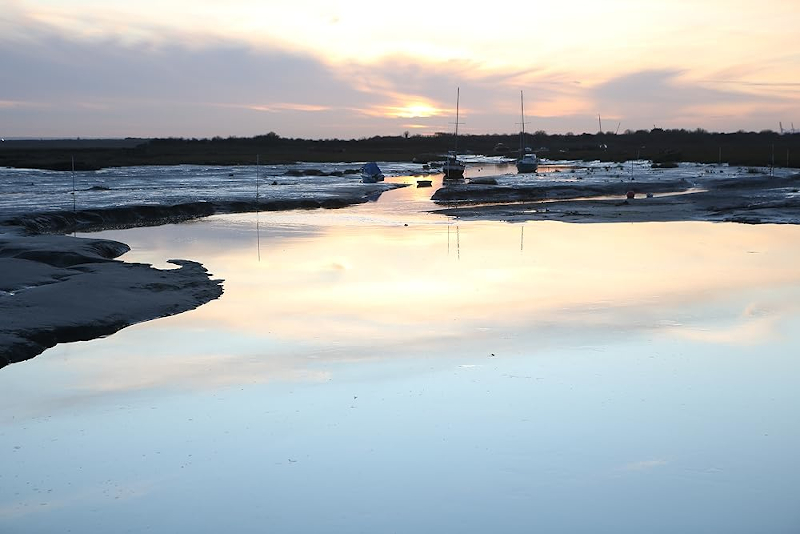
Visual readouts of data on the screen are accompanied by the male voice’s reading out data: “NorthWest direction. Altitude 300 feet. Speed fifty knots.” As well as the vocal narration, there are intertitles. Well, sort of… They appear before us on an otherwise blank screen, as if someone were typing the words in real time. Some of the vocal comments are vague, but they nevertheless slowly build up a sense of dread as the commentator ascertains (wrongly) that there must have been a war that lasted several hundred years.
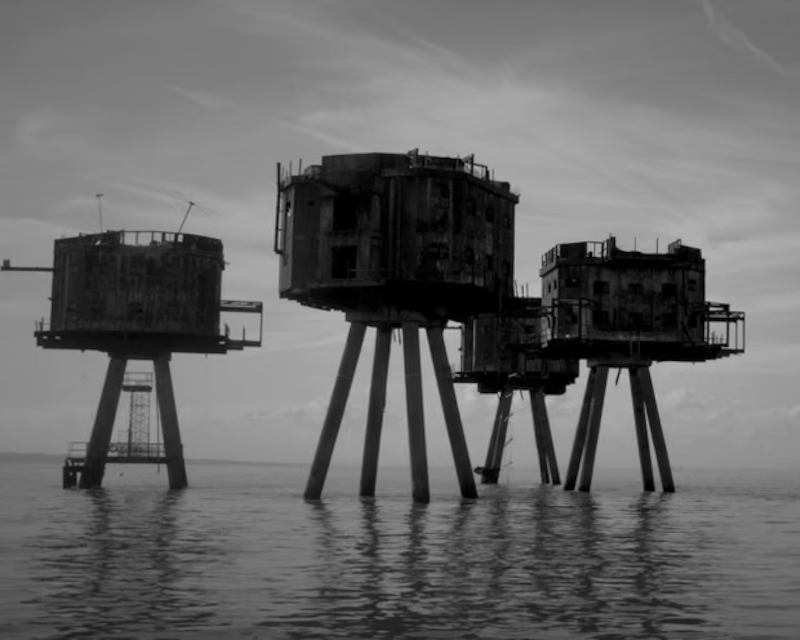
Aerial shots show ships’ graveyards, like remnants of some ancient civilization long since passed (I was reminded of the so-called Space Jockey found by the crew in Alien (Ridley Scott, 1979). A whole sequence involving derricks shrouded in mist against a blood red sky suggests something like a Turner Painting (or a Turner movie had he worked with a camera rather than a paintbrush). He describes platforms similar to the one seen in Slade in Flame (Richard Loncraine, 1975) as if he were reworking H.G.Wells The War of the Worlds; “some of the fighting machines walked on tall, articulated legs.”
Then he finds “something that shook me to the core” – mass graves, where bodies lie exposed to the elements.
The whole thing recalls An Andrei Tarkovsky landscape (Ivan’s Childhood, 1962; Stalker, 1979) devoid of human protagonists – at least until humans appear some twenty plus minutes from the end. And there’s an aesthetic similar to early (pre-feature film) David Cronenberg (Stereo, 1969; Crimes of the Future, 1970) where the film is the visual footage, and the soundtrack voice over is tacked on almost as an afterthought. And yet, there’s something very powerful about the unsynchronised soundtrack. Here, director Behrens builds upon that with a superbly eerie score by composer Bartosz Szpak and arresting sound design by Max Bherens and Brendan Feeney.
The end result is something very special indeed.
London’s Last Wilderness is out in cinemas in the UK on Friday, April 24th.
Trailer: