Director – Damiano Michieletto – 2025 – Italy, France – Cert. 15 – 110m
*****
A young orphan woman comes into her own learning to play the violin under her orphanage’s new Master of Music, Antonio Vivaldi – period drama is out in UK and Ireland cinemas on Friday, April 24th
A group of girls, all wearing similar dresses, fawn over a cat’s newly birthed litter of kittens. That doesn’t last long, as an older woman unceremoniously picks up the kittens one by one, stuffs them into a sack, goes to the huge wooden door of the courtyard, opens it, and throws the sack into the canal. In seconds we have gone from unbearably cute to unspeakably cruel.
The older woman is the Prioress (Fabrizia Sacchi) who presides over an orphanage in eighteenth century Venice. Baby girls are abandoned outside their doors, accompanied by half a memento – should the woman later wish to reclaim her daughter, she need only turn up at the orphanage bearing the matching half. The orphanage’s archive lists the details of every girl, complete with half memento. Many of the mementos are religious, such as an image of the Blessed Virgin Mary.
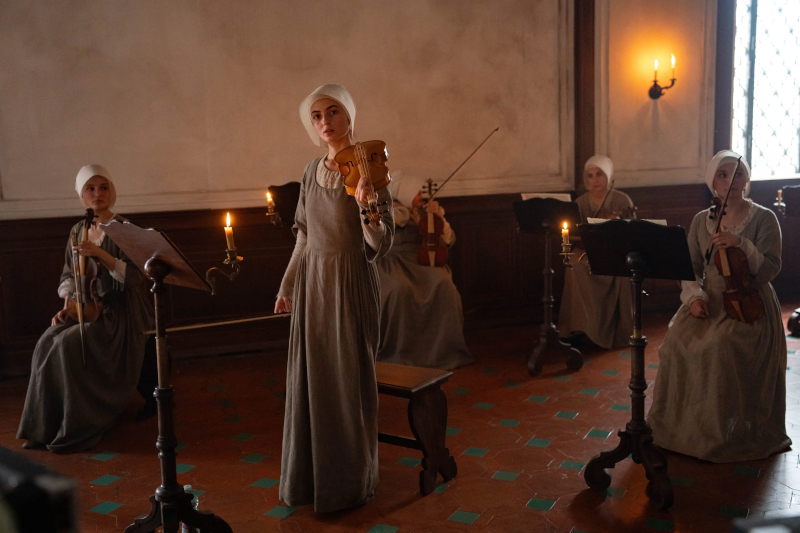
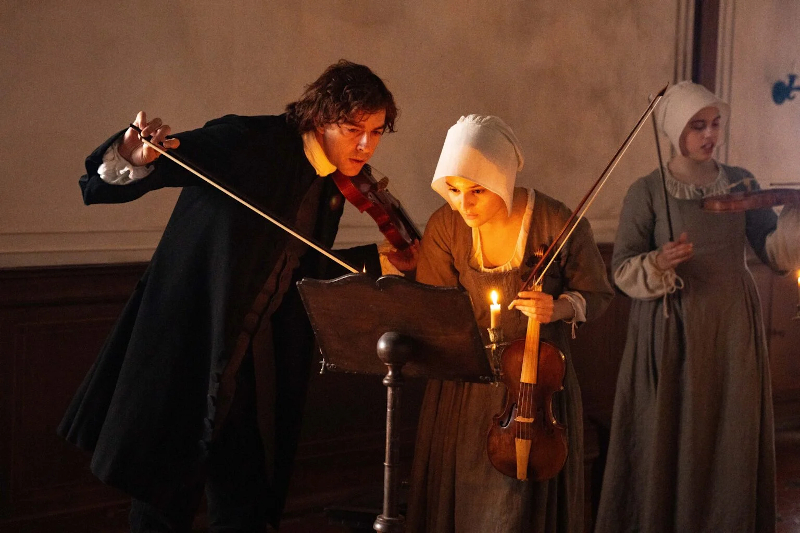
The orphanage is renowned for its orchestra. The orphans who play its stringed instruments will not have a career beyond the institution’s walls. The only way out for the girls is betrothal to a wealthy noble. Once they leave the place and join their new husband, they must abandon their instrument and their playing. Cecilia (Tecla Insolia), for instance, plays violin but will one day be wedded to acclaimed military man Sanfermo (Stefano Accorsi). But this will not happen until the cessation of a war in which he is currently campaigning.
In the meantime, the reputation of the orchestra is suffering something of a downturn, and the orphanage’s governor (Andrea Pennachi) blames the current Master of Music, so decides to replace him since he can secure the services of the priest Antonio Vivaldi (Michele Riondino) at half his predecessor’s wages.
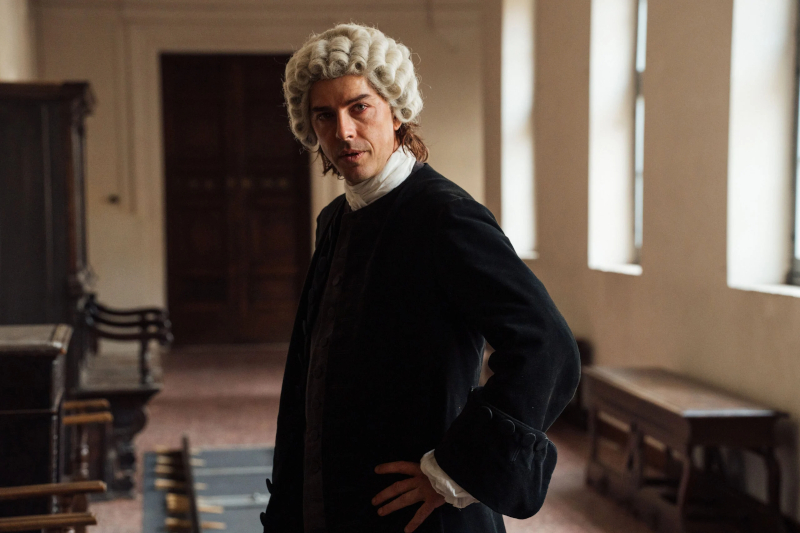
Vivaldi may not make much money, but he is clearly very talented. Working with the girls, he rapidly comes to admire Cecilia’s playing, promoting her to lead violin. He tells her he likes the fact that, unlike the other girls, she doesn’t play for the applause. Devoted as she is to her instrument, Cecila also, understandably, has a fixation on the mother who abandoned her to the place and writes numerous letters to the woman, concealing them in the unused room she visits at night to be alone with her thoughts. The only other person to visit the room is the new music master, who finds the isolated spot an excellent place to compose music uninterrupted, yet on discovering it’s Cecilia’s private place exhibits great kindness in vowing never to come to the room again, so that it may remain hers.
A mother turns up, memento in hand, to claim her child. Cecila hopes against hope that this will be her mother, but it is not; it is the mother of one of the much younger girls.
The orphan girl musicians are often required to tutor members of wealthy families; one such to whom Cecilia is assigned is Elisabetta Parolin (Valentina Bellè from Ferrari, Michael Mann, 2023) who speaks to her patronisingly of experience of love and the outside world. Elisabetta occupies a very different world to the one in which Cecila lives, for example joyously pursuing blindfolded noblemen at large, crowded parties in lavish rooms of vast, ornate homes.
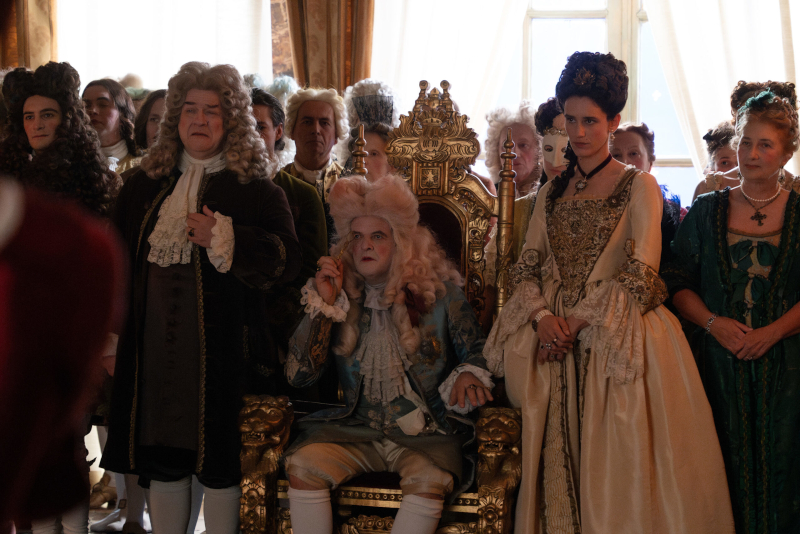
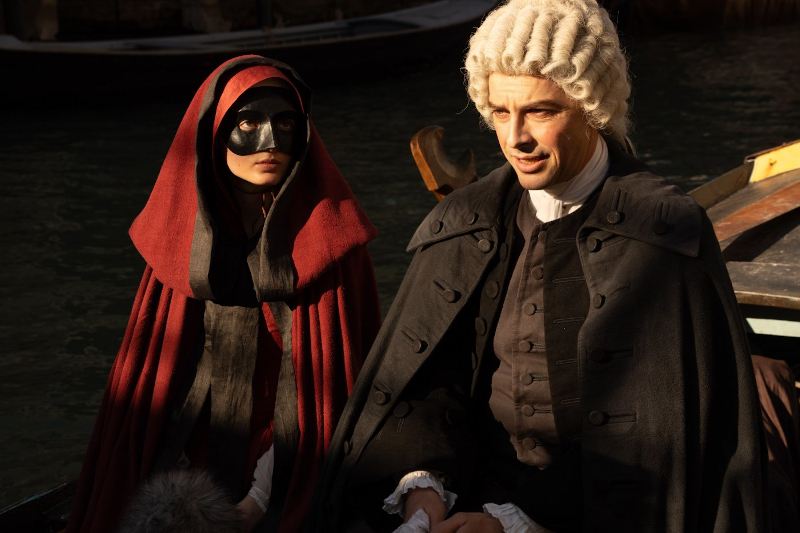
All Cecilia ever sees of this world is when Vivaldi and the orphanage require her and the other girls in the orchestra to play before audiences. As Vivaldi establishes himself and his compositions in his new position, the orchestra’s reputation grows, and ever higher ranking audiences are attracted to hear them perform. Thus it is that, masked alongside the other girls, Cecilia performs before the King of Denmark (Miko Jarry) – who, somewhat curiously, speaks French – or perhaps not that curiously given that this is a Franco-Italian production), and he is taken enough with both the composition and her playing to ask to have her remove her mask so as to view her face.
And then, suddenly, the war is over, and Sanfermo returns, intent on claiming his bride. Which will mean the end for Cecilia’s musical career unless either Vivaldi or she herself can engineer some way to remain single in the orphanage and thus still continue to play the violin…
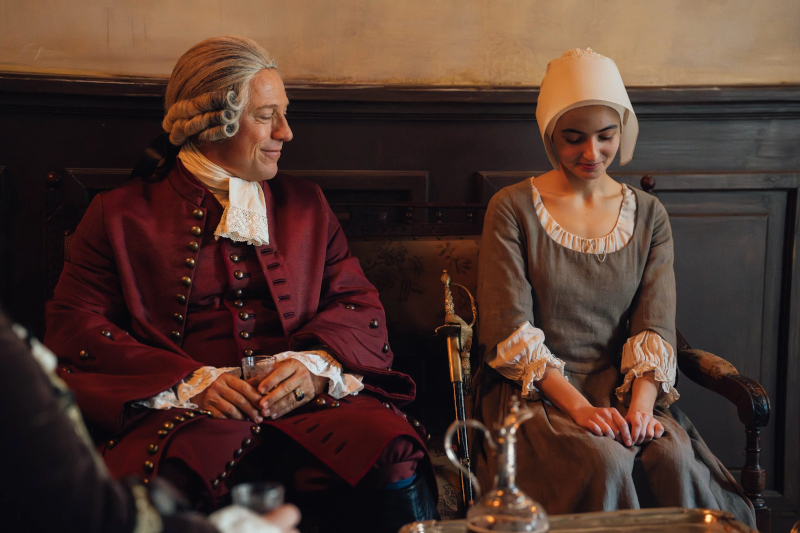
The drama very much hangs on Insolia’s performance as Cecilia, and the actress does a fine job, not only making us believe she’s a gifted musician, but also an insecure girl who’s never quite come to terms with the fact of her position as an abandoned child. Vivaldi brings out something in her; he is a sincere and devout priest, if one far more interested in music than the priesthood, and there’s no suggestion whatever of any misconduct toward the girl (or any of the girls) on his part. Riondino is superb as the artistically driven Vivaldi.
Sacchi as the Prioress plays more of a role than you might expect, since she not only rules the girls with, in effect, a rod of iron, but also takes them in hand when they have any sort of crisis of identity, as Cecilia does. Discovering Cecilia in the archive library trying to find her own records among the vast number of shelved and bound volumes, the older woman takes pity on her and helps her to find the information about her in the relevant volume. A glimpse of the Prioress’ ankle as she retries a book from a high-up shelf reveals her to have the ankle branding of girls admitted; she is a former orphan who grew up in the place herself.
As you might expect from an Italian period piece, the film is meticulously designed and ravishingly if sparsely photographed. Going in knowing nothing about the film, I found myself completely caught up in it. So much so that, at this early stage, it’s a potential contender for the best films of the year.
Primavera is out in cinemas in the UK and Ireland on Friday, April 24th.
Trailer: