
Director – Sergei Loznitsa – 2025 – France, Germany, Romania, Latvia, Netherlands, Lithuania – Cert. 12A – 118m
****1/2
Stalinist Russia, 1937. A young, idealistic prosecutor takes up the case of an unjustly imprisoned, political prisoner – out in UK cinemas on Friday, March 27th
A prison yard. Impassive guards. Inmates on scaffolding work at plastering the exterior wall. A man from a new prisoner detail is given a sack of letters and locked in a cell with a stove. He must burn the letters.
Given two matches, he reads some of the letters before incineration. One is written in blood from an inmate named Stepniak requesting a visit from a prosecutor.
The young, fresh faced prosecutor Kornev (Alexander Kuznetsov) arrives at the prison to see the governor. He is seen instead to the duty assistant (Andria Keiss).
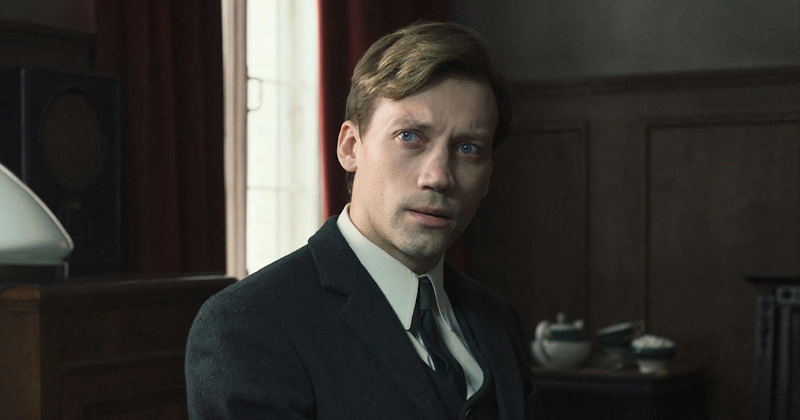
The prosecutor is received, but the interviewing duty assistant lives in a different world. The prison staff live in a world where the apple cart is never to be upset and an easy life is paramount. They laugh uproariously at the current joke doing the rounds about a political celebrity being imprisoned both before and after the Revolution.
They do their jobs efficiently, but woe beside interfering busybodies. Such as this young prosecutor, fresh out of law school. Or anyone believing in Soviet ideals and attempting to act upon them.
Slowly but steadily leading the young man to his office, the older duty manager must pass a sliding, solid metal gate in a courtyard and a seemingly unending series of stone staircases and metal grille doors. each of which must be unlocked by its attendant, impassively standing guard.
It’s like a vast, impenetrable and impregnable machine in which the human operatives are the living parts. A system designed to crush hope for the incarcerated.
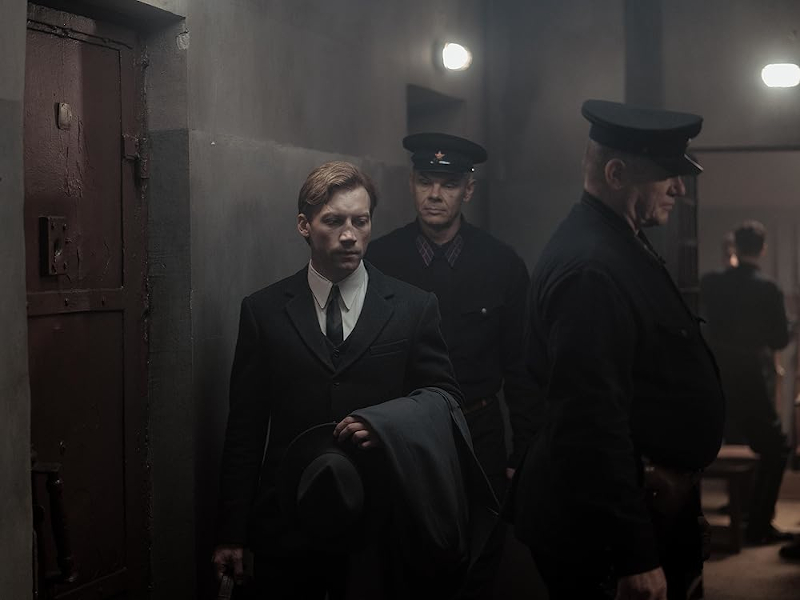
Kornev has somehow received Stepniak’s letter and wants to interview him. He has the block and cell number. The duty manager informs him that the governor is extremely busy. The prosecutor says he’ll wait.
The duty manager goes to see the prison governor (Vytautas Kaniusonis) who appears to be relaxing in hos office with no matters demanding his indicate attention. They share the political prisoner joke and laugh uproariously. The duty manager explains the present situation. We’ll let him stew for a bit, say the prison governor.
So Kornev is told he’ll have to wait.
At the end of the day he’s still there, sitting patiently on a chair in the duty manager’s office.
He is taken to another block to see Stepniak. More stairs. More impassive guards with keys.
In the man’s cell, Stepniak (Aleksandr Fillippenko) asks that all guards be removed from the room and only able to observe them through a peephole, unable to listen. Kornev insists that this is done, to the irritation of the duty manager and the guard.
Stepniak asks that the guards unlock his cell bunk so they have somewhere to sit. They do this.
With no officer or guard in the cell,and assured by Kornev’s documents that he’s not a member of the NKVD (the Soviet secret police), Stepniak explains his innocence to Kornev, showing the wounds and injuries caused by his beating at the hands of the guards. The cell is in a disgusting condition, and the prisoner is clearly in a bad way.
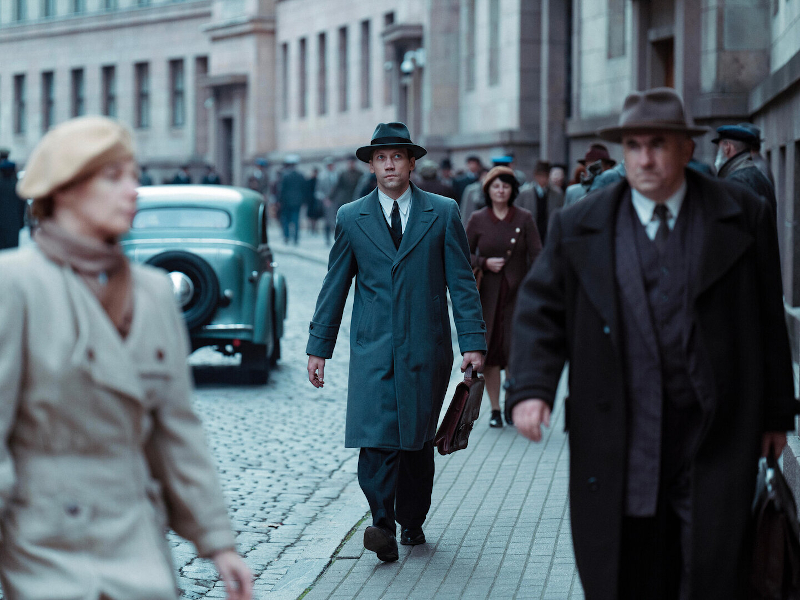
Appalled, Kornev goes to Moscow to the highest prosecutor in the land.
On the train to Moscow, Kornev, so tired he can barely stay awake, finds himself in a carriage where an old war veteran missing half a leg and an arm insists on regaling him with the story of how he visited Lenin to get his war pension when no system existed for doing them out to the needy and deserving. It’s a lengthy and heavily embellished yarn which ultimately suggests that, for some ordinary Russians at least, the State is working for the good of all, or, at least, for those prepared to put in a little effort.
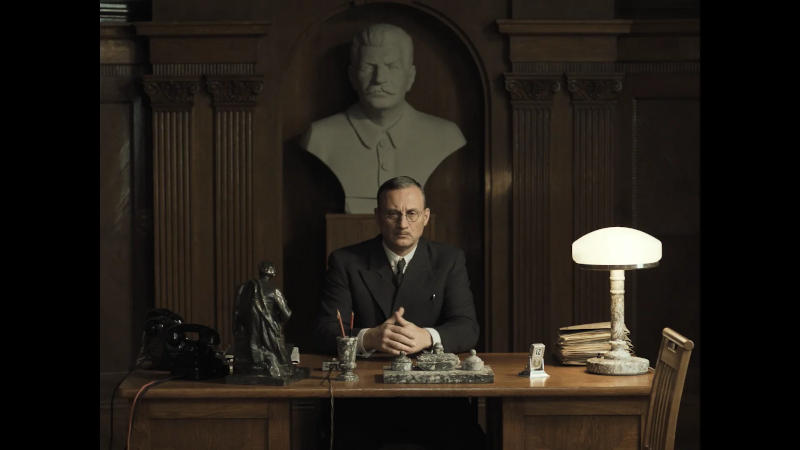
In Moscow, avoiding protocol – that same protocol that let him stew for a bit – he bypasses queues, heads up the ornate stairs, and reaches the top floor. Where he must wait to be seen by the top prosecutor, Vyshinsky (Anatoliy Belyy). In a room full of other man and women, with briefcases, all waiting their turn…
A great deal more onscreen time is spent in the austere prison than in the lavish Moscow bureaucrats’ building, but the similarities are striking. Both are systems designed to maintain the status quo and prevent change, innovation or reform.
A couple of incidents on the stairwell in the Moscow building are worthy of note.
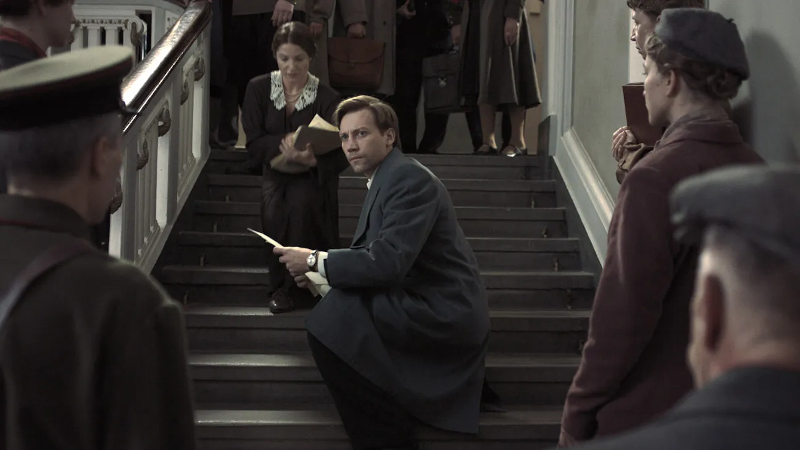
In one, a woman drops a file and must retrieve its scattered papers. Numerous other people pause on the stairs, waiting for her to do so, not offering to help. It’s the perfect metaphor for the repressive system in which everyone does their bit, but no-one ever does more than that. The idealistic Kornev stops to help her. By doing so, he is completely stepping out of line.
In the other, Kornak is accosted by an old college friend who is delighted to see him and wants to know in great detail how he’s getting on. He could be the flip side of the war wounded tale teller on the train.
The problem is that Kornak isn’t sure if he’s ever met the man before. Is he just a lackey trying to curry favour to further his career?
A final scene has Kornev returning on the train in a compartment with two factory inspectors, engineers by trade, who talk incessantly, ply him with vodka, and beg a guitar off the conductor to enable some rousing singing of Soviet songs.
The whole is an extraordinary picture of Soviet idealism within the wider context of the repressive State that Stalinist Russia turned out to be. While it’s clearly a study if a specific historical time and place, the tale transcends those specifics to deliver a cautionary tale about ordinary people getting by and idealists attempting to challenge the system.
If the film pales beside that human rights masterwork National Security (Chung Ji-Young, 2012), it nevertheless remains quite unlike either that film or any other I can think of. Well worth seeing.
Two Prosecutors is out in cinemas in the UK on Friday, March 27th.
Trailer: