Director – Lucile Hadzihalilovic – 2025 – France, Germany, Italy – Cert. 15 – 117m
*****
Midwinter. A homeless girl stumbles onto a film set where a notoriously difficult actress is shooting an adaptation of The Snow Queen – screens exclusively on BFI Player from Monday, January 12th
Opening with microscopic images of of snowflakes and more abstract visuals of refracted light, this swiftly delivers a female voiceover (by Aurélia Petit from Saint Omer, Alice Diop, 2022; By the Grace of God, François Ozon, 2018; Happy End, Michael Haneke, 2017; Personal Shopper, Olivier Assayas, 2016; The Science of Sleep, Michel Gondry, 2006) in French with English subtitles for those of us in the UK, in which the word ‘neige’ (snow) is seemingly, endlessly repeated. Then images of a girl wandering snow covered mountainsides gives way to night time small town streets before Jeanne (newcomer Clara Pacini) is told off for arriving late at the supper table. “I was afraid you’d gone”, says one of the younger girls (Cassandre Louis Urbain).
At night, Jeanne surreptitiously reads a postcard from a friend picturing Alpenaille skating rink addressed to her at the Bon Secours (Good Rescue) Foster Home.
The little girl from earlier comes into her room complaining of a nightmare. Jeanne reads her the story of the Snow Queen, the familiarity of which – despite its terrifying nature (“it froze the child’s heart”) – sends the little one into a calm and tranquil sleep in that manner that the familiar safety of scary children’s stories will. As the voiceover continues, Jeanne is entranced. “At dawn, the child was a sleep at the Queen’s feet.” This as Jeanne handles a prized possession, a necklace of blue beads as she sits beside a window through which snow can be seen in the daylight, giving one of her “magic beads” to the little girl as a parting gift which will protect her.
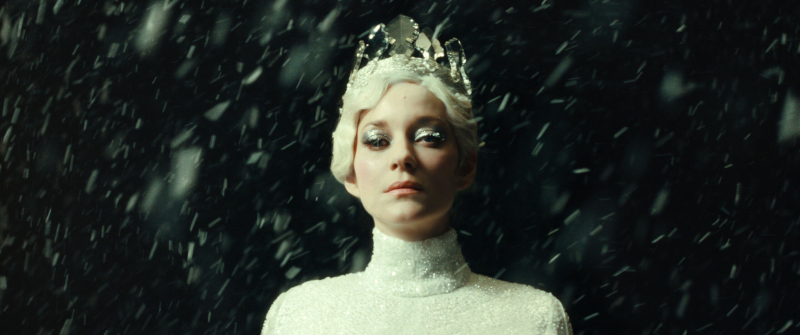
Crossing a mountainside of ice and snow, Jeanne slips and rolls, receiving an open head wound causing bleeding. Getting a link to the ice rink in town, she flees the van to avoid being raped by her male driver. She is entranced by the sight of a beautiful young girl skater (Valentina Vezzoso), who callously leaves with friends rather than offering Jeanne even directions to a youth hostel. Wandering the town alone, she breaks into an abandoned warehouse, dropping her beads, one of which she manages to retrieve. She finds herself wandering in a labyrinth, eventually laying down to rest and sleep on a pile of what could be white, sparkling fabric. Weirdly, given that this is a covered interior, it snows. Through a gap in the labyrinth wall, she see the Snow Queen (Marion Cotillard from Inception, Christopher Nolan, 2010; La Vie en Rose, Olivier Dahan, 2007; A Very Long Engagement, Jean-Pierre Jeunet, 2004) advancing towards her, then hears “cut”. It’s a film set. “Stop the snow,” says a voice.
Next day, phoning the foster home, she tells Rose (the little girl), “I met the Snow Queen and she’s even prettier in real life.” She steals a dropped white handbag from the previous day’s callous skater from the ice rink, and picks up the ID card of one Bianca Ligorio. Looking around the film set building by torchlight, she passes a poster for The Red Shoes (Michael Powell, Emeric Pressburger, 1948) and stumbles across the Snow Queen’s costumes, detaching a small prism from the dress as a keepsake. This is later seen in Jeanne’s hand by the Snow Queen – or the actress playing her in the dress but without her wig – while Jeanne sleeps.
As Bianca, Jeanne meets Stéphanie (Marine Gesbert) at the catering table, telling the latter she’s been sleeping there and has nowhere else to go. Later, dressed and coiffed as one of the Snow Queen’s handmaiden assistants, ‘Bianca’ is warned to beware of Cristina (Cotillard) who is pitiless if anything upsets her. One such tantrum causes a pause in filming, during which she looks around and hears Cristina not opening her door to the frustrated director. She observes through a gap in the doorway as Cristina’s P.A., Max (August Diehl from A Hidden Life, Terrence Malick, 2019; Allied, Robert Zemeckis, 2016; Inglorious Basterds, Quentin Tarantino, 2009) preps her to go back on set, possibly with an injection of a drug since we see her flex her arm as if a needle has just been used on it.
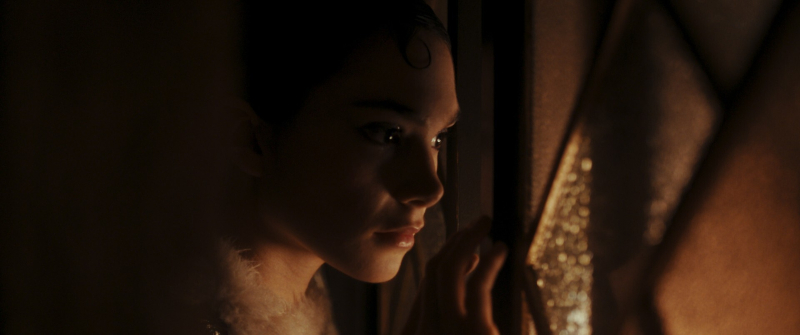
Now ‘Bianca’ is in the projection box, watching rushes of the Snow Queen advancing towards the camera, with director Dino (Gaspar Noé (real life director of Vortex, 2021; Climax, 2018; Irreversible, 2002) attempting to placate the dissatisfied Cristina. As Jeanne attempts to remove he costumed boots for her walking shoes, she is summoned to see Miss van den Berg. Cristina questions her about the film and The Snow Queen, then demands to see the stolen item, in return revealing, in her own hand, three magic beads from Jeanne’s necklace.
At Cristina’s insistence, ‘Bianca’ becomes the stand-in for Chloe who is playing the Queen’s lead handmaiden. She has to work with a raven, stretching out her arm to allow it to alight on her hand. Cristina invites ‘Bianca’ for a drink at a hotel, then stands her up, leaving the girl stranded outside the hotel. Jeanne wanders around the Snow Queen film set, accompanied by the voiceover from earlier, surreally walking through a miniature set and picking up a small, two inch pin maquette of herself in her hand, her eye looking in through a window like the miniature King Kong outside the Empire State Building looking in. She watches the Queen rise from a raised ice slab and walk towards her, and in a fascinating deconstruction of cinematic artifice, Chloe as the handmaiden now becomes a diminutive figure at the foot of the Queen’s tower, observed by ‘Bianca’ from the edge of the set. Handed the raven by the costumed Cristina, Chloe struggles to hold the bird before it bites her lip.
Believing Chloe does not have what it takes to be an actress, Cristina has ‘Bianca’ replace her, upgrading the latter’s accommodation to a hotel to which Max drives her.
In her lavish new room, Jeanne is beset by dreams of herself on set, feeding of the raven like a succubus, wandering lost through the Queen’s realm, listening to Cristina as the Queen telling her that “her sacrifice will be a joy”. Cristina, it turns out, isn’t lodged at this particular hotel, where young girls run laughing joyously past the lobby’s Christmas tree, before which Jeanne stands gazing at blood red baubles, remembering her mother’s fresh corpse on the bed when she was small,with the beads around her dead mother’s neck with which we’re familiar as Jeanne’s “magic beads”.
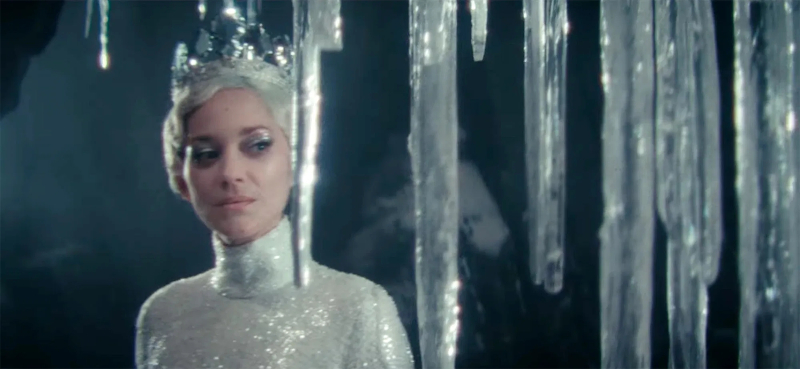
The following night, she and Cristina are drinking mulled wine. It comes out in their conversation that Cristina, too, was in a foster home. Jeanne is overcome with sadness talking about her mother who would never let the youngster play outside because the world was full of danger for a little girl. Jeanne was the one who found her. She was very cold. Predator-like, the actress takes the girl’s hand. They circle each other around icicles in a cave, the rushes watched by director and key crew in a screening room.
Cristina has Max drive the pair of them out to a snow-covered precipice, offering the girl a chance to “leave” with her that night. When ‘Bianca’ pulls away from the ledge, you sense her relationship with the actress might be at an end. Despite Max’s subsequent advice, she goes to see Cristina. The ensuing scene in Cristina’s room might reasonably be described as ‘frosty’ or ‘cold’, realised through costume and sets in dark, flesh and earth tones. Somehow, it shifts from a mutually participatory kiss into Cristina’s attempt to force herself on the young girl. As Jeanne, who has revealed she’s not called ‘Bianca’, leaves, Cristina impotently fumbles with Jeanne’s beads in her hand.
Conversely, back at the foster home, young Rose gazes into the cut stone Jeanne took from the Snow Queen, within which, the voiceover tells us, not only the kingdom of the Snow Queen but a thousand other kingdoms can be glimpsed.
This latest offering from director Hadzihalilovic (Earwig, 2021; Evolution, 2015) turns the artifice of a film set into another of her strange, sealed off worlds. The way she gently brings her heroine into this world from a cold outside world of orphanages, cold mountains, potential rapists and homelessness is beguiling, and by the time Jeanne has arrived in the labyrinth of what we later realise to be the constructed rear facades of studio film sets, she is already playing another character, the callous Bianca who refused to even try and help the homeless girl at the ice rink and whose identity card has chanced to come into Jeanne’s possession.
In her dealings with production assistant Stéphanie, you sense Jeanne trying not to assume this other identity, trying to explain that she is homeless without saying anything that will get her ejected from the the warmth, with dietary sustenance provided, of the film set. Yet, despite her best efforts, the film set casts her in the role of ‘Bianca’, whose name echoes blanc (white). Thus, when she is later cast as Chloe’s stand-in and, later still, replaces Chloe, she is not just playing a role but someone playing a role playing a role. This is a dream role for an actress, and Pacini carries it off well, proving as captivating as Cotillard in their scenes together. Hers is the more complex role, since Cristina is merely an actress playing a role in the film whereas Bianca is an imposter playing a role in the film.
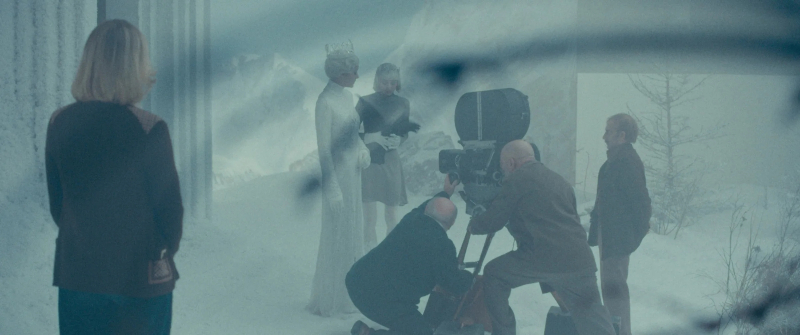
Further viewer disorientation occurs between the world of the film set and the images of the film. This is perhaps most noticeable in scenes which suddenly cut back to Jeanne, Cristina or director Dino watching them from screening room seats, breaking the otherwise magical spell about movie imagery. Jeanne as ‘Bianca’ has come in from the cold, dangerous outside world into the comparative warmth and security of the film set, whereas Cristina by comparison appears to have a coldness about her which may help explain why she can be so convincing playing the Snow Queen. Cotillard is mesmerising as Cristina playing the Snow Queen, and unsettling playing Cristina as she becomes abusive towards Jeanne towards the end.
Before events reach their conclusion, Jeanne is forever peering through gaps in set walls of slightly ajar doorways to glimpse the magical worlds of not only the movie itself but also the wider world of the moviemaking industry with all its people and paraphernalia. Indeed, parts of the film are shot by cinematographer Jonathan Ricquebourg (The Taste of Things, Tran Ahn Hung, 2023) as if through a prism, with an emphasis on refracted light, suggesting a crisp, almost arctic coldness to the visual side of things.
As an essay into the lure of the movies, clad in a veneer of fairytale enchantment, this is peerless. And its appearance in UK cinemas just as the weather starts to turn cold gives it an extra relevance. On the one hand, you go to the cinema to escape from real life; on the other, seen under wintry weather conditions, this movie bites like a chilling frost, a dark journey into a wintry labyrinth. Don’t miss.
The Ice Tower screens exclusively on BFI Player from Monday, January 12th 2026, following its release in UK cinemas on Friday, November 21st 2025.
Trailer: