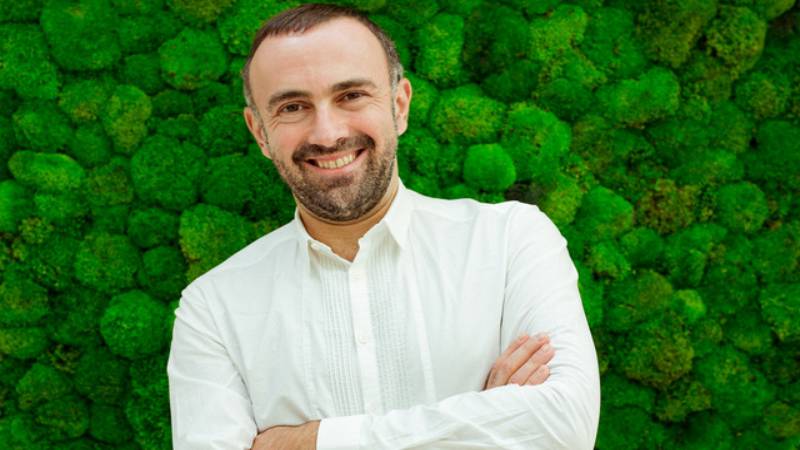
The man at the helm of the highly successful Critics’ Picks strand at the Tallinn Black Nights shares his secrets with Jeremy Clarke, who covered every edition of the new section since its inception in 2022
Article originally published on DMovies.org
Nikolaj Nikitin (more widely and affectionately known as “Niki”) started the Critics’ Picks competitive section of the Tallinn Black Nights Film Festival just three years ago, in 2022, making this year the fourth edition of the strand. Every year 10 to 12 films vie for multiple prizes; Best Film, Best Director and Special Jury Mention. These movies have been amongst the strongest that we encountered in our many years profound wide coverage of the event
Your interviewer Jeremy Clarke is a member of the prestigious London Critics’ Circle and DMovies writer since our establishment 2016. He stepped in immediately in 2022 in order to cover the section. He has reviewed every single film in every edition (you can read Jeremy’s full coverage of last year by clicking here). This year he is being exceptionally replaced by Victoria Luxford (also a member of the London Critics’s Circle), however he remains close to our heart and ready for a return next year.
Click here in order to follow this year’s DMovies’ coverage of Critics’ Picks as it happens.
…
.
Jeremy Clarke – Please tell us a little but about yourself. What were you doing before PÖFF? What is your background?
Nikolaj Nikitin – I’ve always lived and breathed cinema – it’s been at the centre of my world for as long as I can remember. Much like François Truffaut, I used to skip school to go to the movies – and later, I actually went on to study them. Before joining PÖFF, I spent many years exploring different corners of the film world: as a journalist, curator, consultant, producer, and festival director.
I’ve had the privilege of collaborating with extraordinary filmmakers and festivals across the globe, helping stories travel and connect with audiences in meaningful ways. For nearly two decades, I worked with the Berlinale as a delegate. Beyond being part of what was then the largest film festival in the world, I also founded my own festival – Filmplus (now known as Edimotion) – dedicated to the art of film editing. I helped establish the goEast Festival and contributed to developing the Zurich Film Festival. Just this year, I revitalised and reshaped the Lünen Festival, dedicated to German cinema.
For more than 20 years, I’ve also served as the Artistic Director of the Palić Film Festival in Serbia – gaining extensive experience in running, curating, financing, and organizing film festivals, all of which now serve me well in my work with PÖFF.
Alongside my festival work, I’ve always been deeply involved in education. For more than a decade, I led Sofa – School of Film Advancement, a unique training initiative for cultural managers in the film industry. Today, I teach festival distribution and market strategies at various film schools and institutions in Germany and abroad.
For me, film has never been just about art or entertainment – it’s about people, emotions, and the conversations that begin when the lights come back on. At PÖFF, I feel I can bring all of that together the experience, the curiosity, and above all, the love for stories that move us and help us see the world differently. Let’s remember the old saying: cinema is both a window to the world and a mirror of society. Now, more than ever, we need to understand our neighbours – and what better way to do that than by watching their stories unfold on the big screen?
JC – How did you get involved with PÖFF, and how did the Critics’ Picks strand come about?
NN – After my time at the Berlinale, I wanted to continue working with an a-class festival alongside my other festival commitments. As a Berlinale representative, I already knew Tallinn very well and had long admired the incredible work being done there. Tiina Lokk first invited me to join one of her early juries, and for many years I handled my Baltic pre-selections in Tallinn while also collaborating with the Industry strand.
When Tiina and I spoke again, she immediately offered me a place on the main competition selection committee – a wonderful opportunity, as it allows me to explore cinema from all over the world and, together with my amazing colleagues, craft a programme that truly reflects global creativity. But we also realised that with my background, I could bring something more to PÖFF – and that’s how the idea of Critics’ Picks was born.
JC – Were you ever a film critic yourself and is that why the strand is named as such?
NN – Yes, I do have a background as a film critic. For 15 years, I ran my own film magazine, SCHNITT (which means “editing” in German). Back then, it was the most widely distributed independent cinema publication in the German-speaking world, and many called it the German Cahiers du Cinéma – though I personally saw us more in the spirit of Positif. We carved out a unique position among film magazines: I even invented a feature called Dreischnitt, where three critics would write about the same film, creating a kind of pre-social-media debate on paper that both readers and industry professionals loved. We were also the first to cover short films and documentaries with the same dedication as features. From SCHNITT eventually grew my editing festival, Filmplus (now Edimotion).
As for the name Critics’ Picks, my goal was to challenge how so-called arthouse cinema is often perceived: as black-and-white, slow, difficult, or depressing. The selection, both last year and this year, is colourful, diverse, surreal, and full of life. What keeps it “arthouse”, from a Hollywood perspective, is simply that these are independent, non–English-language films without studio backing. But to me, they echo the spirit of the great US independent films of the ’80s and ’90s – the era of my cinematic heroes like Jim Jarmusch, Quentin Tarantino, Kevin Smith, Steven Soderbergh, Alexandra Rockwell, Harmony Korine, Richard Linklater, John Waters, Alexander Payne, Sofia Coppola, and of course, the Coen Brothers.
I’m certain that the filmmakers featured in Critics’ Picks will soon be known to international audiences. This strand offers them a safe haven to present their work and to be discovered globally – much like the critics of the past who championed emerging voices: the Nouvelle Vague writers at Cahiers du Cinéma, or Pauline Kael at The New Yorker, who helped launch legends like Scorsese and Altman in the ’60s and ’70s.
The word “curator” comes from the Latin curata, meaning “to heal”. I’m not claiming to be “Dr. Film” here to cure audiences of their streaming habits, but I do want to offer them something restorative: cinematic voices that deserve to be heard because they reflect, politically and personally, the world we live in. Think of it like dining at a Michelin-starred restaurant: you might wait longer for a table and pay a little more, but the experience will stay with you – incomparable to a quick bite from a fast-food chain. So, I invite audiences to savour the cinematic delicacies of this year’s Critics’ Picks selection.
JC – Who are your favourite directors, writers, cinematographers, composers, actors, etc? In other words, the artists that have informed your taste in film.
NN – Ah, that’s a very tricky question – and surely there are far too many to name! Whoever I mention, I’ll immediately realise I’ve forgotten dozens of others. And if I tried to include them all, this would turn into a very, very long article.
Let me instead refer to the great honour I once had of compiling a Top Ten for Sight and Sound. I think my top three choices capture the range of my cinematic taste quite well: M by Fritz Lang [1931], Bringing Up Baby by Howard Hawks [1938], and Once Upon a Time in the West by Sergio Leone [1969].
But of course, there are many, many more – the rest of my “Magnificent Seven,” so to speak: Marco Ferreri, Dziga Vertov, Sergei M. Eisenstein, Jasmila Žbanić, Michel Hazanavicius, Ildikó Enyedi, and Lina Wertmüller. And how could I possibly leave out Ernst Lubitsch and Billy Wilder, Rainer Werner Fassbinder, Věra Chytilová, Charlie Chaplin, Buster Keaton, François Truffaut, John Boorman, Wong Kar-Wai, Cristian Mungiu, Martin Scorsese, Andrzej Wajda, Steven Spielberg, Akira Kurosawa, Leo McCarey, Maya Deren, and of course, Luis Buñuel.
As for cinematographers, composers, and actors – well, that list would be just as long… and we’d be here all day!
JC – What qualities or elements are you looking for when choosing films for Critics Picks?
NQ – What I look for above all is quality and artistic vision – in every department. I deeply appreciate cinema that is exquisitely executed yet bold enough to break boundaries. Thanks to the wonderful support of our festival director, Tiina Lokk, I enjoy complete artistic freedom – and the entire world as my playground.
This year, we’ll present an international Top 10 of the very best that world cinema has to offer. All Critics’ Picks competition titles are world premieres, meaning the Tallinn audience – along with the attending press and industry – will be the very first to experience them. Each screening is also accompanied by the filmmakers themselves, who come to introduce their work in person.
The section is inspired by the idea behind the Cannes Critics’ Week, founded in 1962 (the oldest non-official sidebar in Cannes), and its Venetian counterpart, launched in 1984 – when I was 10 years old. Cannes’ Critics’ Week focused on first- and second-time filmmakers and helped discover world-renowned auteurs such as Bernardo Bertolucci, Ken Loach, Tony Scott, Agnieszka Holland, Alejandro González Iñárritu, and French legends like Jacques Audiard, Gaspar Noé, François Ozon, Julia Ducournau, and Justine Triet.
At PÖFF, since we already have a debut competition, I decided not to restrict Critics’ Picks to first- or second-time directors – though debuts certainly feature among the selections. And while Cannes presents only seven feature films (hence the “Week”), I wanted to expand the frame to better reflect the diversity of world cinema – which, after all, spans nearly 200 countries – so we showcase 10.
Perhaps most importantly, I don’t want to present only “difficult” or highly demanding arthouse films, but rather crossover works — films that balance artistic integrity with broader appeal. In simple terms: well-crafted auteur genre films. This philosophy traces back to my inspirations from the French Nouvelle Vague critics who first redefined Alfred Hitchcock as an auteur. For me, Critics’ Picks continues that spirit – discovering bold voices that merge cinematic mastery with emotional and cultural accessibility.
JC – In the journey of putting together the Critics’ Picks strand, either this year or in previous years, are there any peculiar moments, memories and anecdotes that stick out?
NN – What happened couple of times is that I was really in love with a movie I saw quite early and then they ended up in Cannes or Venice (that happens quite often) which of course is wonderful for the movie as those festivals guarantee lots of attention. What always happens and I know I not the only one that in the beginning of the selection process there is always the fear – I will not sure the word panic that I won’t have enough intriguing films for the line-up and as closer as I get to the deadline the more wonderful films are there and it gets difficult to select the last remains slots as there is always a long waiting-list I have to decide from. I love the set-up of having only 10 films as by this a guarantee all those world premieres lots of attention!
JC – Now that Critics’ Picks is on its fourth year, what do you see in terms of the way the strand has developed or grown? What are the biggest milestones?
NN – Oh, there are quite a few moments that stick out – some funny, some a little bittersweet. It’s happened more than once that I’ve completely fallen for a film early in the season, only to see it later announced for Cannes or often Venice. Of course, that’s wonderful for the film (and secretly a nice confirmation that my instincts were right!), but still… it feels a bit like falling in love and then watching someone else take your date to the prom.
And then there’s the classic curator’s emotional rollercoaster. At the start of the selection process, I’m always convinced there won’t be enough great films – a mild sense of panic sets in, the kind every curator knows too well. Then, as the deadline gets closer, the problem flips completely: suddenly there are too many brilliant films, and I find myself agonizing over which ones to let go.
But that’s the beauty of Critics’ Picks. With only 10 films, every choice truly matters, and each one gets the attention it deserves. It is a cozy but mighty line-up – every film is a world premiere, every screening feels like an event, and every filmmaker gets their moment in the sun. That’s what makes it all worth it.
JC – How many films do you watch in the annual process of choosing the films that make up the Critics’ Picks?
NN – Each year, I watch around 1,000 films, since I’m also a member of the selection committee for the Official Competition. So, if you do the math, only about 1% make it into Critics’ Picks. It’s a tough but thrilling process – a bit like digging through vast cinematic terrain to find that one – or in my case 10 – shining diamond(s).
Of course, I also watch many titles that aren’t officially submitted – discoveries from other festivals, recommendations, or unexpected finds – as we also highlight exceptional works from our colleagues’ programs.
And yes, despite all the screeners and digital viewing, I still go to the cinema regularly. Nothing compares to that moment when the lights dim and the story begins. My latest recommendation? One Battle After Another [Paul Thomas Anderson, 2025] for me, an absolute must-see.
JC – I would absolutely agree with you about One Battle After Another.
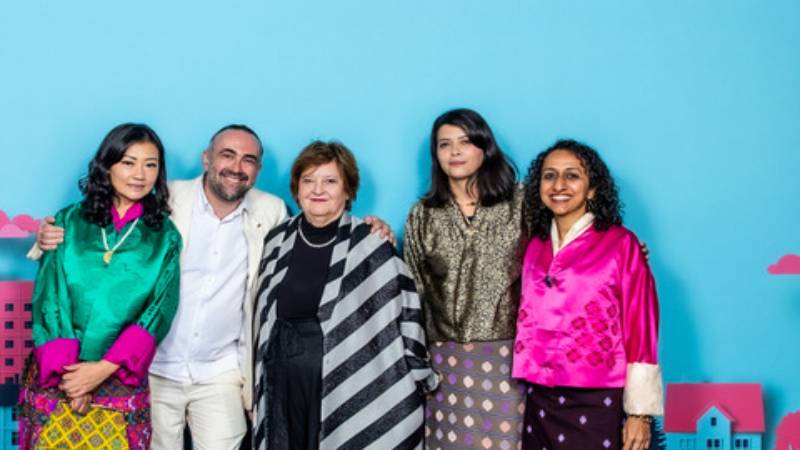
Have your selection criteria changed at all? Last year, there were some genre films (Italian gangster movie, cat and mouse thriller) although looking back on the first year, you had a terrific gangster film in Roxy [Dito Tsintsadze, 2022], and other years you had mafia drama The Bone Breakers [Vincenzo Pirrotta, 2022] and an animated film Pelikan Blue Laswzlo Csaki, 2023]. The movie I, The Song [Dechen Roder, 2024] was a quasi-Hitchcockian thriller. [Niki is pictured above with Festival director Tiina Lokk and I, The Song team].
NN – Not really – my criteria haven’t changed, but each year brings its own unique buffet of films. A festival can only be as strong as the contemporary cinema it reflects (retrospectives aside, of course). So in a way, we’re just responding to what the world is cooking up at that moment.
Once the first titles are in, I look for what I call the “red thread” – those subtle conversations between films, like whispered connections that make the lineup feel like one big cinematic dinner party.
And diversity is essential. Not just geography, but tone, genre, and perspective. I want each film to have its own voice – no clones allowed! Together, though, they create a programme that’s dynamic, surprising, and, I hope, unforgettable – a little like a tasting menu where every course has its own flavor, but the whole meal leaves you thinking, dreaming, and talking long after the lights come up.
JC – Are there any new directions in this year’s strand that have pleasantly surprised you?
NN – I’m really happy with the genre mix we have this year. Hard-boiled thrillers, in particular, are taking center stage – a genre I’ve always loved throughout film history. We all know Siegfried Kracauer’s famous idea that cinema is a mirror of society, and right now, in politically turbulent times – unfortunately, we’re definitely living through them, genre cinema seems to be stronger than ever across the globe.
Many festivals are still a bit cautious when it comes to programming genre films, but I’ve always been very open to it. Making a well-done genre film – especially a comedy or an action movie – is incredibly hard. Yet audiences love them, and many go on to endure, sometimes being rediscovered decades after their premiere. For me, that’s what makes genre cinema so exciting: it’s both challenging and timeless, and it always has the power to connect with people.
JC – Most of the titles in your selection were by little known writers and directors. I can think of a couple of exceptions: the British director Carol Morley [Typist Artist Pirate King, 2024] and Phedon Papamichael [Light Falls, 2023] who is known as a cinematographer but turns out to be a gifted director. How do you feel about that?
NN – Well, I’ve always thought Phedon Papamichael is one of the most outstanding cinematographers working today — and Sideways [Alexander Payne, 2024] happens to be one of my favourite films (definitely another one to add to the list). I even had the pleasure of sitting next to Alexander Payne at the Venice closing dinner, chatting at length about that masterpiece — a real treat.
JC – As for Phedon as a director, it’s not surprising at all how strong and distinctive his work is. He’s learned from decades of experience collaborating with some of the best filmmakers in the world, and it shows. In that sense, he reminds me a bit of Clint Eastwood, who worked with the masters and then went on to create his own modern classics. It’s a great reminder that sometimes, being behind or in front the camera first can make your own directorial voice even stronger.
JC – I am continually appalled by how few of these films seem to make it into UK distribution. Any thoughts on this?
NN – Ah, you’ve touched a sore point – and one of my main motivations in this work. When I started nearly 30 years ago, far more world cinema titles made it into distribution in Germany – and, of course, in the UK as well. That’s changed drastically in recent years.
Don’t get me wrong – in a way, there are still too many films in major markets, but most of them are local productions or Hollywood blockbusters. Germany, for example, produces a lot of films, and many of them get distribution but don’t perform well, which ends up taking away slots for wonderful films from other countries. I suspect it’s similar in the UK.
Remember, the average cinema-goer sees a max of three films a year – usually two blockbusters and one local hit. That leaves very little room for the kind of films we showcase in Critics’ Picks. Luckily, festivals fill the gap. Right now, there are roughly 40,000 festivals worldwide — more than a hundred happening every day. In the UK alone, there are around 150 festivals, with at least 50 in London, which is roughly one festival a week. Here in Berlin, where I live, we have even more than 50. That gives audiences plenty of opportunities to catch these films as they travel the festival circuit.
As we know from Spider-Man: “with great power comes great responsibility!” I take my role as a curator very seriously, making sure the films I select reach audiences worldwide. For instance, I, The Song, which you mentioned earlier, is Bhutan’s official Oscar submission this year. We’re keeping our fingers crossed, and I’m thrilled that the director, Dechen Roder, will also be joining us here at PÖFF this year as a jury member of Critics’ Picks. If it makes the shortlist or even the nomination, it will be a dream come true for all of us.
JC – What might the future bring to Critics’ Picks and Niki?
NN – As the famous German soccer coach Sepp Herberger said: “after the game is before the game”. So, of course, I’m already looking ahead to the next edition of PÖFF and keeping an eye on some very fresh titles – it will be our first little anniversary!
Besides that, I’m focusing on teaching at film schools, festivals, and institutions around the world. My main focus is festival distribution and market strategies. As I mentioned earlier, our industry has changed a lot recently, and a successful festival run has become crucial for young directors and film professionals to get seen. I’m thrilled to be able to share my knowledge and insights with the next generation, helping them navigate the ever-evolving landscape of cinema.
…
Niki is pictured on both images illustrating this article, which was originally published here on DMovies.org.
Critics’ Picks mashup trailer:
Festival teaser trailer: