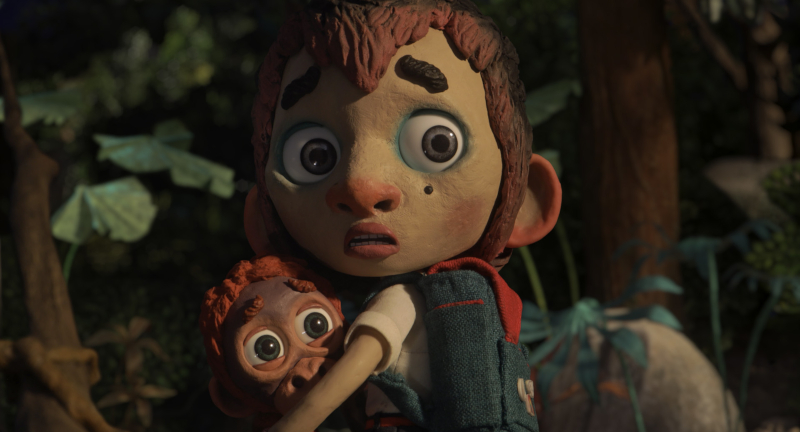
Director – Claude Barras – 2024 – Switzerland – Cert. PG – 87m
French with English subtitles.
*****
An indigenous pre-teenage girl stands up to loggers destroyingthe local rainforest – stop-frame animated feature from the director of My Life as a Courgette is out in UK cinemas on Friday, August 1st
From its opening moments in darkness following unsettling creature noises suggesting a jungle forest, followed by jungle forest establishing shots – a frog jumping across a river via a series of stones, a snake slithering around a tree, a baby orangutan (non-verbal voice: soundtrack composer and co-sound editor Charles de Ville) swinging on a branch – it’s clear that this has high ambitions indeed. All the above would be one thing to execute in live action – a few location natural history shots… possibly library footage. In model – or stop-motion – animation, you need to physically build everything in terms of miniature model sets, so to achieve such images is a major undertaking.
Having already set the production bar high, this then pushes it up further with the rasping sound of a chainsaw, as the tree heights on which the baby orangutan and its mother (voice: de Ville again), who has just rescued the infant from the attentions of the deadly snake, are resting suddenly topples into a camp of workers who are going about their allotted task of destroying the creature’s natural habitat.
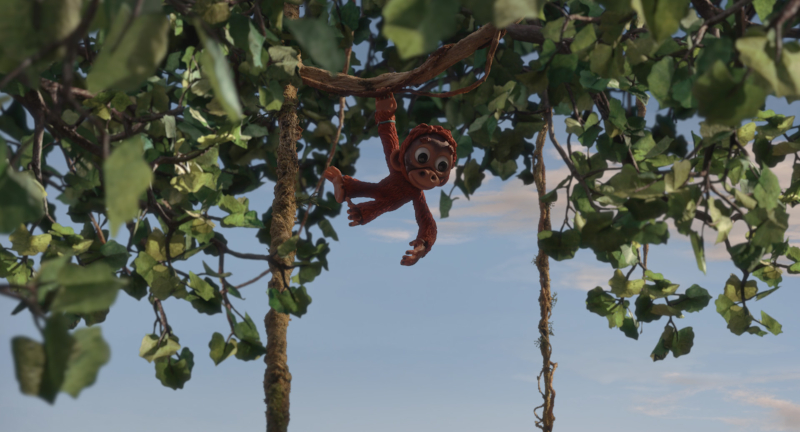
Before you know it, in a scene as traumatic as the mother’s death in Disney’s Bambi (David Hand, 1942), and reminiscent of similar, early scenes in Mighty Joe Young (Merian C. Cooper; stop-frame animation: Willis O’Brien, Ray Harryhausen, Pete Petersen, 1949) and, particularly, its remake (Ron Underwood, 1998), the mother ape is rampaging through the logging site and is shot by a worker. 11-year-old Kéria (voice: Babette De Coster) spots the traumatised infant and her father Mutang (voice: Benoît Poelvoorde) – there to harvest fruit from the trees – hides the ape child in her rucksack before it too gets shot.
At home, only child Kéria names the baby Oshi, and bottle feeds him milk. Like him, she too has lost her mother. No sooner have her maternal instincts kicked in, however, than the world of her and her ‘baby’ is disrupted by the arrival of her cousin Selaï (voice: Martin Verset), who is being left by her visiting grandfather Along Sega (voice: Pierre-Isaïe Duc), to stay with the family for a while.
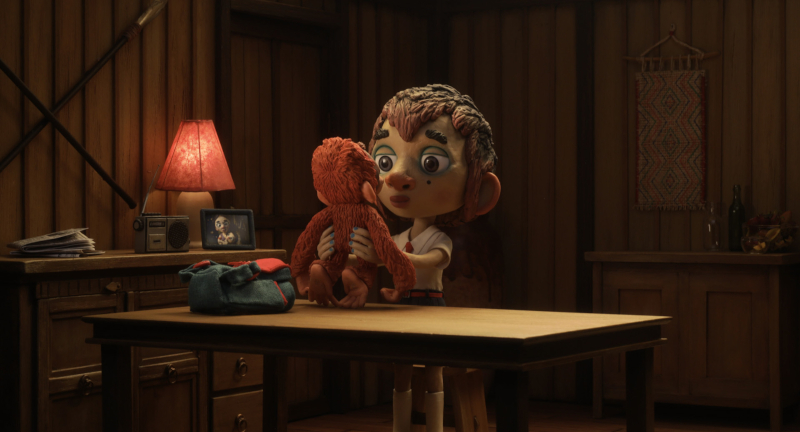
While Kéria’s father has compromised his indigenous heritage and found a way to work within the economics of deforestation, her grandfather has in contrast remained fiercely true to his native roots and speaks only Penan, the language of his ancestors, forcing her father to likewise speak it when conversing with him.
Now Kéria finds herself in a tiz, ostracising the boy who has been designated to stay with her in her room and embarrassed with her peer group at school that the smelly boy dressed like a native is actually her cousin. Selaï has soon had enough of it and does a bunk into the nearby jungle, with the orangutan hot on his tail, obliging Kéria to go out and look for the pair of them.
On the phone, lost, she lies on an incoming call to her concerned father that the boy is with her, and they will both be home soon. Further into the jungle, where there’s no mobile signal and, anyway, her smartphone battery has died, the whole dynamic between the two children is reversed: the older Kéria is completely out of her depth while the younger Selaï is totally at ease in the natural environment, and possesses all the skills to get them home.
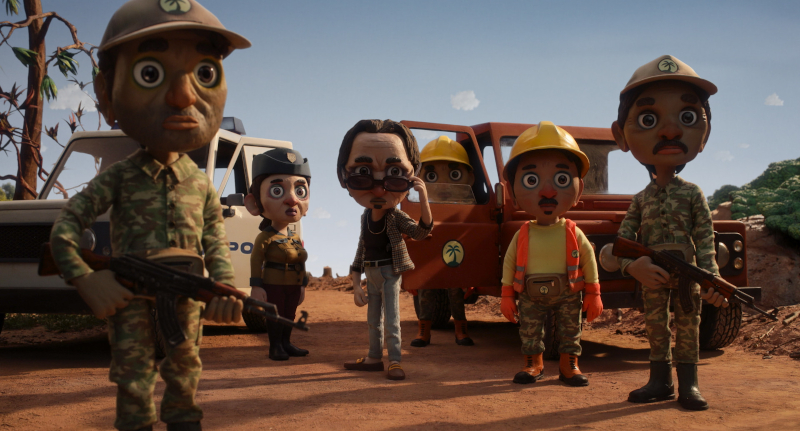
Eventually, they will make their way to their grandfather’s jungle home. And it will not be long before the whole group will have to confront the loggers, who plan to develop (i.e. cut down) their part of the jungle has the backing of the authorities and therefore, also, the local police…
Barras’ previous animated feature My Life as a Courgette (2016) dealt with children in care homes, cut off from the perceived societal norm of the nuclear family by circumstances outside their control. This new film again deals with orphans (the baby orangutan, whose father is never seen and whose mother is shot early on) but also children struggling to cope with the loss of a parent, specifically the mother, with Kéria being raised by her dad after, as the story goes, she was killed by a panther. The theme of myth making also looms large here: once the two children and the little ape enter the jungle, Selaï terrifies Kéria with tales of Tepun, a monster in the forest that his parents have warned him eats children.
The film is child-friendly, although be warned that the scene where the baby ape is bitten by a venomous snake is pretty terrifying, even for adults, and (obviously) the death of the same ape’s mother early on is potentially traumatic (although this parental death element has never done either Bambi or The Lion King any harm). There’s a clear environmental theme too, with financial gain from palm oil extraction the main business motivation for the destruction of the jungle, and the jungle-dwelling human family (and an Oxbridge graduate-turned-gone-native-campaigner) posited as the resistance. It’s never stated, but the setting is around the palm oil jungles of Borneo, the orangutan’s natural habitat, which is being systematically and foolishly destroyed in the harvesting of palm oil for financial gain.
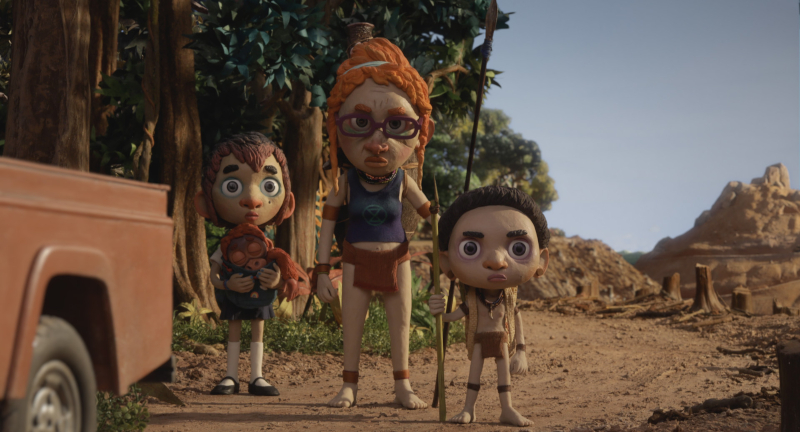
As in Courgette, again, the level of model artistry is high – the puppets blink, and the animators bring them to life in a totally engaging manner, as nuanced as any actor giving a live action performance to camera. Director Barras talks in the press notes about the hands-on physicality of working with stop-frame puppets and model sets, and given that Kéria is, like many in the civilized world, obsessed with her smartphone until, in the jungle, it turns out to be useless compared with Selaï’s many, learned survival skills, this echoes the value of the real, outdoors natural world over some digitally imagined immersive environment.
Ironically, much is made of the usefulness of modern technology in contemporary life. Along Sega may be living in the jungle with his extended family and fending off loggers’ bulldozers, but he makes considerable use of a mobile phone (complete with an Eye of the Tiger ringtone!), and when towards the end of the narrative Kéria finds herself once again confronting loggers who want to destroy Along Sega’s environmental home, she uses her smartphone to film the loggers’ activities and drum up popular and media support from the internet via a viral video (a subject much better handled than in the well-intentioned but ultimately ill-conceived Ozi: Voice of the Forest, Tim Harper, 2023).
Like Courgette, this is another compelling stop-frame film about children trying to cope with life well outside the sort of family situation so often portrayed in movies. And, also like Courgette, it’s another winner.
Savages is out in cinemas in the UK on Friday, August 1st.
Teaser Trailer:
Trailer: